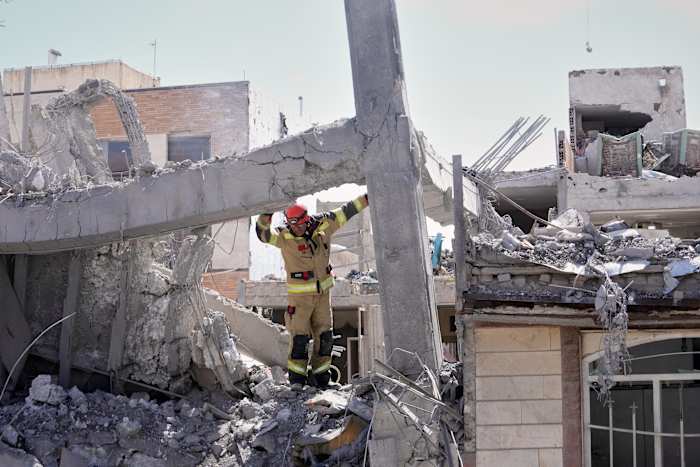
The current volatility in the Middle East is no longer a localized series of skirmishes or a manageable diplomatic friction. It has evolved into a high-stakes endurance test for the existing international order, where the margin for error has shrunk to zero. We are witnessing a systemic breakdown of the traditional deterrence mechanisms that kept regional powers in check for decades. The danger today is not just the immediate violence, but the unpredictable ways these kinetic conflicts are bleeding into global energy markets, shipping lanes, and the internal politics of Western nations.
When analysts call the situation "extremely dangerous," they often fail to explain the mechanics of that danger. It isn't just about the rockets or the rhetoric. The real threat lies in the collapse of back-channel communication and the rise of decentralized actors who do not answer to any central government. This creates a vacuum where a single tactical mistake by a junior officer on any side can trigger a regional conflagration that no one actually wants but everyone is forced to join.
The Death of Predictability
In previous decades, the Middle East operated under a grim but stable logic. You knew the players, you knew their red lines, and you knew who could pull the leash on their respective proxies. That logic is dead. Today, the landscape is populated by "autonomous nodes"—militias and political movements that have acquired high-grade technology like GPS-guided drones and anti-ship missiles without the corresponding state-level accountability.
This decentralization of power means that traditional diplomacy is hitting a brick wall. How do you negotiate a ceasefire with a group that views its own destruction as a spiritual victory? How do the United States or regional heavyweights like Saudi Arabia exercise influence when the players on the ground are increasingly motivated by local grievances that ignore the "grand strategy" of the capitals?
The unpredictability stems from this lack of a central kill-switch. In the past, a phone call between Washington and a regional ally could cool a boiling pot. Now, that pot has a dozen different lids, and several of them are being held down by actors who believe they have nothing left to lose.
The Energy Chokehold and the Shipping Crisis
While the human cost of these conflicts is the most immediate tragedy, the economic aftershocks are what will dictate the global response. The Red Sea is not just a body of water; it is the jugular vein of global trade. When container ships are forced to reroute around the Cape of Good Hope, it adds ten days and millions of dollars in fuel costs to every journey.
This is a direct tax on the global consumer. If these disruptions persist, we will see a resurgence of inflation that central banks are poorly equipped to handle. The "dangerous" element here is the realization that a relatively small group of insurgents, using equipment that costs a fraction of a modern destroyer, can effectively shut down a global shipping lane.
The Asymmetric Advantage
Consider the math of modern warfare. An interceptor missile fired from a billion-dollar warship to take down a "suicide drone" can cost upwards of $2 million. The drone itself might cost $20,000. This is an unsustainable economic equation for the West. We are spending our high-end munitions to swat at flies, while the adversary simply waits for our magazines to run dry or our political will to crumble.
This asymmetry extends to the oil markets. While the world has become less dependent on Middle Eastern crude than it was in the 1970s, the psychological impact of a strike on major infrastructure remains potent. A 10% spike in oil prices doesn't just hurt drivers; it ripples through the cost of plastics, fertilizer, and food. In a fragile global economy, this is the "unpredictable" spark that could ignite a broader recession.
The Failure of Deterrence
For years, the prevailing theory was that "integrated deterrence"—a mix of military presence and economic partnerships—would keep the peace. That theory has been tested and found wanting. The presence of carrier strike groups in the Mediterranean and the Persian Gulf has not stopped the escalation. In fact, in some circles, it has acted as a magnet for further provocation.
The hard truth is that deterrence only works if your opponent fears the consequences more than they value their objective. For many actors in the current theater, the objective is the disruption itself. They are not looking for a seat at the table; they want to kick the table over.
The Nuclear Shadow
Looming over all of this is the quiet acceleration of enrichment programs and the erosion of international oversight. We are moving toward a reality where multiple regional players may soon possess the capability to build a nuclear device, or at least the "breakout" capacity to do so within weeks.
If the conventional situation is "unpredictable," the introduction of nuclear hedging makes it catastrophic. We are seeing a shift from a bipolar standoff to a multi-polar scramble for security, where every nation feels the need to arm itself to the teeth because they no longer trust the "security umbrellas" provided by the superpowers.
The Domestic Spillover
The instability is not staying in the Middle East. It is manifesting on the streets of London, Paris, and New York. The polarization of public opinion on these conflicts is creating internal security challenges for Western governments, forcing them to balance foreign policy objectives with domestic stability.
This creates a feedback loop. When a government is preoccupied with internal unrest, it has less bandwidth to manage external crises. Foreign adversaries know this. They use digital influence operations to pour gasoline on these domestic fires, ensuring that the West remains distracted and divided while the regional order is dismantled.
Rebuilding a Realistic Framework
The path out of this crisis requires a move away from the "wishful thinking" that has characterized Middle East policy for the last decade. There is no "solving" these ancient grievances with a single summit or a clever treaty. The focus must shift toward containment and resilience.
- Diversifying Supply Chains: National security now depends on having trade routes that do not rely on a single narrow waterway. This means investing in terrestrial corridors and domestic manufacturing.
- Hardening Infrastructure: Cyber-attacks on electrical grids and water systems are the new front line. The "unpredictable" event of tomorrow is more likely to be a digital blackout than a conventional bombing.
- Redefining Red Lines: Vague warnings have proven useless. Clear, enforceable, and credible consequences must be established, and they must be backed by more than just words.
We have entered an era where the old maps no longer match the terrain. The institutions built after 1945 are buckling under the weight of 21st-century tribalism and high-tech insurgency. To pretend otherwise is to invite the very catastrophe we are trying to avoid.
The situation is indeed dangerous, but the greatest danger is our own refusal to see the world as it actually is. We are not "navigating" a temporary storm; we are witnessing the birth of a more chaotic, fragmented, and violent global system. The only way to survive it is to stop waiting for the "old normal" to return and start building the defenses required for the new reality.
Verify your own supply chains and assume that the current shipping disruptions are the new baseline for the next five years.