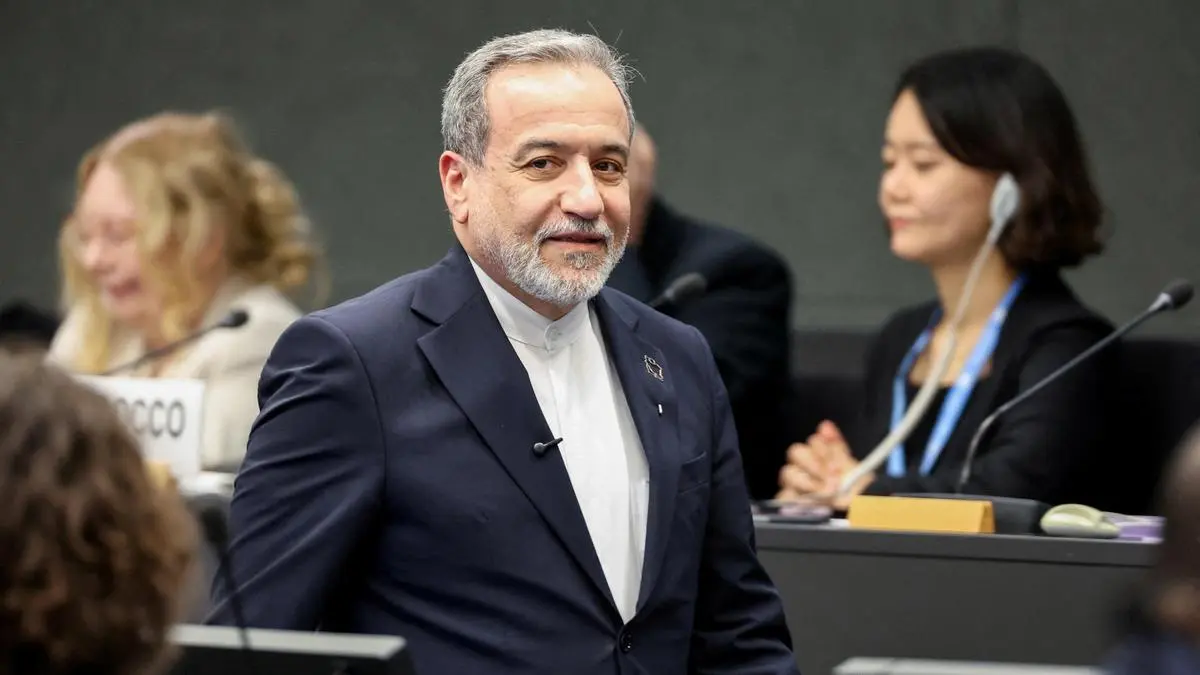
The ink on a formal letter to the United Nations is always cold. It is dry, bureaucratic, and weighed down by the leaden language of international law. But behind the recent correspondence sent from Tehran to the Security Council lies a visceral, thumping pulse of anxiety. Iran has officially alerted the world that it believes its Foreign Minister, Abbas Araghchi, and Parliament Speaker, Mohammad Bagher Ghalibaf, are walking targets.
This isn't just another headline in a 24-hour news cycle. It is a signal that the very floor of global shadow-boxing has dropped away, revealing a basement where the rules no longer apply.
When a state actor formally accuses rivals of plotting to eliminate its top diplomats, the "great game" of geopolitics stops being a metaphor. It becomes a hunt.
The Weight of the Suit
Consider the life of a modern high-level diplomat. We often see them in photos: stepping off Gulfstreams, adjusted silk ties, the forced symmetry of a handshake in a marbled foyer. We see the prestige. We rarely see the math.
For men like Araghchi and Ghalibaf, every public appearance is now a calculated risk against a violent variable. Imagine standing at a podium in a foreign capital, knowing that somewhere, in a room without windows, a group of people is staring at your high-resolution likeness on a monitor, discussing the "kinetic potential" of your afternoon schedule.
Every motorcade route is a gauntlet. Every hotel floor is a potential trap. When Araghchi travels across the Middle East to discuss ceasefires or regional stability, he isn't just carrying a briefcase; he is carrying the target painted on his back. This is the human cost of a collapsing world order. Diplomacy requires a baseline of physical safety to function. If the messenger is terrified of being vaporized before he reaches the table, the message never gets delivered.
Iran’s letter to the UN serves as a frantic flare launched into a dark sky. It claims to have evidence of "assassination plans" orchestrated by external intelligence agencies. While the document follows the rigid structure of a legal complaint, the subtext screams of a desperate realization: the red lines have been erased.
The Architecture of the Shadow War
To understand why this matters to someone sitting thousands of miles away, we have to look at the historical precedent of "targeted removals." For decades, there was a silent agreement between bitter enemies. You spy, you sabotage, you perhaps even fund proxies, but you do not decapitate the sitting civil leadership of a sovereign nation.
That agreement is dead.
The precedent was shattered in 2020 with the drone strike on Qasem Soleimani. Whether one viewed that moment as a necessary strike or a reckless escalation, it changed the chemistry of the region. It proved that the high-ranking elite were no longer "off-limits." Since then, the frequency of these high-stakes threats has accelerated.
Imagine a chessboard where the players start throwing the wooden pieces at each other’s heads instead of moving them across the squares. That is where we are. When Ghalibaf—a man who represents the legislative heart of the country—and Araghchi—the face of its foreign policy—are identified as targets, it signifies that the opposition is no longer interested in changing Iran’s behavior. They are interested in deleting its brain.
This creates a feedback loop of paranoia.
Security details grow. Interaction with the public vanishes. Leaders retreat into bunkers. When the people who run a country are forced into a state of permanent survival mode, their decision-making becomes brittle. They stop looking at the horizon and start looking at the ceiling.
The Invisible Stakes
Why does the UN get a letter instead of a phone call? Because in the theater of global politics, the paper trail is the only shield left. By naming the threat, Iran attempts to "burn" the operation. They are telling the potential assassins: We see you.
But visibility doesn't always equal safety. We live in an era of deniable technology. Loitering munitions, remote-operated sniper platforms, and cyber-breaches that turn a car’s navigation system into a steering wheel for a collision. The "invisible stakes" are the bystanders—the aides, the journalists, the hotel staff, and the civilians who happen to be on the same street when a "surgical strike" turns out to be anything but surgical.
There is a specific kind of silence that follows a political assassination. It isn’t the silence of peace; it’s the silence of a vacuum. When a top official is removed, the power structure beneath them doesn't just fold; it panics. It lashes out.
If Araghchi or Ghalibaf were to be eliminated, the response wouldn't be a legal filing. It would be fire. This is why the UN letter is so heavy. It isn't just about protecting two men. It’s about preventing a regional wildfire that could easily become global.
The Mechanics of Fear
Let’s look at the psychology of the "hit list."
In any intelligence community, the goal of an assassination isn't always the death itself. Often, the goal is the disruption. If you can make a Parliament Speaker afraid to speak, you have won. If you can make a Foreign Minister afraid to fly, you have severed the country's vocal cords.
Ghalibaf recently made headlines for personally flying a plane into Lebanon shortly after a series of heavy strikes in Beirut. It was a show of defiance. It was a message to his own people and his enemies that he would not be intimidated by the closing circle of violence. But that kind of bravado is a finite resource.
Every time a leader survives a close call or a thwarted plot, they don't become more peaceful. They become more radicalized. They become more convinced that the only way to survive is to strike first. We are watching the slow-motion erosion of the "diplomatic immunity" that has kept the world from total anarchy since 1945.
The Human Element in the Crosshairs
We often talk about "Iran" or "The West" or "The UN" as if they are monolithic blocks of stone. They aren't. They are collections of people.
Abbas Araghchi has a family. He has a history. He has a career built on the nuance of language. Mohammad Bagher Ghalibaf has a long, complicated political life. When we strip away the titles, we are looking at two human beings who are currently existing in a reality where their movements are being tracked by satellites and their names are being whispered in kill-rooms.
The fear is real. The stakes are total.
If the international community treats Iran's warning as mere propaganda, they risk ignoring the smoke before the explosion. If they treat it as a valid threat, they have to admit that the global security framework is failing. There is no easy path here.
We are entering a phase of history where the "men in suits" are as vulnerable as the "men in boots." The separation between the battlefield and the boardroom has vanished.
When the letter to the UN is filed away in some archive in New York, the names on the page won't just be entries in a ledger. They are the final threads holding a frayed world together. If those threads are cut, the garment doesn't just tear. It unravels completely.
The sun sets over Tehran, and two men prepare for another day of looking over their shoulders, wondering if the next shadow they see belongs to a ghost or a machine.
Would you like me to analyze the historical parallels between these specific threats and the events leading up to previous regional escalations?