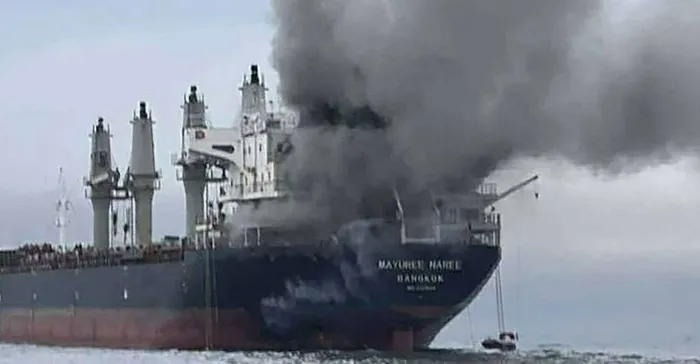
A rust-streaked hull groans against the swell of the Persian Gulf. On the bridge of a Panamax vessel, the air smells of brine and cheap coffee. The captain doesn't stare at the radar for weather anymore. He stares for a ripple. A shadow. The sudden, violent bloom of a fast boat cutting through the surf. He is carrying thousands of tons of cargo that the world assumes will simply arrive, as if by magic, on a shelf in a suburban grocery store or a terminal in a bustling port. But here, in the narrow throat of the Strait of Hormuz, magic is in short supply. Uncertainty is the only reliable currency.
The world’s energy pulse beats through this stretch of water. It is a geographical fluke, a strip of ocean so narrow that the geopolitical tensions of decades can be shouted across it. Recently, the rhetoric from Tehran has shifted from vague threats to a pointed, surgical brand of defiance. They claim the Strait is closed only to "enemies." It sounds like a controlled burn. It sounds like a policy.
But if you ask the underwriters at Lloyd’s of London, the view from the counting houses is far more chaotic.
The Mathematics of Fear
In the oak-paneled rooms where global risk is priced, the "enemy" is not a political entity. The enemy is the unknown. When Iranian officials suggest that the passage is a gated community—open to friends, barred to foes—they imply a level of order that the actual data refutes. Lloyd’s has been watching the recent spate of seizures and drone strikes with the cold eye of a mathematician. They see no pattern. They see no clear list of transgressions that leads to a ship being boarded.
To a shipowner, a "patternless" threat is the most expensive kind. If you know that only tankers flying a specific flag are at risk, you re-flag or you avoid the route. But when the attacks appear random—striking a mid-sized bulk carrier one day and a Tier-1 tanker the next—the entire insurance apparatus begins to vibrate with anxiety.
War risk premiums are not just numbers on a spreadsheet. They are the invisible taxes on every gallon of gas and every plastic component manufactured in the West. When Lloyd’s reports that there is no "clear pattern" to the aggression, they are essentially telling the world that the safety of the Strait is currently a coin flip.
The Ghost in the Machine
Consider the "Dark Fleet." This is not a metaphor. It is a literal collection of hundreds of aging vessels, their transponders silenced, their ownership buried under layers of shell companies in jurisdictions that barely exist on a map. They move through the Strait like ghosts. They carry oil that officially shouldn't be moving, sold to buyers who officially aren't buying it.
These ships are the pressure valve for the Iranian economy. While official channels are choked by sanctions and the threat of seizure, the Dark Fleet keeps the lights on. This creates a bizarre, mirrored reality. On one hand, you have the "enemies"—the legitimate, insured, and tracked vessels that provide the world with its energy stability. On the other, you have a shadow economy that thrives on the very instability that terrifies the rest of the world.
The tension lies in the definition of "enemy." In a globalized economy, an attack on a vessel owned by a Greek firm, managed by a Singaporean company, and crewed by sailors from the Philippines and Ukraine is an attack on everyone and no one. Whose enemy is that ship? The answer depends entirely on who is holding the drone controller that afternoon.
The Human Cost of High-Stakes Poker
We often talk about "maritime security" as if it were a game of Battleship played by giants. We forget the thirty-year-old second mate who hasn't slept in twenty hours because his ship is transiting the "high-risk area." He is not a politician. He is not a combatant. He is a man who wants to finish his contract and go home to see his daughter's piano recital.
When a ship is seized, these men become the ultimate bargaining chips. They are held in a limbo that the headlines rarely capture. They are the collateral damage of a strategy designed to test the limits of international law. The "no clear pattern" noted by Lloyd’s is, for these sailors, a psychological meat grinder. You cannot prepare for a threat that refuses to define itself.
The strategy of ambiguity is intentional. By keeping the criteria for "enemy" status fluid, the Iranian maritime forces maintain a constant state of leverage. If the rules of engagement were clear, the international community could adapt. By keeping them opaque, Tehran ensures that every single transit through the Strait is a gamble.
The Fragility of the Flow
Everything you are touching right now likely spent time on a ship. The world operates on a "just-in-time" delivery model that assumes the oceans are a frictionless void. We have built a civilization on the belief that the blue parts of the map are neutral territory.
The Strait of Hormuz is the place where that illusion goes to die.
When Lloyd’s signals that the attacks show no pattern, they are pulling the rug out from under the global supply chain. Markets hate randomness. They can price in a war. They can price in a blockade. They cannot price in a whim.
The current standoff isn't just about oil or regional hegemony. It is a fundamental challenge to the way the modern world moves. It is a test of whether a single nation can claim the right to sort the world’s commerce into "friends" and "enemies" at the mouth of a cannon.
The captain on the bridge watches the horizon. He sees a smudge of smoke in the distance. Is it a friend? Is it a foe? Is it a ghost from the Dark Fleet? He checks his instruments, but they don't have the answer. The answer is being written in a boardroom in London and a command center in Tehran, while the rest of us wait for the price of the world to change.
The ocean has always been a place of monsters, but the modern ones don't have scales. They have legal briefs, drone swarms, and a terrifying lack of predictability. We are all passengers on that rust-streaked hull, whether we know it or not, drifting toward a chokepoint where the rules are rewritten every hour.