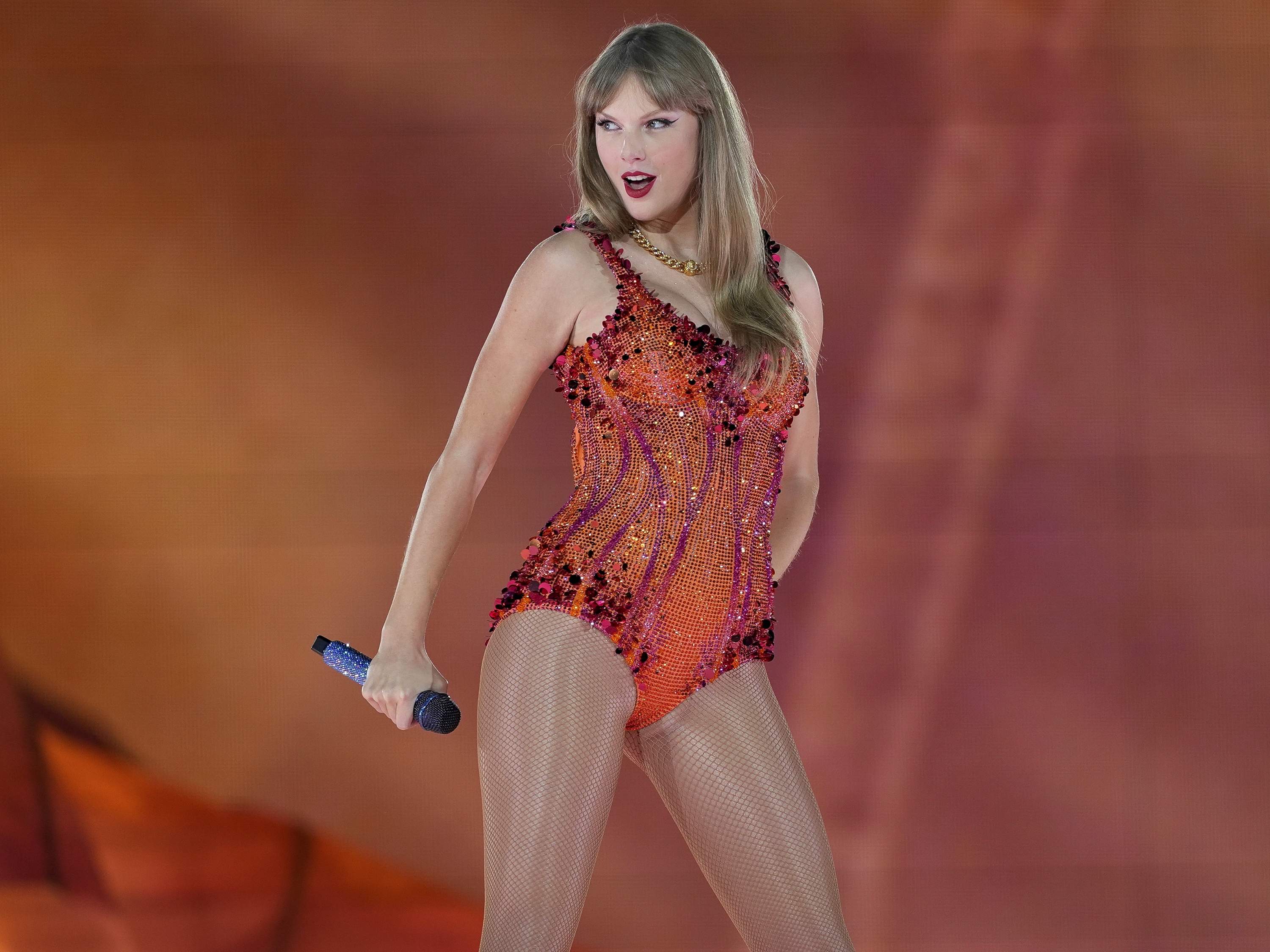
The trademark infringement lawsuit filed against Taylor Swift regarding the phrase "Life of a Showgirl" is not merely a dispute over a song lyric or a tour visual; it is a high-stakes collision between the expansionist nature of celebrity "ecosystem branding" and the foundational protections of the Lanham Act. When a global entity like Taylor Swift Productions (TSP) incorporates phrases that overlap with existing small-business trademarks, the legal friction reveals a systemic vulnerability in how massive intellectual property (IP) portfolios are vetted. The core of this conflict lies in the tension between Commercial Impression, Market Saturation, and the Strength of Mark.
The Triad of Trademark Infringement Analysis
To evaluate the viability of the "Life of a Showgirl" litigation, one must move past the surface-level similarities and apply the DuPont factors—the standard criteria used by the United States Patent and Trademark Office (USPTO) and federal courts to determine the likelihood of confusion. In this specific case, the analysis rests on three primary pillars.
1. The Similarity of the Marks in Sight, Sound, and Meaning
Trademark law does not require identities to be identical to find infringement. The standard is whether an ordinary consumer would believe the goods or services originate from the same source.
- Phonetic Identity: "Life of a Showgirl" is a specific sequence of five words. Any deviation in the source (e.g., a performer vs. a clothing line) does not inherently negate the phonetic overlap.
- Commercial Impression: The plaintiff’s use of the mark likely centers on a specific aesthetic or "vibe" associated with Las Vegas or burlesque culture. If the defendant’s use mirrors this aesthetic within a commercial context—such as tour merchandise or promotional content—the commercial impression becomes indistinguishable.
2. The Proximity of Goods and Marketing Channels
This is where most celebrity-related IP cases are decided. Taylor Swift is no longer just a musician; she is a diversified conglomerate. Her brand touches apparel, digital media, cinematic experiences, and live events.
- The "Bridge the Gap" Theory: Even if the plaintiff and defendant do not currently compete in the same niche, the court considers whether the plaintiff is likely to expand into the defendant’s market, or if consumers would naturally assume such an expansion has occurred.
- Digital Congestion: Because both parties utilize global social media platforms (Instagram, TikTok, YouTube) as their primary marketing channels, the "geographic distance" that once protected local trademarks has effectively evaporated.
3. The Strength of the Mark and the Crowd-Out Effect
Trademarks are categorized on a spectrum: Generic, Descriptive, Suggestive, Arbitrary, or Fanciful. "Life of a Showgirl" sits precariously between Descriptive (describing a lifestyle or profession) and Suggestive (requiring imagination to link it to a specific product).
- Acquired Distinctiveness: The plaintiff must prove the mark has "secondary meaning"—that the public associates that specific phrase with their brand specifically, rather than the concept of being a showgirl generally.
- Reverse Confusion: This is the most potent threat in the Swift litigation. Reverse confusion occurs when a junior user (the larger entity, Swift) so heavily saturates the market with a similar mark that the public begins to believe the senior user (the smaller entity) is actually the infringer or is somehow affiliated with the celebrity.
The Economic Burden of High-Velocity Content Production
The occurrence of this lawsuit highlights a breakdown in the IP Clearance Lifecycle. For an artist operating at Swift’s scale, the volume of creative output—lyrics, set designs, social media captions, merchandise slogans—creates an enormous surface area for accidental infringement.
The Clearance Bottleneck
In traditional corporate branding, a new product name undergoes a multi-month "knockout search" and a formal legal opinion before launch. In the music industry, particularly during a global tour, the speed of content creation often outpaces the capacity of legal teams to conduct exhaustive searches for every evocative phrase used in a 3.5-hour performance or its accompanying marketing.
The "Life of a Showgirl" phrase likely bypassed the "high-risk" filter because it appears descriptive or thematic rather than a core brand name. However, in the modern trademark environment, "thematic use" often bleeds into "trademark use" the moment it is printed on a $50 t-shirt.
The Cost Function of Settlement vs. Litigation
For a defendant with the capital reserves of Taylor Swift, the decision to fight or settle is a cold mathematical calculation.
- Direct Litigation Costs: Legal fees, expert witness testimony on consumer confusion, and discovery.
- Reputational Tax: The risk of being perceived as a "corporate bully" crushing a small creator.
- Injunction Risk: The most dangerous variable. If a court issues a preliminary injunction, Swift could be forced to halt the sale of specific merchandise or edit concert film footage, costing millions in lost revenue and logistical overhauls.
Structural Vulnerabilities in Celebrity Ecosystems
Celebrity brands often rely on Fair Use defenses, specifically "Descriptive Fair Use." This allows a party to use a trademarked term if they are using it in its primary, descriptive sense rather than as a brand identifier.
The Fair Use Test: Does the use of "Life of a Showgirl" describe a portion of the show’s narrative, or is it being used to sell a product? If the phrase appears on a garment tag where a brand name usually sits, the Fair Use defense collapses.
Furthermore, the "Life of a Showgirl" suit underscores the "Small-Player Leverage" in the digital age. Previously, a small trademark holder lacked the resources to challenge a titan. Today, the democratization of legal visibility and the threat of viral "David vs. Goliath" narratives give small plaintiffs significant settlement leverage. They are not just suing for damages; they are suing for a "License to Exist" in a market that the celebrity is unintentionally monopolizing.
Quantifying the Likelihood of Confusion
To win, the plaintiff must provide empirical evidence. This is typically done through Eveready Surveys, which measure how many consumers actually confuse the two brands.
- The Threshold: If more than 15-20% of surveyed consumers show confusion, the plaintiff has a strong case for an injunction.
- The "Crowding" Variable: If the plaintiff can show that their search engine optimization (SEO) has been decimated by Swift’s use of the term—meaning people searching for the original "Life of a Showgirl" only find Swift content—this constitutes a measurable commercial injury.
The Strategic Pivot for High-Scale Creators
The "Life of a Showgirl" litigation serves as a case study in the necessity of Predictive IP Auditing. To mitigate these risks, large-scale entertainment entities must move beyond reactive legal defense and adopt a proactive "Brand Proximity" strategy.
- Automated Phrase Scrubbing: Implementing LLM-based tools to scan all tour-related copy against the USPTO TESS database for "Live and Active" marks in Classes 25 (Clothing), 41 (Education/Entertainment), and 35 (Advertising).
- Distinctive Modification: Rather than using common phrases, legal teams should mandate "Creative Distancing"—adding unique identifiers to common phrases to ensure they move from "Suggestive" to "Arbitrary" territory.
- Pre-emptive Licensing: In cases where a phrase is vital to the creative vision but already trademarked by a smaller entity, the most efficient move is to secure a "Co-existence Agreement" before the tour launches. This allows both parties to use the mark within defined boundaries, preventing litigation before it begins.
The resolution of this case will likely not come from a courtroom verdict but through a confidential settlement that includes a "Phase-Out" period for the merchandise or a licensing fee. For the plaintiff, the goal is to protect their brand’s identity in an era where a single celebrity mention can functionally erase a small business’s digital footprint. For Swift, the goal is the preservation of the "Eras" ecosystem—a machine too large to be stalled by five words, yet vulnerable to the very laws that protect its own massive value.
Entities operating in this space must prioritize the "Seniority of Use" over the "Magnitude of Reach." Failure to do so results in a recurring cycle of high-cost litigation that functions as a self-imposed tax on creativity. The "Life of a Showgirl" dispute is the latest reminder that in the eyes of trademark law, the smallest trademark holder can be a significant roadblock to the world’s largest brand.