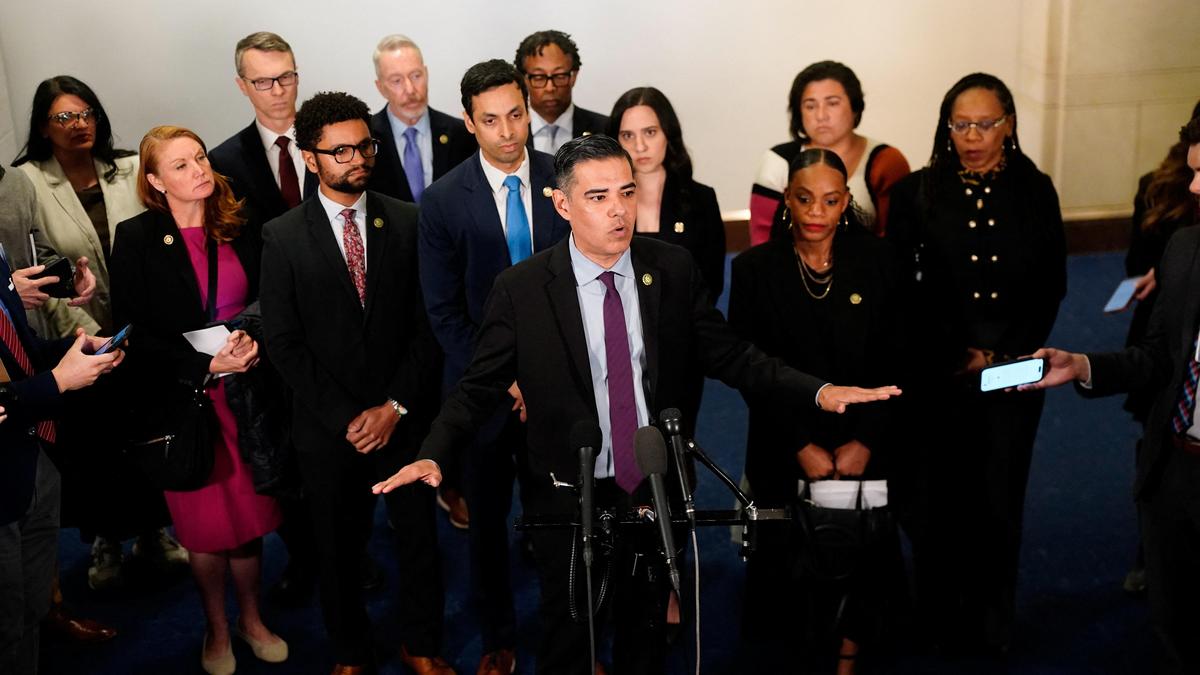
The breakdown of the Department of Justice (DOJ) briefing regarding the Jeffrey Epstein files is not a mere partisan skirmish; it is a systemic failure of information transparency protocols within a high-stakes legal framework. When lawmakers exit a closed-door session citing "non-responsiveness," they are identifying a bottleneck in the executive branch's duty to provide oversight on cases of profound public interest. This friction exists at the intersection of ongoing investigative integrity, the protection of third-party privacy, and the statutory requirements of congressional inquiry. To understand why these briefings fail, one must analyze the structural tension between the DOJ’s "Glomar" style of non-disclosure and the legislative demand for absolute evidentiary accounting.
The Architecture of Withholding: Three Pillars of Institutional Resistance
The Department of Justice operates under a specific set of constraints that frequently collide with the political urgency of the Epstein case. These constraints are often interpreted as political stonewalling, but they are rooted in the internal logic of federal law enforcement.
1. The Investigative Integrity Shield
The DOJ adheres to the principle that disclosing information about an ongoing or "technically open" investigation could compromise future prosecutions or lead to the spoliation of evidence. Even in the wake of Epstein’s death, the potential for co-conspirator indictments allows the Department to invoke a broad perimeter of secrecy. This creates a logical paradox: the more significant the potential criminal network, the less information the Department feels it can legally share with the public or Congress.
2. Privacy Rights of Non-Charged Third Parties
Under Departmental guidelines, specifically those evolved from the Privacy Act and Grand Jury Secrecy rules (Rule 6e), the names of individuals mentioned in files who have not been charged with a crime are heavily protected. In the context of the Epstein files, this involves a massive data set of flight logs, phone records, and financial transactions. The DOJ’s refusal to provide "unredacted" access is a defensive posture against potential litigation from high-profile individuals whose names appear in the proximity of the investigation without being central to a specific criminal act.
3. The Executive Privilege Buffer
The briefing's collapse suggests a disagreement over the scope of internal deliberative processes. When DOJ leadership refuses to answer "how" or "why" certain investigative paths were or were not taken, they are asserting that these internal strategies are protected from legislative interference. This creates a hard wall between "what happened" (facts) and "why it was handled this way" (strategy), the latter of which is almost always shielded from congressional view.
The Cost Function of Delayed Disclosure
The strategic cost of maintaining this level of secrecy is a total erosion of public and legislative trust. This erosion functions as a "trust tax" on every subsequent action the Department takes. When the DOJ fails to meet the threshold of transparency required by a bipartisan or even a unilateral committee, they trigger a series of predictable escalations:
- Subpoena Escalation: The transition from voluntary briefings to compulsory process. This moves the conflict from a conference room to a courtroom, often delaying the release of information by months or years as judicial reviews take place.
- Budgetary Retaliation: Congress possesses the power of the purse. Continued obstruction provides the political capital necessary for lawmakers to threaten the funding of specific DOJ programs or the salaries of specific officials.
- Information Asymmetry: Because the DOJ holds the primary source documents, the public discourse is filled by leaked fragments and unverified claims. The Department's silence does not stop the narrative; it simply ensures the narrative is shaped by the most aggressive, and often least accurate, outside actors.
Logical Fallacies in the "National Security" Justification
Frequent justifications for withholding Epstein-related data touch upon national security or the sensitivity of international relations. However, this logic fails under rigorous scrutiny. If the individuals involved were foreign assets or diplomats, the proper channel for disclosure would be the Intelligence Committees, not a total blackout to the Judiciary Committee. The use of "sensitivity" as a blanket term for "political embarrassment" is a documented phenomenon in institutional sociology, where organizations seek to minimize external shocks to their own stability rather than maximizing the delivery of their stated mission.
The friction in the briefing room was a conflict between two different definitions of "resolution." For the DOJ, resolution is a closed file or a conviction. For Congress, resolution is the public accounting of how a prolific offender operated within the U.S. financial and legal systems for decades without intervention. These two goals are currently mutually exclusive because the DOJ’s process is designed to protect the system, while the legislative process is designed to expose its flaws.
The Bottleneck of Redaction Protocols
The technical process of releasing the "Epstein Files" involves a granular review of thousands of pages. Each page must be reviewed by multiple departments:
- FBI/Criminal Division: For active leads.
- Office of Privacy and Civil Liberties (OPCL): For PII (Personally Identifiable Information).
- Legal Counsel: To ensure no violation of previous court seals or settlement agreements.
This sequential processing creates an inherent delay that the Department leverages as a tactical advantage. By providing a "trickle" of information, they satisfy the letter of the request while denying the spirit of the inquiry. The "storm out" by lawmakers was a recognition that the DOJ’s "good faith" effort was actually a choreographed exercise in procedural delay.
Strategic Play: The Path to Compelled Transparency
To break the current stalemate, the legislative strategy must shift from requesting "briefings" to demanding specific, audited data sets. The following tactical maneuvers represent the only viable path to overcoming Departmental inertia:
- Appointment of a Special Master for Congressional Review: Rather than relying on DOJ-selected redactors, Congress should move for an independent judicial officer to review the files and determine what truly falls under Rule 6e vs. what is being withheld for political convenience.
- Statutory Carve-outs: Legislative action to specifically exempt the Epstein investigative files from certain Privacy Act protections, citing the overwhelming public interest and the death of the primary subject.
- Leveraging Contempt of Congress: While the DOJ rarely prosecutes its own for contempt, the formal citation serves as the necessary legal floor for a civil lawsuit to compel production.
The DOJ is currently betting that the complexity of the documents and the legal density of their excuses will outlast the news cycle. Breaking this cycle requires a move away from the "outrage" model of politics and toward a "litigation" model of oversight. The goal is no longer to hear what the DOJ has to say; the goal is to see what they are hiding. The shift from "briefing" to "deposition" is the only logical next step for an oversight body that has been systematically denied its constitutional function.