Donald Trump has issued a 48-hour ultimatum that threatens to dismantle the fragile survival mechanism of the modern Middle East: its water. By explicitly naming desalination plants as potential targets in the escalating conflict with Iran, the White House has moved beyond traditional military posturing into a realm of unconventional warfare that could leave millions without drinking water. This is not just a threat of "obliteration" against power grids or oil fields; it is a direct challenge to the life-support systems of the Persian Gulf.
For decades, the strategic calculus in the region revolved around the "Tanker War" or the "Oil Chokehold." If the Strait of Hormuz closed, the world’s economy bled. But the 2026 reality is far more visceral. Iran is currently in its fifth year of a catastrophic drought, with Tehran’s reservoirs hovering below 10% capacity. Meanwhile, the Gulf Cooperation Council (GCC) nations—Saudi Arabia, the UAE, Qatar, and Kuwait—have effectively transformed into "saltwater kingdoms," where up to 90% of potable water is birthed from the sea.
To strike these facilities is to weaponize thirst. It is an escalation that treats civilian survival as a secondary concern to maritime dominance.
The Engineering of Vulnerability
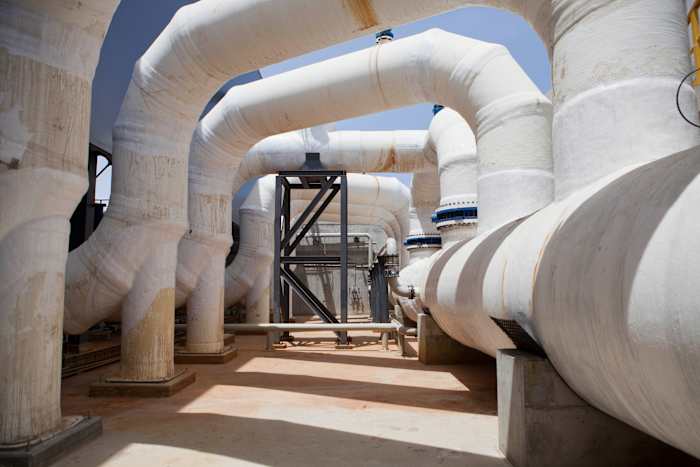
Desalination is not a simple tap; it is a massive, energy-intensive industrial process. Most of the region relies on two primary technologies: Multi-Stage Flash (MSF) distillation and Reverse Osmosis (RO). MSF plants are essentially giant kettles that boil seawater using waste heat from power plants, while RO facilities use high-pressure pumps to force water through semi-permeable membranes.
Both are incredibly fragile. A single well-placed drone or missile strike does not just break a pipe; it destroys specialized, long-lead-time components like high-pressure pumps and delicate membrane racks that cannot be replaced overnight. Because these plants are almost always co-located with power stations—to share the massive energy load—an attack on one is effectively an attack on both.
The Kill Switch Strategy
The U.S. and Israel have already demonstrated the "cut the water by cutting the power" doctrine. On March 7, 2026, a desalination plant on Qeshm Island was reportedly hit, disrupting supplies to dozens of villages. While the U.S. denied direct involvement, the message was sent: infrastructure is no longer off-limits.
If Trump follows through on his threat to "obliterate" Iran's biggest power plants, the cascading failures will be instantaneous. Water pumping stations will lose the juice needed to move liquid through thousands of miles of desert pipelines. Without electricity, the treatment plants that prevent preventable diseases like cholera from entering the municipal supply will go dark. The result is a "Water Day Zero" where the taps don't just run dry—they become vectors for illness.
Iran’s Asymmetric Retaliation
Tehran knows it cannot win a conventional blue-water naval battle against the U.S. Fifth Fleet. Instead, it has spent years perfecting a "poor man's" deterrence: the threat of absolute regional chaos. Mohammad Bagher Ghalibaf, the Iranian parliament speaker, has been clear that if Iranian infrastructure falls, GCC desalination facilities are "legitimate targets."
This is the ultimate "wedge" strategy. By threatening the water supplies of U.S. allies like the UAE and Qatar, Iran is forcing these nations to choose between their security partnership with Washington and the literal survival of their populations.
- The UAE’s Taweelah Plant: One of the largest RO facilities in the world, serving millions.
- Saudi Arabia’s Ras al-Khair: A massive hybrid plant that is a cornerstone of the Kingdom’s Vision 2030.
- Qatar’s Ras Laffan: Critical for both water and the LNG exports that keep the global lights on.
These are not bunkers; they are sprawling, open-air industrial complexes sitting on the coastline, perfectly visible to even the most basic Iranian drone. Unlike oil refineries, which might have some redundancy or strategic reserves, water has no "Strategic Petroleum Reserve" equivalent. Most Gulf cities have only three to five days of water storage in their reservoirs. If the plants go down, the clock starts ticking immediately.
The Legal and Ethical Abyss
International law, specifically the Geneva Conventions, prohibits the destruction of "objects indispensable to the survival of the civilian population." This includes drinking water installations and irrigation works. By targeting these, the U.S. enters a legal gray area that human rights organizations are already labeling a "premeditated war crime."
The counter-argument from the administration is built on the "dual-use" doctrine. They argue that these plants provide the power and water necessary for IRGC military bases and drone manufacturing sites. Under this logic, the civilian suffering is considered "proportionate" to the military advantage gained by crippling the Iranian war machine.
But proportionality is a difficult sell when 10 million people in Tehran or 3 million in Dubai lose access to water during a heatwave. The environmental fallout is equally grim. Desalination plants produce brine—a hyper-salty byproduct. If these plants are bombed, millions of gallons of brine, along with chemicals like sulfuric acid and sodium hypochlorite used in the cleaning process, could spill into the Persian Gulf, devastating the very marine ecosystem the region relies on.
Beyond the Missiles: The Cyber Threat
While the world watches for cruise missiles, the real "obliteration" might happen on a server in Tehran or Virginia. Modern desalination plants are run by Industrial Control Systems (ICS) and SCADA networks. These systems are notoriously difficult to patch and often have "air-gapped" vulnerabilities that can be bridged by sophisticated state actors.
We have already seen "precursor" attacks. In March 2026, Bahrain reported material damage to a desalination plant from a drone, but experts believe the more dangerous move was the attempted cyber-intrusion into their distribution network's logic controllers. If an attacker can change the chemical dosing levels—increasing chlorine to toxic levels or shutting down pressure valves until pipes burst from the inside—they can destroy a plant without firing a single shot.
This is the "invisible" water war. It is cheaper than a Tomahawk missile and provides the attacker with plausible deniability.
The Collapse of the Saltwater Kingdoms
The Middle East has spent the last two decades building an urban miracle in the desert, fueled by the assumption that technology could always outpace geography. That assumption is now being tested by a president who views civilian infrastructure as a bargaining chip.
If the desalination plants are hit, the migration crisis that would follow would dwarf anything seen in the last century. People can live without electricity; they can even live without fuel. They cannot live without water for more than 72 hours. The "panic flights" that experts warn about would not just be limited to expatriate workers in Dubai; it would be a fundamental hollowing out of the region’s most productive cities.
The ultimatum stands. The 48-hour window is closing. And as the rhetoric heats up, the most valuable commodity in the Middle East isn't the oil under the sand, but the water coming out of the sea—and it has never been more at risk.
Check the current water storage levels of your local municipality and ensure you have a minimum of 15 liters of potable water per person stored in a cool, dark place.