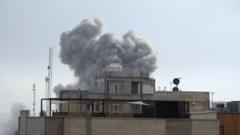
The United States has effectively shuttered its primary diplomatic presence in the Persian Gulf, a move that signals a terrifying shift from regional skirmishing to a state of near-total war. On Tuesday, the State Department suspended operations at embassies in Saudi Arabia and Kuwait following a wave of precision drone and missile strikes that targeted American diplomatic compounds. This is not a standard security precaution. It is a structural admission that the "security umbrella" Washington has promised its Gulf allies for half a century is presently being shredded by Iranian retaliation.
By pulling diplomats out and telling private citizens to "depart now" from 14 countries, the administration has telegraphed that the current conflict with Tehran is no longer a contained operation. It is a regional wildfire. While the initial headlines focused on the physical damage—fires in Kuwait and drone debris in Riyadh—the deeper reality involves the failure of American-led integrated air defenses to stop low-cost, high-attrition Iranian hardware from hitting the most sensitive targets in the region.
The Strategy of Saturation
The closure of the Riyadh and Kuwait missions follows a weekend of unprecedented bombardment. Iran has moved beyond targeting remote military outposts or shipping lanes in the Strait of Hormuz. Instead, it is employing a saturation strategy, launching waves of Shahed drones and ballistic missiles designed to overwhelm the Patriot and THAAD batteries protecting Gulf capitals.
In Riyadh, two drones struck the embassy compound, causing what officials described as a "limited fire." In Kuwait, the damage was more severe, forcing an immediate and indefinite suspension of all consular services. The message from Tehran is clear. If the United States and Israel continue their campaign of "regime change" strikes inside Iranian borders, no American presence in the Middle East is safe.
This isn't just about the embassies. Iran is also striking the economic heart of the region. Drones have targeted the Ras Tanura oil refinery in Saudi Arabia and energy facilities in Qatar. By forcing the U.S. to close its embassies, Iran has achieved a massive psychological victory, proving that even the most heavily fortified diplomatic "Green Zones" can be turned into liability centers overnight.
Why Conventional Defense is Failing
The Pentagon has spent billions of dollars hardening these facilities, yet they remain vulnerable. The reason is simple math. A single interceptor for a Patriot missile system can cost millions of dollars. The Iranian-made drones being used to swarm these sites cost roughly $20,000 to $50,000 each.
When Iran launches thirty drones at a single target, they aren't expecting all of them to hit. They only need two to get through. If those two drones hit a fuel depot or a diplomatic residence, the mission is a success. This cost-asymmetry has forced the State Department’s hand. Maintaining a physical presence in these cities has become a high-stakes gamble with American lives that the current administration is no longer willing to take.
- Riyadh: Embassy closed after drone impact; staff ordered to shelter in place.
- Kuwait City: Operations suspended following a fire caused by a drone strike.
- Dhahran: Consular staff moved to secure locations due to "imminent" missile threats.
- Beirut: Embassy evacuated as Hezbollah-Israel fighting intensifies.
The broader evacuation order, which includes non-essential staff in Bahrain, Qatar, and the UAE, suggests that the U.S. intelligence community expects the next wave of Iranian strikes to be significantly larger.
The Trump Doctrine in Flux
President Donald Trump has doubled down on the military campaign, stating on Monday that the U.S. has a "virtually unlimited supply" of munitions and that the conflict could last weeks or months. However, there is a glaring disconnect between the White House’s rhetoric and the reality on the ground. While the U.S. and Israel have successfully struck Iranian nuclear sites and decapitated much of the IRGC leadership, they have not been able to stop the retaliatory launches.
The administration’s refusal to rule out "boots on the ground" further complicates the security of these embassies. If the U.S. shifts to a ground invasion or a more intensive occupation of Iranian territory, the remaining outposts in Baghdad and Amman will become even more attractive targets for Iranian proxies.
The current diplomatic drawdown is the largest since the 2003 invasion of Iraq. But unlike 2003, the U.S. is not operating from a position of regional consensus. Many Gulf allies, while fearful of Iran, are increasingly wary of being caught in the crossfire of a war aimed at total regime collapse. They are watching the U.S. pull its diplomats out while their own populations remain under the flight paths of Iranian missiles.
The Limbo of American Citizens
For the thousands of American contractors, teachers, and businesspeople living in the Gulf, the embassy closures have sparked a panic. The State Department’s advice to "depart now" using commercial transport is becoming increasingly difficult to follow. Airspace over much of the region is restricted, and commercial flight prices have tripled in the last 48 hours.
The government has not yet mobilized military transport for civilian evacuations, leaving many stranded. This is a recurring failure in modern American foreign policy: the "Big Wave" of military action is planned with precision, but the "Small Wave" of civilian protection is left to the whims of the commercial market.
If the U.S. cannot protect its own diplomatic compounds, the confidence of the private sector will evaporate. This will lead to a massive capital flight from the region, further destabilizing the very allies Washington claims to be protecting. The closure of the embassies isn't just a temporary security measure. It is a sign that the regional order is being re-written in real-time, and right now, the pen is being held by whoever can launch the most drones.
Check your nearest consulate’s emergency frequency and ensure your STEP enrollment is current, because the window for a coordinated exit is closing.