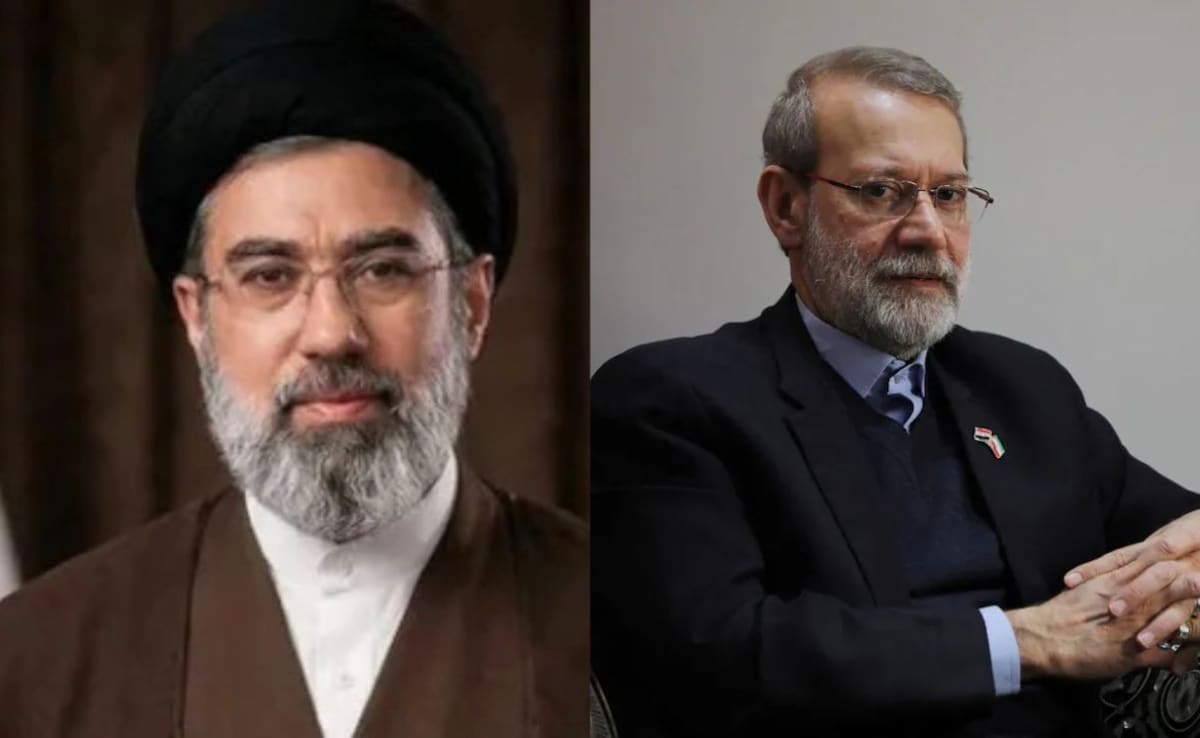
In the quiet, heavy air of a high-security room in Tehran, a man sits with the weight of a name that is both a shield and a target. Mojtaba Khamenei does not speak often to the public. He exists in the blurred edges of photographs, a shadow moving behind the tall, imposing figure of his father. But when he does speak, the words do not merely drift; they land like stones in a still pool, sending ripples through the entire architecture of the Middle East.
The occasion was not a celebration. It was a mourning.
Mohammad Reza Larijani is dead. To the world, he was a name on a news ticker, a high-ranking official caught in the crosshairs of a shadow war that has no front lines and no clear end. To Mojtaba, he was a piece of a larger machinery, a loyalist whose absence leaves a jagged hole in the regime’s defensive line. When Mojtaba stood to address the loss, he didn't reach for the sterile language of diplomacy. He spoke of blood.
"Every drop has a price," he whispered.
It is a terrifyingly simple arithmetic. In the logic of the region, blood is the only currency that never devalues. When a commander falls, the ledger must be balanced. This isn't just about one man’s death; it is about the credibility of a dynasty.
The Architect in the Shadows
To understand why Mojtaba’s vow matters, you have to look at the man himself. He is not a soldier in the traditional sense. He does not wear the olive-drab fatigues of the Revolutionary Guard in the field. Instead, he is the architect of influence. For years, rumors have swirled that he is being groomed for the highest office in the land. He is the keeper of the secrets, the one who manages the delicate internal balance between the clerics and the generals.
Imagine a grand chessboard where the pieces are not made of wood, but of human lives, oil routes, and ideological fervor. Mojtaba has spent decades learning how to move these pieces without ever touching them directly. But the killing of Larijani changed the temperature of the room. It felt personal. It felt like a breach of the inner sanctum.
When a high-ranking figure like Larijani is eliminated, it sends a message: We can reach you. It suggests that the walls aren't as thick as they seem and that the intelligence agencies of the opposition—whether they operate from Tel Aviv or Washington—have eyes inside the house.
For Mojtaba, the vow of vengeance is a way to patch those walls. It is a signal to his own people that the center still holds. If he remains silent, he looks weak. If he looks weak, the succession he has worked so hard to secure begins to crumble.
The Invisible Toll
We often talk about geopolitics as if it’s a game of Risk, played with plastic tanks on a cardboard map. We forget the sensory reality of it. The smell of acrid smoke after an explosion. The ringing in the ears of the survivors. The sudden, hollow silence in a family home when the father doesn't return from the office.
Larijani was a father. He was a husband. He was a man who likely had a favorite tea and a specific way of laughing at a joke. When Mojtaba talks about the "price" of his blood, he is attempting to bridge the gap between that human loss and the cold, hard reality of state power. He is turning a private grief into a public weapon.
But what does that price look like in practice?
It looks like more drones over the desert. It looks like more covert operations in the narrow alleys of foreign capitals. It looks like a cycle of escalation that nobody seems to know how to break. The problem with a blood price is that the debt is never fully paid. Each act of "justice" creates a new martyr, a new reason for the other side to strike back, and a new set of grieving families.
The Weight of the Turban
There is a specific kind of pressure that comes with being the son of a Supreme Leader. Mojtaba lives in a world where every gesture is scrutinized for a sign of what the future holds. Is he more radical than his father? Is he more pragmatic?
The rhetoric regarding Larijani suggests a man who understands that, in his world, power is maintained through the credible threat of violence. You cannot rule through prayer alone. You rule by convincing your enemies that the cost of crossing you is higher than they are willing to pay.
In the streets of Tehran, the mood is often a complex mix of weariness and defiance. The average person is worried about the price of bread and the stability of the rial. But the elite—the men like Mojtaba—are worried about the price of honor.
Larijani’s death is a reminder that the shadow war is moving closer to home. It’s no longer just happening in the hills of Syria or the plains of Iraq. It’s happening in the heart of the power structure. This makes the response unpredictable. When a cornered animal feels the heat of the hunter’s breath, it doesn't calculate; it lunges.
The Ledger of the Future
Consider the mechanics of a vow. When you promise "vengeance," you are essentially writing a check that your future self has to cash. If Mojtaba fails to deliver a visible blow to those he holds responsible, his words become hollow. They become the "dry facts" of a failing leader.
But if he does deliver, he risks a full-scale conflagration that could consume the very throne he wishes to inherit.
It is a delicate, dangerous dance. He is balancing the need to appear strong for his base with the need to keep the country from sliding into a war it cannot afford. The "price" he mentioned is not just a threat to his enemies; it’s a burden on his own people. They are the ones who will ultimately pay that price, whether through economic sanctions, increased surveillance, or the loss of their own sons in a retaliatory strike.
We often look at these headlines and see "Iran" or "The Regime" as a monolith. But it is a collection of men with fears, ambitions, and deep-seated grudges. Mojtaba is a man trying to prove he is worthy of his father’s legacy while watching his closest allies disappear one by one.
He sits in that room, the scent of rosewater and old paper hanging in the air, looking at the photographs of the fallen. He knows that his name will one day be at the top of the list, or it will be the one signing the orders.
The blood has been spilled. The price has been set. Now, the world waits to see who will be forced to pay it.
There is a finality to the way he ended his speech, a coldness that lingered long after the cameras were turned off. It wasn't the shout of a soldier; it was the quiet promise of a man who has all the time in the world to wait for his moment. He isn't looking for a quick skirmish. He is looking at the long arc of history, where names are etched in stone and debts are collected in the dark.
The ghost of Larijani now walks the halls of power, a constant reminder that no one is safe. And Mojtaba, the man who would be king, is the one left to decide how many more ghosts he is willing to create.