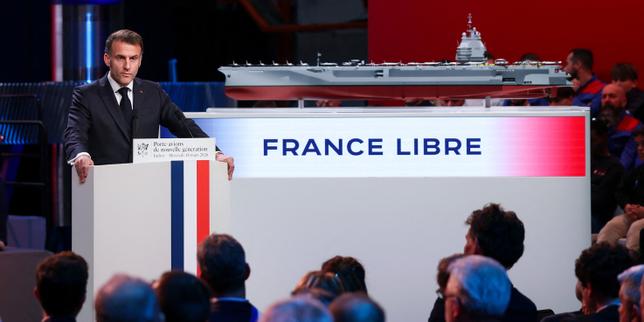
The confirmation of "France libre" as the designation for the Porte-Avions de Nouvelle Génération (PA-NG) represents more than a symbolic nod to Gaullist tradition; it marks the commencement of a forty-year cycle of naval dominance and industrial commitment. This vessel is not a mere replacement for the Charles de Gaulle (R91). It is a fundamental shift in European power projection capabilities, shifting from a medium-sized nuclear platform to a heavy-class carrier that aligns French naval doctrine with the operational standards of the United States Navy’s Gerald R. Ford class.
The strategic necessity of the PA-NG is rooted in the "permanence of alert" doctrine. Without a second carrier, France accepts a structural vulnerability: the periodic absence of sea-based air power during major maintenance overhauls (ATM). The PA-NG is designed to bridge this gap while expanding the envelope of what a European carrier strike group (CSG) can achieve in contested littoral and blue-water environments.
The Triple Constraint of Naval Aviation Architecture
Designing a nuclear-powered aircraft carrier involves a relentless trade-off between three core variables: displacement, energy output, and sortie rate.
- Displacement and Hull Hydrodynamics: The PA-NG will displace approximately 75,000 tonnes, nearly double that of its predecessor. This increase is not elective. It is the physical requirement for a 300-meter flight deck capable of operating the SCAF (Système de Combat Aérien du Futur), a sixth-generation fighter significantly heavier and larger than the current Rafale M.
- The Nuclear Thermal Gradient: Propulsion will be provided by two K22 nuclear reactors, each generating 220 megawatts of thermal power. This represents a 50% increase over the K15 reactors used in the Charles de Gaulle. The energy requirement is driven by the transition from steam to electricity-heavy ship systems.
- The Sortie Generation Rate (SGR): The ultimate metric of a carrier's lethality is how many aircraft it can launch and recover in a 24-hour window. The PA-NG aims for a sustained SGR that exceeds current European benchmarks by utilizing electromagnetic launch systems (EMALS).
Electromagnetic Transition and the Death of Steam
The most critical technological leap in the "France libre" is the abandonment of steam catapults (C13-3) in favor of the General Atomics Electromagnetic Aircraft Launch System (EMALS) and Advanced Arresting Gear (AAG). This shift solves a fundamental mechanical bottleneck in naval aviation.
Steam catapults require a massive footprint of piping, freshwater tanks, and boilers. They exert a violent, non-linear stress on the aircraft’s airframe, effectively "jerking" the plane into flight. Because the pressure cannot be finely tuned, light unmanned aerial vehicles (UAVs) often cannot be launched without sustaining structural damage.
EMALS utilizes a linear induction motor to accelerate the shuttle. This allows for:
- Precision Acceleration Control: The system can be calibrated for the specific weight of the aircraft, whether it is a 30-tonne SCAF fighter or a 2-tonne stealth drone.
- Reduced Structural Fatigue: Smoother acceleration curves extend the operational lifespan of the airframe.
- Higher Sortie Frequency: EMALS resets faster than steam systems, which require time to rebuild pressure between launches.
However, this transition introduces a significant engineering risk: the requirement for massive, instantaneous electrical discharge. The ship must be capable of storing gigajoules of energy in flywheels or capacitor banks and releasing it in milliseconds without crashing the rest of the ship's electrical grid.
The K22 Reactor and Energy Sovereignty
The decision to utilize nuclear propulsion is a strategic choice for "unlimited" endurance. While a conventionally powered carrier (using gas turbines or diesel) is a "slave to the tanker," requiring refueling every few days during high-tempo operations, the PA-NG is limited only by its aviation fuel (TR5) and food supplies for the crew.
The K22 reactors serve a dual purpose. Beyond propulsion, they provide the "hotel load" for a digitized ship. Modern naval warfare is increasingly defined by directed-energy weapons (lasers for missile defense) and high-power active electronically scanned array (AESA) radars. These systems are energy-intensive. By over-specifying the thermal output of the K22, the French Navy is future-proofing the hull against the next three decades of weapon evolution.
Air Wing Composition and the SCAF Integration
The PA-NG is built around the SCAF, which functions as a "system of systems." The carrier will not just host manned fighters but will act as a node for "Remote Carriers" (loitering munitions and loyal wingman drones).
The flight deck layout must accommodate:
- 30 to 32 Next-Generation Fighters (SCAF).
- 3 E-2D Advanced Hawkeye airborne early warning and control aircraft.
- A complement of unmanned aerial systems (UAS) for ISR (Intelligence, Surveillance, Reconnaissance) and electronic warfare.
The increased deck space allows for "pit stop" refueling and rearming stations, similar to those used in Formula 1. This layout minimizes "deck spots" where aircraft are parked but cannot be moved, maximizing the flow of the hangar-to-deck elevator system.
Economic and Industrial Scaling
The construction of the "France libre" is an exercise in sovereign industrial preservation. The project is managed by MO Porte-Avions, a joint venture between Naval Group and Chantiers de l'Atlantique.
The industrial logic follows a specific sequence:
- Drying Dock Infrastructure: Construction must occur in Saint-Nazaire, as the Toulon naval base lacks a dry dock large enough for a 75,000-tonne hull.
- Nuclear Integration: Once the hull is launched, it will be towed to Toulon for the installation of the nuclear boiler rooms, a task performed under the strict oversight of TechnicAtome.
- Supply Chain Concentration: The project sustains approximately 2,000 high-skill jobs over two decades. The "cost of entry" for this technology is high—estimated between €7 billion and €10 billion—but the cost of not building it is the total loss of the ability to design and maintain nuclear naval reactors, a skill set that cannot be reacquired quickly once lost.
Geopolitical Friction and Interoperability
The PA-NG reinforces France’s position as the only European power capable of high-intensity carrier operations without relying on the short-takeoff/vertical-landing (STOVL) limitations of the F-35B. While the UK’s Queen Elizabeth class uses a "ski-jump," the PA-NG’s CATOBAR (Catapult Assisted Take-Off But Arrested Recovery) configuration allows for:
- Greater Payload: Aircraft can take off with full fuel tanks and maximum weapon loads.
- E-2D Compatibility: Essential for long-range radar coverage that STOVL carriers struggle to provide.
- US-French Interoperability: French pilots can land on US carriers and vice versa, a level of integration that provides a force multiplier during NATO operations.
The primary strategic risk remains the timeline. With sea trials slated for the late 2030s and operational entry in 2038, there is a "mid-life" gap where the Charles de Gaulle must be maintained beyond its ideal retirement age. Any delay in the K22 reactor development or EMALS integration will result in a lapse of French naval supremacy.
The strategic play for the French Ministry of the Armed Forces is to lock in the industrial contracts for the K22 reactors by the end of this fiscal cycle. Securing the long-lead items—specifically the forged steel for the reactor vessels and the electromagnetic components from General Atomics—is the only way to mitigate the inflationary risk and technical drift inherent in a project of this scale. The PA-NG is not just a ship; it is a forty-year hedge against the erosion of European strategic autonomy.


