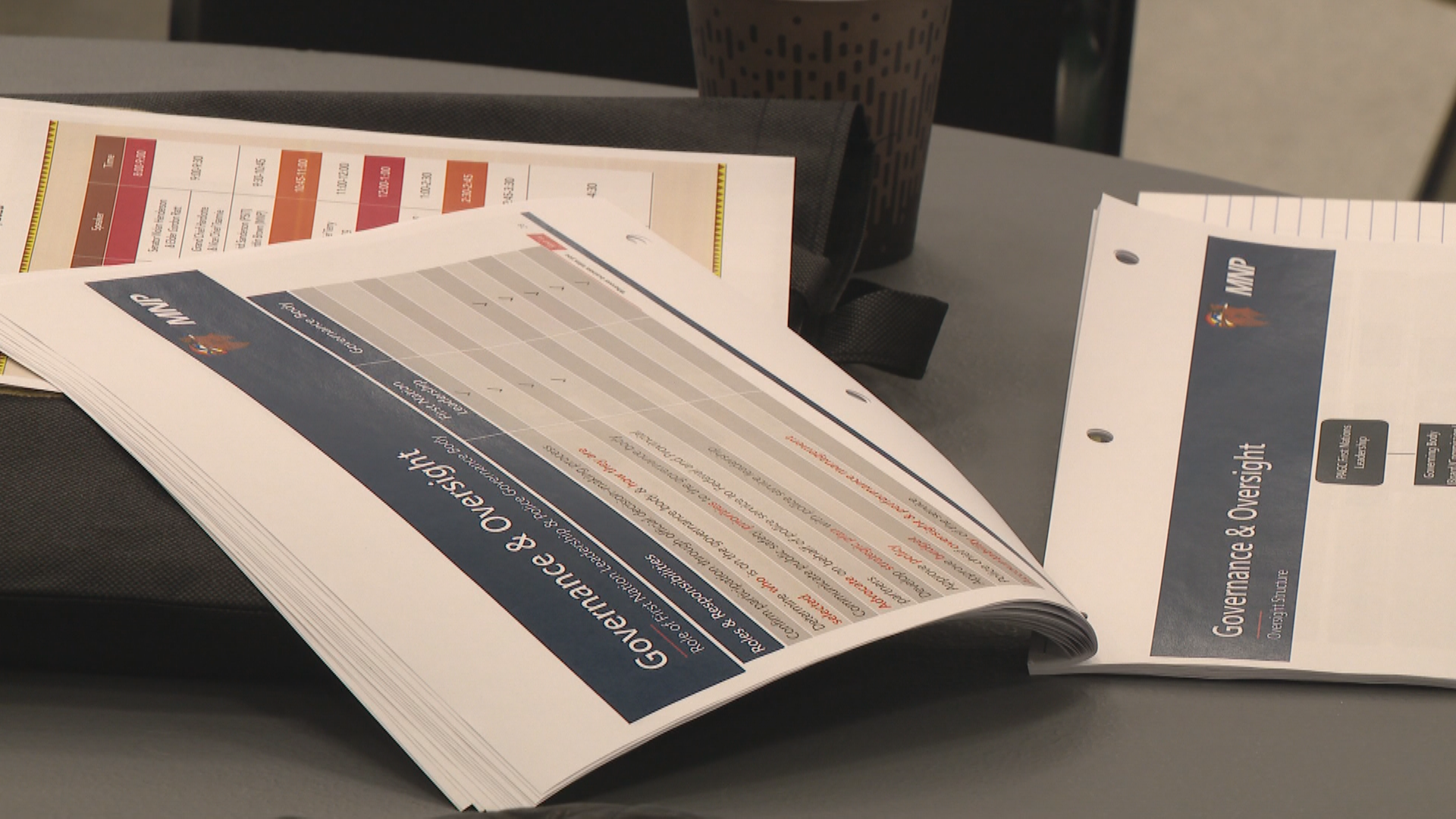
The Prince Albert Grand Council (PAGC) just dropped $1.4 million on a policing study. They called it a "monumental step." They talked about "community-led solutions" and "cultural alignment." They hired consultants, held meetings, and printed a report that probably weighs as much as a small sled dog.
Everyone is clapping. I’m not.
If you want to fix public safety in Northern Saskatchewan, the last thing you need is another million-dollar binder sitting on a shelf in an office in Prince Albert. We are addicted to the "study" as a substitute for sovereignty. We treat data collection like it’s a form of liberation. It isn't. It’s a bureaucratic stalling tactic that keeps the status quo comfortable while the actual streets stay exactly as dangerous as they were before the first clipboard arrived.
The Consultant Industrial Complex
Let’s talk about where that $1.4 million actually went. It didn’t go to training officers. It didn’t go to equipment. It didn’t go to frontline mental health responders who can actually handle a crisis at 3:00 AM in a remote community.
It went to the Consultant Industrial Complex.
I’ve seen this play out in corporate boardrooms and government halls for twenty years. A group identifies a massive, systemic problem. Instead of taking the political risk of actually changing a policy or reallocating a budget, they commission a "feasibility study." This does two things: it makes the leadership look like they are "taking action," and it pushes any actual decision-making down the road by at least twenty-four months.
By the time the study is finished, the political will has evaporated, the budget for implementation has been eaten by inflation, and the consultants are already bidding on the "Phase 2: Implementation Framework" contract.
The PAGC study supposedly identifies a "gap" in service. You don't need a million dollars to find a gap. Ask any grandmother in a remote northern community how long it takes for the RCMP to respond to a call. She’ll give you the answer for free: "Too long, if they come at all."
The Sovereignty Myth of the Self-Police Force
The "lazy consensus" here is that if Indigenous communities simply run their own police forces, the problems of crime, addiction, and violence will magically dissolve. This is a dangerous oversimplification that ignores the brutal math of modern policing.
To run a functional, independent police force in 2026, you don't just need people in uniforms. You need:
- High-speed digital forensic capabilities.
- Secure, climate-controlled evidence storage that meets national judicial standards.
- A 24/7 dispatch infrastructure that doesn't fail when the northern lights get heavy.
- Comprehensive liability insurance that would make a Fortune 500 CFO weep.
When we push for "self-policing" without a massive, permanent, and unconditional transfer of federal wealth—not just a one-time grant for a study—we are setting these communities up to fail. We are essentially saying, "Here, take over this broken, underfunded system and try to make it work with 'culture' as your primary resource."
Culture is vital. It is a foundation. But culture doesn't process a crime scene or manage a high-speed pursuit. If the PAGC wants real policing, they should stop asking for permission to study and start demanding the keys to the treasury.
The False Premise of "Better Data"
People often ask: "Don't we need the data to prove the need for funding?"
No. The premise is flawed. The data already exists. Every interaction with the RCMP, every court appearance in the provincial system, every hospital admission for violence—it’s all logged. The "need" has been proven a thousand times over in the last fifty years.
Generating more data is a trap. It forces Indigenous leaders to speak the language of the colonizer’s bureaucracy to justify their own survival. It’s a performance. You are being asked to prove you are drowning while the water is already in your lungs.
Imagine a scenario where a town is on fire. Does the fire chief sit down to conduct a $1.4 million study on the "thermal dynamics of the local architecture" and "community perceptions of smoke"? No. They grab the hose.
The PAGC is currently holding a very expensive thermometer while the house is burning.
The Liability Trap Nobody Admits
Here is the truth no one in the room wants to say: Independent Indigenous police forces are a liability nightmare in the current Canadian legal framework.
When an RCMP officer makes a mistake, the federal government has deep pockets and a massive legal team to handle the fallout. When a small, community-run force makes a mistake—an accidental discharge, a wrongful arrest, a failure to protect—the legal costs alone can bankrupt the entire tribal council.
Without a fundamental change in the First Nations Policing Program (FNPP) to grant these forces the same legal standing and "essential service" designation as provincial police, these studies are just roadmaps to a financial cliff. The federal government loves these studies because they keep the conversation focused on "models" and "frameworks" rather than the hard reality of legal indemnity and permanent core funding.
Stop Studying and Start Seizing
The path forward isn't a new report. It’s a shift in leverage.
If the PAGC wants to disrupt the policing landscape, they should stop participating in the study cycle. They should stop acting like supplicants waiting for a "feasibility" stamp of approval from Ottawa.
- Demand "Essential Service" Status Now: Currently, First Nations policing is treated as a "program," not a right. Programs can be cut. Programs require constant studies. Essential services (like the RCMP or OPP) are mandated.
- Defund the Consultants: Take the next $1.4 million and put it into a local training academy. Build the human capital first.
- Reject the "Pilot Project" Label: Pilot projects are where good ideas go to die. They are temporary by design.
We don't need to "understand" the problem better. We understand it perfectly. The northern communities are under-served, over-surveilled in the wrong ways, and abandoned when the sun goes down.
A million dollars could have paid for ten more boots on the ground for two years. Instead, it paid for a stack of paper that says what everyone already knows.
If you want to fix the North, stop writing reports and start building power. The time for studying the "feasibility" of survival is over.
Move the money to the front lines or get out of the way.