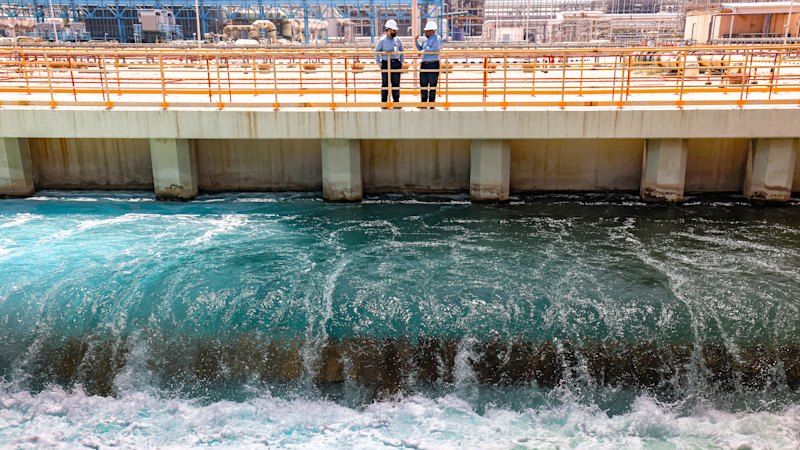
The stability of the Saudi Arabian state is mathematically tethered to the operational integrity of its desalination infrastructure. While traditional geopolitical analysis focuses on crude oil price volatility or ballistic missile defense, the true systemic vulnerability lies in the energy-water nexus. If a kinetic or cyber-kinetic strike successfully disrupts the Kingdom’s primary desalination plants, the countdown to social and industrial paralysis is exactly as long as the strategic reserve capacity—roughly seven days for most urban centers.
The Triad of Desalination Vulnerability
Saudi Arabia produces over 7.5 million cubic meters of desalinated water per day, accounting for approximately 60% of its total water consumption and nearly 90% of urban demand. This dependence creates a concentrated risk profile centered on three specific vectors:
- Geographic Centralization: The majority of production is clustered in a few mega-facilities, such as Al Jubail on the Arabian Gulf and Shoaiba on the Red Sea. A localized failure at one of these nodes cannot be easily compensated for by the existing national grid due to the immense energy requirements of lateral water transport across the Nejd plateau.
- Energy-Water Interdependency: Most Saudi plants are Multi-Stage Flash (MSF) or Multi-Effect Distillation (MED) systems co-located with power plants. Any disruption to the fuel gas supply or the electrical grid immediately halts water production. Unlike a power outage, which can be remedied by restoring the circuit, a water outage involves physical depletion of a finite volume that is difficult to "re-pressurize" once the system goes dry.
- The Brine and Intake Weakness: Desalination requires a continuous intake of seawater. Asymmetric warfare tactics—such as the deployment of sea mines, oil spills, or "red tide" biological contaminants—can force a total plant shutdown more effectively than a direct missile strike.
The Seven Day Decay Function
The "Seven Day" threshold is not a rhetorical device but a reflection of the storage-to-consumption ratio in the Kingdom’s strategic reservoirs. When production hits zero, the system enters a state of rapid entropy characterized by the following phases:
Phase 1: The Pressure Drop (Hours 0–24)
As reservoirs begin to deplete, line pressure throughout the municipal grid drops. This is not merely a convenience issue; low pressure allows groundwater or contaminants to seep into the aging pipe networks through micro-fractures, compromising the entire remaining water supply.
Phase 2: The Industrial Halt (Days 2–4)
Saudi Arabia’s heavy industry, including petrochemical refining and mining, is water-intensive. Without a steady flow of high-purity desalinated water for cooling and processing, these facilities must initiate emergency shutdowns to prevent catastrophic equipment failure. The economic cost during this phase is measured in billions of dollars per hour.
Phase 3: The Reservoir Exhaustion (Days 5–7)
By the end of the first week, strategic reserves in major cities like Riyadh and Jeddah reach the "dead storage" level—water that cannot be gravity-fed or pumped out without specialized equipment. At this point, the state must pivot from a distribution model to a rationing and logistics model, utilizing truck-mounted tankers.
Kinetic vs. Cyber-Physical Attack Vectors
The threat from regional actors like Iran is often framed through the lens of the "Tanker War" or drone strikes on oil processing facilities like Abqaiq. However, a "Water War" employs different mechanics.
The Cyber-Physical Loop
Modern Reverse Osmosis (RO) plants rely on Industrial Control Systems (ICS) and SCADA networks. A sophisticated actor can manipulate the chemical dosing levels or the high-pressure pump settings. By forcing the membranes to foul or the pumps to cavitate, an attacker can cause physical damage that takes months—not days—to repair. This extends the "Seven Day" crisis into a multi-month humanitarian catastrophe.
The Asymmetric Maritime Strike
The Arabian Gulf is shallow and characterized by high salinity and slow currents. An intentional oil spill or the release of chemical agents near the Jubail intake pipes would force an immediate emergency shutdown. Because the Gulf has a low flushing rate, the contaminant could linger near the intake for weeks, effectively blockading the water supply without firing a single shot.
Quantifying the Strategic Reserve Gap
To understand the severity, one must look at the Resilience Coefficient ($R_c$), defined as:
$$R_c = \frac{S_r}{C_d - P_e}$$
Where:
- $S_r$ is the Strategic Reserve volume.
- $C_d$ is the daily consumption.
- $P_e$ is the emergency production capacity (groundwater and mobile units).
Currently, Saudi Arabia’s $R_c$ is dangerously close to 7 for most urban hubs. While the Kingdom has invested heavily in massive underground reservoirs—most notably the Riyadh Strategic Reservoir project—these are designed for short-term shocks, not a sustained regional conflict that targets the desalination fleet simultaneously.
Redundancy Limitations and the Energy Penalty
A common misconception is that the Kingdom can simply tap into its vast fossil water aquifers to offset a desalination loss. This ignores two physical realities:
- Salinity: Much of the remaining groundwater is brackish and requires treatment (desalination) before it is potable or usable in industrial boilers.
- Logistics: The infrastructure to move massive volumes of water from inland aquifers to coastal cities is underdeveloped compared to the coastal-to-inland pipelines.
The energy cost of moving water is a linear function of altitude and distance. Lifting water from sea level to the 600-meter elevation of Riyadh requires significant power. In a scenario where the energy grid is also under duress, the "water-power" feedback loop creates a downward spiral where neither system can be restored without the other being functional.
Strategic Hardening and the RO Pivot
The Kingdom is currently transitioning from thermal desalination (MSF/MED) to Seawater Reverse Osmosis (SWRO). This shift, while more energy-efficient, introduces new risks. SWRO membranes are highly sensitive to water quality. While a thermal plant can "boil" through some level of contamination, an SWRO plant will be completely blinded by an oil spill or a biological bloom.
To mitigate the seven-day chaos scenario, the strategy must move beyond simple storage.
- Decentralization: Replacing mega-plants with a network of smaller, modular SWRO units spread along the coastline reduces the impact of a single kinetic strike.
- Atmospheric Water Generation (AWG): While currently inefficient at scale, AWG provides a "last-resort" decentralized water source for critical infrastructure like hospitals.
- Nuclear Desalination: Integrating Small Modular Reactors (SMRs) with desalination units would decouple water production from the hydrocarbon supply chain, providing a more resilient energy source that is harder to disrupt via conventional sabotage of pipelines.
The most critical tactical adjustment is the integration of "Passive Defense" mechanisms. This includes the installation of massive, deep-water intake pipes that draw from below the surface layer where oil and biological contaminants typically reside. Furthermore, the development of a "National Water Grid" that allows for bidirectional flow between the Red Sea and the Arabian Gulf is the only way to ensure that a localized conflict in one body of water does not starve the entire peninsula.
The immediate strategic priority must be the acceleration of the "Water Transmission and Technologies Company" (WTTCO) initiatives to link disparate regional networks. If the Kingdom cannot achieve a 30-day $R_c$ (Resilience Coefficient) by 2030, its geopolitical rivals will continue to view the desalination intake pipe as the ultimate "kill switch" for Saudi sovereignty. Deploying high-altitude missile defense around Jubail is a necessary but insufficient deterrent; the real defense lies in the boring, expensive work of building redundant, cross-country pipelines and subsurface storage vaults that can survive a sustained kinetic campaign.