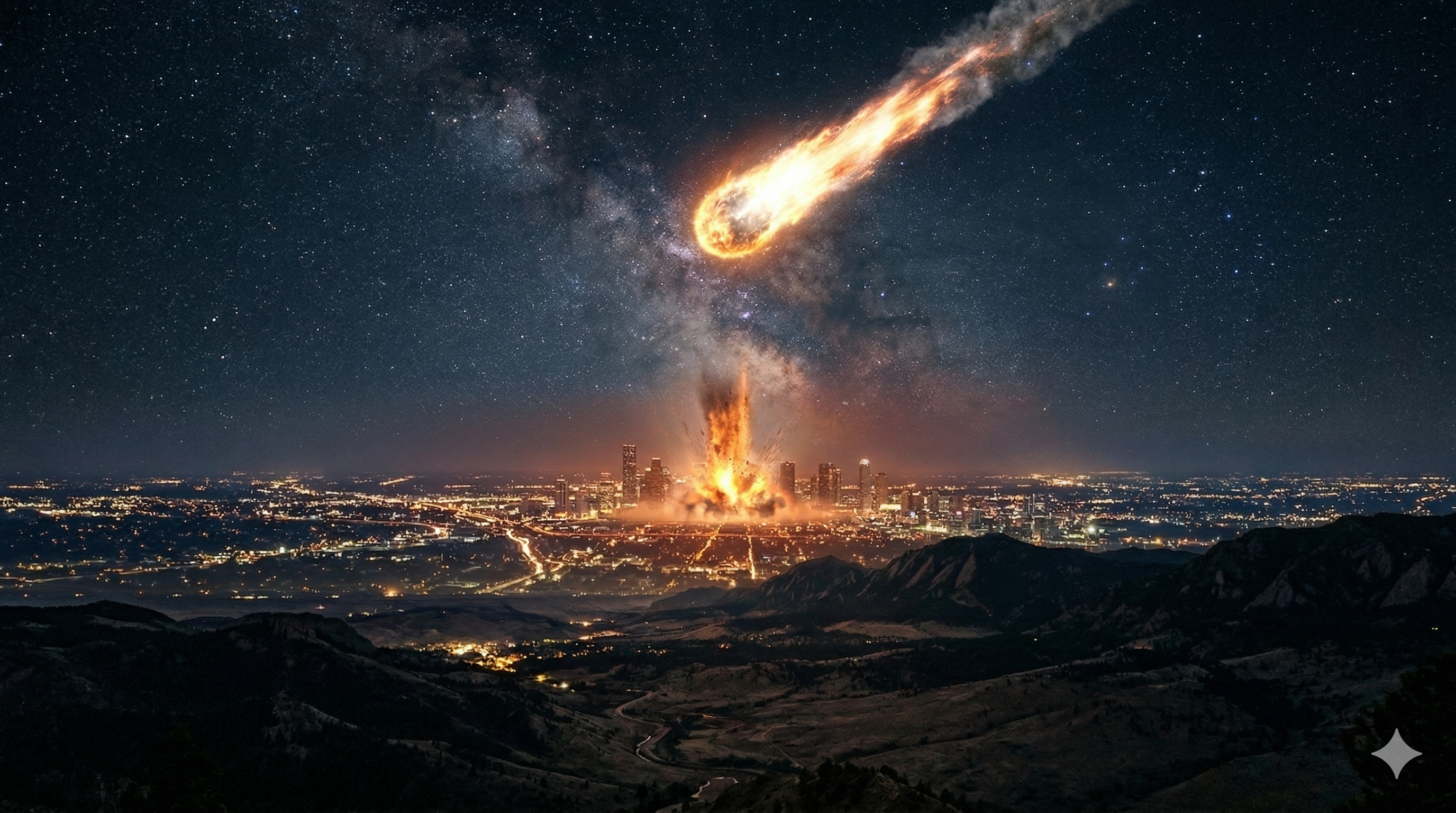
You’re sitting in your living room in suburban Houston on a quiet Saturday afternoon when the sky literally falls. Not the metaphorical "bad day" kind of falling, but a 35,000-mph chunk of an ancient asteroid smashing through your shingles. That’s exactly what Sherrie James says happened to her home in Spring, Texas, on March 21, 2026.
While most of us were checking our phones or grabbing a coffee, a one-ton celestial visitor decided to introduce itself to the North Houston suburbs. It didn't just cause a "boom"—it unleashed the energy of 26 tons of TNT. If you think your neighbors are loud, try living under the flight path of a disintegrating space rock.
The moment the sky exploded over Texas
It wasn't a gradual thing. At 4:40 PM, a fireball became visible about 49 miles above Stagecoach. Within seconds, it streaked southeast, screaming through the atmosphere at a pace that makes a Formula 1 car look like it's standing still. By the time it reached Bammel, just west of Cypress Station, the pressure became too much. The rock gave up, shattering into fragments 29 miles up.
That's when the "boom" hit. People from Bridgeland to Dickinson reported houses shaking and a sound like a massive blast. NASA later confirmed that this wasn't just a loud noise; it was a pressure wave from the asteroid's violent breakup.
What happened at the James house?
For Sherrie James, the science became very personal, very fast. While the sonic boom rattled windows across the city, something physical punctured her roof. According to James, the object tore through her ceiling, bounced off the floor, hit the ceiling again, and finally came to rest near a TV.
Her grandson was the one who found the hole. When they saw the rock, they knew it wasn't a typical Texas pebble. Local fire crews initially thought it might be debris from a plane, but the timing was too perfect. NASA’s Doppler radar was already lighting up with "meteorite falls" between Willowbrook and Northgate Crossing.
Why NASA is paying attention
It’s easy to dismiss these stories as "weird news," but for the folks at NASA and the American Meteor Society, this is high-stakes data. This specific rock was estimated to be about three feet in diameter. In the vacuum of space, that's a grain of sand. In our atmosphere, it’s a hammer.
NASA’s Geostationary Lightning Mappers (GLM) on the GOES satellites caught the flash. This wasn't a guess. They tracked the altitude, the speed, and the energy release with terrifying precision. When NASA says an object released the energy of 26 tons of TNT, they aren't being dramatic—they’re calculating the physics of a high-speed collision with our air.
How to tell if you actually found a meteorite
After an event like the Houston sighting, everyone with a weird-looking rock in their backyard starts wondering if they’ve hit the cosmic lottery. Honestly, most of the time, you've just found "slag" or a heavy piece of Earth rock. But if you're standing in the "strewn field" (the area where fragments land), here’s what you actually look for.
- The Fusion Crust: As the rock screams through the air, the outer layer melts. Real meteorites usually have a thin, dark, eggshell-like crust. If the rock is light-colored all the way through, it’s probably not from space.
- The Magnet Test: Most meteorites contain a lot of iron and nickel. If a strong magnet doesn't stick to it, your odds of it being an extraterrestrial visitor drop significantly.
- Regmaglypts: Think of these as "thumbprints" in the rock. They are shallow indentations caused by the air carving out the surface during the fall.
- The Weight: Meteorites are dense. If the rock feels surprisingly heavy for its size—like it's made of lead—you might have the real deal.
What to do if a rock hits your house
First, don't touch it with your bare hands. Not because it’s radioactive (it isn't), but because the oils from your skin can contaminate the rock. Scientists want to see the chemical makeup of the solar system, not what you had for lunch. Use aluminum foil or a clean plastic bag to pick it up.
If you’re in the Houston area and think you’ve found a piece of the March 21 fall, your next move is reaching out to experts. NASA doesn't usually come to your house to pick up rocks, but the American Meteor Society and the Smithsonian Institution are the primary groups that track these finds. They use these fragments to piece together the history of our solar system—literally.
If you think you saw the fireball or found a fragment, file a report with the American Meteor Society. Your data helps scientists map the trajectory and find more pieces of this three-foot-wide puzzle that just rattled the fourth-largest city in the U.S.