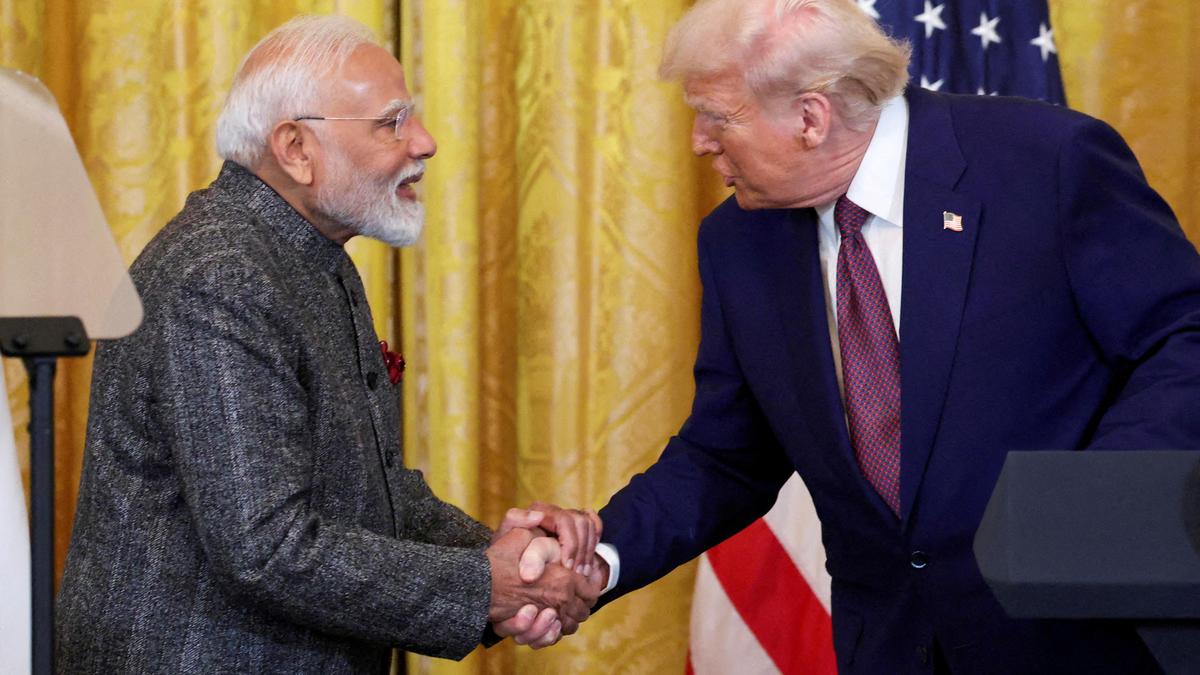
Geopolitics loves a predictable script. The latest headlines follow it to the letter: Donald Trump and Narendra Modi hop on a call, exchange pleasantries about their "special bond," and then pivot to the "grave concern" of the Strait of Hormuz. The mainstream media laps it up. They frame it as two titans of industry and statecraft securing the world’s energy arteries.
They are wrong.
The obsession with the Strait of Hormuz as a global "choke point" is a 1970s hangover that refuses to fade. While the press focuses on the optics of naval cooperation and bilateral stability, they miss the tectonic shift in how energy actually moves—and who actually pays for it. This isn't a story about security. It is a story about two leaders posturing for domestic audiences while the very "crisis" they claim to manage is being rendered obsolete by technology and shifting trade routes.
The Myth of the Choke Point
Every freshman international relations student can recite the stat: roughly 20 to 30 percent of the world’s total oil consumption passes through the Strait of Hormuz. It is the jugular of the global economy. Or so we are told.
In reality, the "choke point" narrative serves the interests of defense contractors and career diplomats more than it serves energy consumers. I have watched analysts predict a global collapse every time an Iranian speedboat gets too close to a tanker. It never happens. Why? Because the market is smarter than the politicians.
Saudi Arabia and the UAE have spent the last decade building massive pipelines that bypass the Strait entirely. The East-West Pipeline in Saudi Arabia can move 5 million barrels per day to the Red Sea. The Abu Dhabi Crude Oil Pipeline sends 1.5 million barrels per day to the Gulf of Oman. When Trump and Modi talk about "securing" the Strait, they are protecting a route that the region’s own producers are actively trying to circumvent.
India’s Energy Delusion
Modi’s involvement is framed as a strategic necessity for India’s growing economy. India imports over 80 percent of its oil, much of it from Iraq, Saudi Arabia, and the UAE. The standard logic says India needs the U.S. Navy to keep the lights on in Delhi.
This logic is flawed. It ignores the "China Factor" and the "Russian Pivot." Since 2022, India has become the world’s premier laundromat for Russian crude. By importing discounted Russian oil—which often arrives via the Red Sea or direct Pacific routes—India has decoupled its immediate survival from the volatility of the Strait of Hormuz.
When Modi discusses West Asia with Trump, he isn't asking for protection. He is performing a balancing act. He wants to ensure that if the U.S. ramps up sanctions on Iran, India gets a "get out of jail free" card for its investments in the Chabahar Port. It’s not about security; it’s about securing exemptions.
Trump’s "Art of the Deal" is a Subsidy for Asia
For Donald Trump, the Strait of Hormuz is a leverage point. He views the U.S. Navy as a security guard that hasn't been paid its tips. His "America First" rhetoric usually demands that allies pay their "fair share."
But here is the irony the "insider" crowd misses: by maintaining a massive naval presence in the Persian Gulf to "protect" the flow of oil, the U.S. is effectively subsidizing the energy costs of its biggest economic competitors—namely China and India.
The United States is now a net exporter of petroleum. The oil flowing through Hormuz isn't going to New Jersey; it’s going to Ningbo and Mumbai. Trump’s posturing about "stability" in West Asia is essentially the U.S. taxpayer footing the bill to ensure China’s factories have cheap power. If Trump were actually a contrarian, he would pull the fleet and tell Beijing to send their own destroyers to guard the tankers.
The False Premise of "Stability"
The competitor article treats "stability" as a static goal that can be achieved through a few high-level phone calls. This is a fundamental misunderstanding of the region's mechanics.
West Asia is not a puzzle to be solved; it is a market to be managed. Conflict in the Strait of Hormuz actually benefits certain players. Every time a "security concern" is raised, the risk premium on oil spikes. For producers, "instability" is a revenue driver. For Trump, it's a way to keep domestic shale producers profitable by keeping global prices from bottoming out.
We need to stop asking "How do we secure the Strait?" and start asking "Who benefits from the fear of it being closed?"
The Rise of the Dark Fleet
While the U.S. and India discuss official maritime security, a "dark fleet" of hundreds of tankers is already operating outside the bounds of international law and "security" agreements. These ships turn off their transponders, engage in ship-to-ship transfers in the middle of the night, and move millions of barrels of sanctioned oil from Iran and Russia.
The Strait of Hormuz is already "leaking." The formal naval patrols are a theater production played out for the benefit of the evening news. The real movement of energy is happening in the shadows, unbothered by whether Trump and Modi had a productive chat.
The Brutal Reality for Investors
If you are an investor or a policy wonk looking at this "dialogue" as a sign of future stability, you are looking at the wrong data.
- Ignore the Summits: A call between leaders is a lagging indicator. It happens after the markets have already priced in the risk.
- Watch the Infrastructure: The real "security" of the region is being built in concrete and steel—the pipelines in Oman and Saudi Arabia—not in diplomatic communiqués.
- Follow the Currency: The real threat to the status quo isn't a blockade; it's the shift toward settling oil trades in Yuan or Rupees, bypassing the Petro-dollar.
The Ghost in the Machine
The Strait of Hormuz is a ghost of a previous era. It haunts our foreign policy because we don't have the courage to admit that the "global policeman" model is a relic.
Trump knows this, which is why he complains about the cost. Modi knows this, which is why he buys Russian oil while nodding along to U.S. security concerns. The "Strait of Hormuz" is no longer a geographical reality; it is a rhetorical tool used to justify military budgets and political alliances that would otherwise look increasingly irrelevant.
Stop reading the tea leaves of diplomatic readouts. The world has moved on from the 1973 oil crisis. It’s time our leaders—and our media—did the same.
The Strait is open because everyone—including Iran—needs the money. The "threat" is the product. The "solution" is the sales pitch. Don't buy what they're selling.
Check the pipeline capacity charts in Fujairah if you want the truth. The rest is just noise.
Get used to the noise; it’s the only thing keeping the old guard in power.