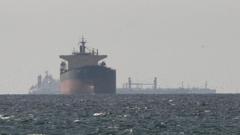
The Strait of Hormuz is functionally closed. On paper, it remains a body of international water, but for the global energy market, it has become a "no-go" zone that is strangling the world’s supply of oil and liquefied natural gas (LNG). President Donald Trump’s recent demand that the United Kingdom, China, France, Japan, and South Korea deploy their own warships to the region is not merely a request for military assistance. It is a fundamental shift in the American security doctrine that has underpinned global trade since the end of World War II.
For decades, the United States Navy acted as the world’s unpaid security guard in the Persian Gulf. That era is over. Trump is now making it clear that if nations want their oil to flow, they must be willing to bleed for it—or at least pay for the privilege.
The Decapitation Paradox
Trump’s public messaging on Truth Social has been characteristically blunt. He claims the United States has already "destroyed 100% of Iran's military capability." However, the reality on the water tells a different story. While heavy strikes on Kharg Island and Iranian naval assets have crippled Tehran's ability to wage a conventional blue-water war, they have not stopped the asymmetric "war of the mosquitoes."
Even a "decapitated" military can drop a sea mine from a civilian dhow or launch a low-cost suicide drone from a hidden cove along the jagged Iranian coastline. These low-tech threats have achieved what a full-scale navy could not: they have made the Strait uninsurable. When war-risk premiums for tankers skyrocket or are canceled altogether, the Strait is closed regardless of how many carrier strike groups are loitering in the Arabian Sea.
Trump’s strategy is to force the primary consumers of Persian Gulf energy—specifically Asian and European powers—to take a front-line role. By inviting China and Japan to send warships, the administration is effectively outsourcing the risk of "first contact." If an Iranian drone hits a Chinese destroyer, it is Beijing’s problem to solve, not Washington’s.
The British Dilemma
For the United Kingdom, this demand comes at the worst possible time. Prime Minister Keir Starmer has spent months trying to navigate a "middle path," avoiding direct involvement in the initial strikes on Iran to preserve what remains of British diplomatic leverage. That strategy has now collided with the reality of the "Special Relationship" under a second Trump term.
The Royal Navy is currently a shadow of its former self. With a fleet of fewer than 20 frigates and destroyers, the UK is already overstretched. Sending two aircraft carriers to the Middle East, as Trump has suggested, would leave the North Atlantic and home waters virtually undefended. Furthermore, the British defense budget is in a state of crisis. Analysts suggest that meeting Trump’s expectations for naval presence and broader NATO spending would require an additional £80 billion—a sum that does not exist in the current Treasury projections without gutting social services.
Britain’s hesitation has already drawn the President's ire. Trump's recent comments that "we don't need them any longer—but we will remember" serves as a warning. The cost of staying out of the Gulf may be high tariffs or a total withdrawal of the U.S. security umbrella in Europe.
The Economic Chokepoint
The stakes go far beyond the price of a gallon of gas. The Strait of Hormuz is the world's jugular. Roughly 20 million barrels of crude oil and a fifth of the world's LNG pass through this 21-mile-wide gap daily.
| Commodity | Global Share Passing Through Hormuz |
|---|---|
| Crude Oil & Products | ~25% |
| Liquefied Natural Gas (LNG) | ~20% |
| Global Helium Supply | ~30% |
The closure has already triggered a "fertilizer shock." Because synthetic nitrogen fertilizer is primarily manufactured using natural gas, the disruption in Gulf shipments has sent urea prices up by 30%. Farmers in Brazil, India, and the American Midwest are now facing a choice between ruinous input costs or lower crop yields. This is how a naval standoff in the Middle East becomes a food security crisis in the Southern Hemisphere.
Beyond Oil: The Helium and Fertilizer Crisis
While the media focuses on $120-a-barrel oil, the real "silent killer" is the disruption of non-energy commodities. Qatar’s Ras Laffan hub is the source of nearly one-third of the world’s helium. This gas is not for party balloons; it is essential for cooling the superconducting magnets in MRI machines and for the manufacturing of high-end semiconductors.
A prolonged blockade doesn't just stall cars; it stalls hospitals and silicon fabs. By demanding an international flotilla, Trump is betting that the pain of these supply chain disruptions will eventually force China and the UK to stop "free-loading" and take active measures against Iranian interference.
The Risk of Escalation
The danger of this "team effort" is the lack of a unified command structure. In previous operations, like Operation Prosperity Guardian in the Red Sea, the U.S. provided the backbone of intelligence and coordination. Under the new "Hormuz Gamble," we may see a fragmented sea where different navies have different rules of engagement.
Iran has already signaled it will view any nation participating in this task force as a legitimate target. Tehran’s recent threats against the United Arab Emirates, accusing them of hosting U.S. launch sites, show that the conflict is rapidly expanding from a bilateral war to a regional conflagration. The IRGC’s strategy is simple: if they cannot export oil, no one in the Gulf will.
The U.S. is currently offering "political risk insurance" through the Development Finance Corporation to encourage shipping lines to return to the Gulf. But insurance is no substitute for a safe sea. Tanker captains will not sail into a literal minefield just because they have a government guarantee. They will only return when the "shoreline is bombed," as Trump promised, or when a wall of international warships provides a corridor of steel.
The coming weeks will determine if Trump’s "America First" maritime policy can actually secure the world's most vital waterway, or if it will simply leave the world's navies to fight over the scraps of a broken global trade system. Britain, China, and the rest now have to decide if the cost of the mission is lower than the cost of a global depression.
Would you like me to analyze the specific naval assets the UK currently has available for a Gulf deployment compared to the requirements of a sustained carrier strike group mission?