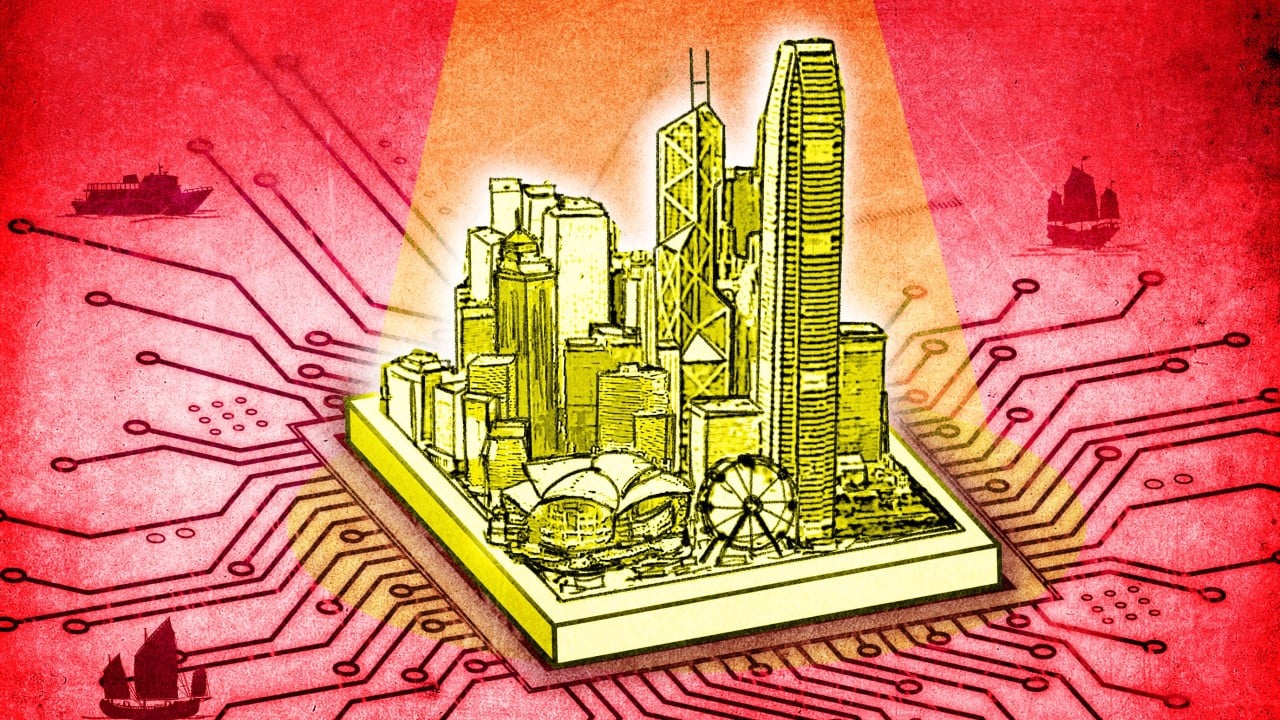
Hong Kong’s attempt to position itself as a global hub for Artificial Intelligence (AI) faces a fundamental friction between high-speed infrastructure investment and the absence of a unified regulatory architecture. While the government has committed billions to hardware and R&D, the lack of a statutory roadmap creates an environment of "compliance paralysis" for private enterprises. The central challenge is not a lack of capital, but the failure to resolve the tension between open-data flows and the stringent data sovereignty requirements of its primary economic partners.
The Triad of AI Integration
To evaluate Hong Kong’s current standing, one must decompose the AI ecosystem into three distinct, interdependent layers. The failure of any single layer creates a bottleneck that prevents the others from scaling.
- The Compute Layer (Infrastructure): This includes the physical hardware, specifically the Cyberport AI Supercomputing Centre. The goal is to provide local startups with the FLOPS (floating-point operations per second) necessary to train Large Language Models (LLMs) without relying on US-based cloud providers currently restricted by export controls.
- The Model Layer (Intellectual Property): This involves the creation of domain-specific models, particularly in fintech and logistics, where Hong Kong holds a historical data advantage.
- The Governance Layer (Guardrails): This is the regulatory framework—currently a patchwork of "ethical guidelines" rather than binding law—that dictates how AI can be deployed in public and private sectors.
The current strategy focuses heavily on the Compute Layer while leaving the Governance Layer in a state of conceptual flux. This imbalance increases the risk premium for international investors who require legal certainty regarding liability and data cross-border transfers.
The Cross-Border Data Paradox
Hong Kong’s unique status as a "Special Administrative Region" creates a complex data geometry. To function as an AI hub, the city must ingest vast datasets from Mainland China while maintaining the "free flow of information" status that attracts Western firms.
The GBA Data Flow Mechanism
The "Standard Contract for the Cross-boundary Flow of Personal Information within the Guangdong-Hong Kong-Macao Greater Bay Area" is the current attempt to bridge this gap. However, it operates on a voluntary basis and applies only to specific sectors. This creates a fragmented data environment. AI models require massive, diverse datasets to minimize bias and improve accuracy; if data from the Mainland is siloed from international data due to conflicting security protocols, the resulting AI models will be "narrow" and incapable of global competition.
Sovereign Compute vs. Global Access
The US-China trade tensions have resulted in restricted access to high-end GPUs, such as NVIDIA’s H100 and A100 series. Hong Kong’s reliance on domestic or "gray-market" hardware alternatives introduces a performance tax. Local AI firms must optimize code for less efficient hardware, which increases the time-to-market. The government’s subsidization of local compute power is a necessary reaction, but it does not solve the underlying software-ecosystem gap—specifically the dominance of CUDA-based libraries which are optimized for the very hardware Hong Kong struggles to procure at scale.
Mapping the Regulatory Vacuum
The Hong Kong government has opted for a "soft-law" approach, issuing circulars from the Office of the Privacy Commissioner for Personal Data (PCPD) and the Hong Kong Monetary Authority (HKMA). This sector-specific guidance provides flexibility but lacks the enforcement teeth of the EU AI Act.
The Liability Gap
A primary deterrent for AI adoption in Hong Kong’s dominant legal and financial sectors is the ambiguity of professional liability. If an AI-driven medical diagnostic tool or a high-frequency trading algorithm fails, the current legal framework does not clearly define the chain of accountability between the developer, the operator, and the end-user. Without a statutory definition of "AI Personhood" or a clear "Strict Liability" or "Negligence-based" framework, firms are relegated to low-stakes pilot programs rather than core-business integration.
The Talent Asymmetry
The "Top Talent Pass Scheme" has successfully attracted high-volume applications, but a qualitative analysis reveals a mismatch. The inflow is heavily weighted toward general software engineering rather than the specialized fields of neural architecture search, reinforcement learning from human feedback (RLHF), and AI safety engineering. Hong Kong universities produce world-class researchers, but the "brain drain" to Silicon Valley or Singapore persists because the local ecosystem lacks a "Lead Firm"—a massive AI-first company like OpenAI, DeepMind, or Baidu—that serves as an anchor for the talent pool.
The Cost Function of Delayed Regulation
Delaying the implementation of a comprehensive AI roadmap is often framed as a pro-innovation stance. In reality, it imposes a "Shadow Tax" on the economy.
- Insurance Premiums: Insurers cannot accurately price the risk of AI-integrated businesses without a legal baseline, leading to higher premiums or total lack of coverage for AI-related errors and omissions.
- Interoperability Costs: As other jurisdictions (EU, Singapore, China) firm up their laws, Hong Kong-based startups must build multiple versions of their software to comply with varying standards.
- Data Liquidity: Without clear "Right to Explanation" laws (allowing users to know why an AI made a decision), the public trust remains low, limiting the willingness of individuals to contribute data to public-good AI projects.
Strategic Divergence: The Singapore Comparison
Singapore has updated its Model AI Governance Framework to include Generative AI specifically, focusing on "Model AI Governance Framework for Generative AI." Hong Kong, by contrast, has relied on the 2021 "Ethical Guidelines on AI." The difference is in the granularity. Singapore’s framework addresses hallucination risks, intellectual property rights for training data, and the carbon footprint of model training.
Hong Kong’s lack of a specific Generative AI roadmap is particularly visible in its civil service. While Singapore has integrated "Pair" (an internal AI assistant) for civil servants, Hong Kong’s public sector adoption remains cautious and siloed. This creates a "Governance Lag" where the regulators are less technically proficient than the industries they are meant to oversee.
The Path to Technical Autonomy
To move beyond the current state of "reactive policy," the administration must shift from being a landlord of compute space to a designer of technical standards.
1. The Localization of Model Weights
Hong Kong should focus on "Vertical AI"—models trained on the city's specific high-density data in finance, maritime logistics, and urban planning. Instead of competing with the US on general-purpose LLMs, the focus should be on Small Language Models (SLMs) that can run on edge devices and comply with local data privacy laws. These models are cheaper to train and easier to audit, addressing both the hardware shortage and the transparency requirement.
2. Sandbox 2.0: The Regulatory API
The existing regulatory sandboxes are too slow. A "Regulatory API" approach would involve the government providing a testing environment where AI models can be stress-tested against synthetic datasets to ensure they meet safety and bias standards before they are granted a "seal of approval" for use in the Hong Kong market. This turns regulation into a service rather than a hurdle.
3. Intellectual Property (IP) Reform for the AI Age
The current Copyright Ordinance needs an "AI Exception" for text and data mining (TDM). Without clear legal protection for the act of scraping or ingesting data for the purpose of model training, local AI firms remain in a legal gray area. This reform would provide the "Safe Harbor" necessary for the Model Layer to flourish.
The Final Strategic Play
The window for Hong Kong to define itself as the "Neutral Bridge" for AI is closing. As the technology moves from the "Hype Phase" to the "Utility Phase," the absence of a unified guardrail system becomes a systemic risk. The administration must immediately transition from issuing "guidelines" to drafting a "High-Tech Development and Safety Act."
This act should not aim to restrict AI, but to standardize its failure modes. It must mandate:
- Algorithmic Audits for any AI used in "High-Stakes" decisions (hiring, lending, law enforcement).
- Watermarking Requirements for AI-generated content to protect the integrity of the information environment.
- A "Mutual Recognition" Protocol for AI safety standards between Hong Kong, the Mainland, and international bodies to ensure local models are "Export Ready."
The objective is to transform Hong Kong from a passive consumer of AI hardware into the primary architect of AI-Trust for the Asian market. Success will be measured not by the number of GPUs in Cyberport, but by the number of international firms that choose to domicile their AI intellectual property in Hong Kong because the legal framework is more predictable than the competition.
Execute a mandatory, time-bound audit of all current public-sector AI projects to establish a baseline for a unified "HK-AI Standard." Parallel to this, establish a "Green Lane" for AI talent that bypasses traditional visa hurdles for individuals with verified contributions to open-source AI repositories. This dual-track approach addresses both the governance deficit and the talent bottleneck simultaneously.