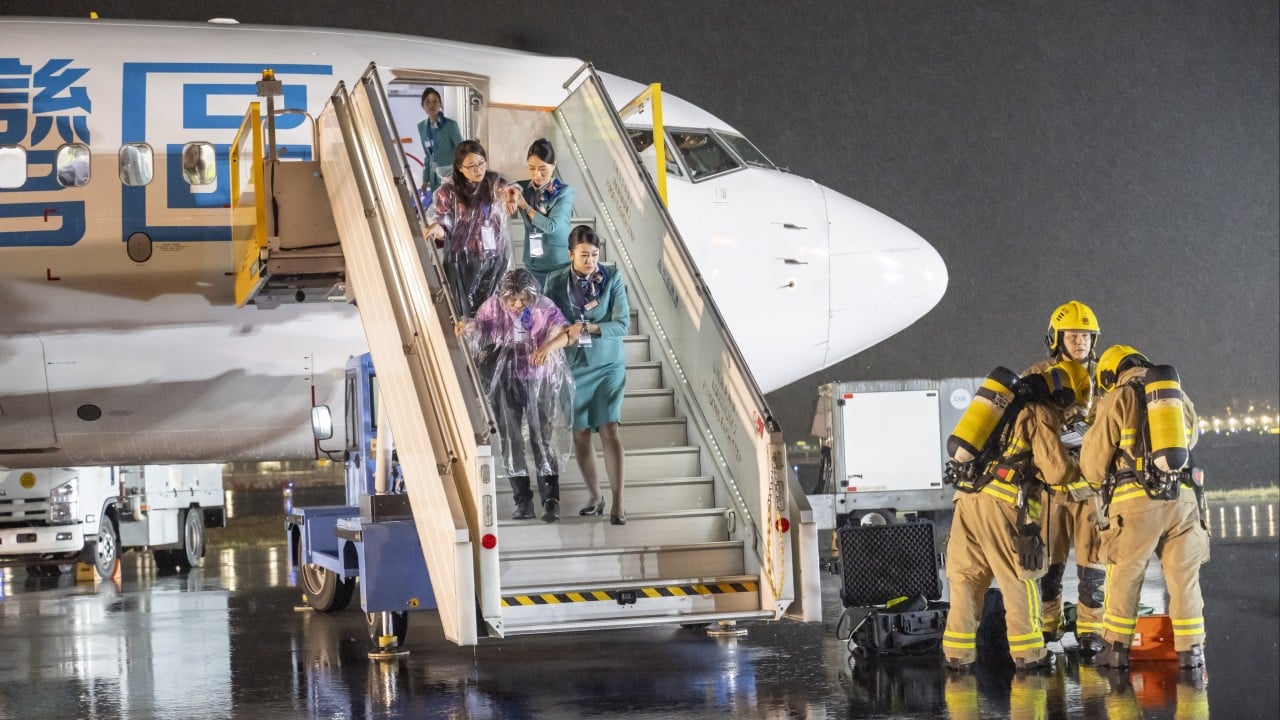
The sight of smoke billowing from a grounded Airbus A350 at Hong Kong International Airport (HKIA) usually signals a catastrophe that would paralyze global supply chains. On a recent Tuesday morning, however, the chaos was choreographed. More than 1,000 personnel and volunteers descended on the tarmac to execute a massive emergency crash drill, a biennial ritual that has taken on a heavy new significance. This was not merely a compliance exercise required by international aviation bodies. It was a high-stakes demonstration of operational readiness for a hub that is still fighting to reclaim its status as the premier gateway to Asia.
The drill simulated a landing accident involving a passenger aircraft, triggering a cascade of responses from the Fire Services Department, Police, and hospital authorities. While the surface-level objective is to put out fires and triages "victims," the real work happens in the friction points between different government bureaucracies. An airport is a city-state. When a crisis hits, the transition from civilian management to emergency command must happen in seconds.
The Invisible Architecture of an Airport Crisis
Most travelers see HKIA as a shopping mall with runways. For the people running it, the facility is a massive risk management engine. The recent exercise focused on the Triple Runway System, a multi-billion dollar expansion designed to increase capacity. But more capacity brings more complexity. Every additional flight path and taxiway increases the mathematical probability of a ground collision or a landing mishap.
During the drill, the Airport Authority Hong Kong (AAHK) tested its upgraded Emergency Power System and the digital coordination tools that link the control tower with off-site rescue teams. In a real-world scenario, the first sixty minutes—the "Golden Hour"—determine the survival rate of passengers and the long-term reputation of the airline. If the airport fails to clear the wreckage and resume operations quickly, the economic fallout ripples through the logistics sector within hours.
Logistics of a Simulated Disaster
The sheer scale of the 1,000-person turnout highlights a logistical hurdle that the industry rarely discusses: the manpower shortage. Coordinating a drill of this magnitude requires stripping active duty personnel from their regular posts or paying overtime to hundreds of volunteers.
- 100 Volunteers acted as injured passengers, requiring moulage (special effects makeup) to simulate realistic trauma.
- 18 Fire Appliances were deployed to test water pressure and response times on the newer sections of the airfield.
- Multi-Agency Communication was filtered through a centralized command post to prevent the radio frequency clutter that often hampers real-world rescues.
The challenge isn't just putting out the fire. It is managing the information flow. In 2026, a crash isn't just a physical event; it is a viral one. Within minutes of an incident, footage from passenger smartphones would be on global news feeds. The drill included a component for "media management" and "family assistance," acknowledging that the psychological aftermath of an accident is as volatile as the jet fuel itself.
Why Modern Drills Often Fail the Reality Check
Critics of these large-scale exercises argue they are too scripted. In a planned drill, everyone knows the "crash" is coming at 10:00 AM. They have had their coffee. They are briefed. True emergencies happen at 3:15 AM during a rainstorm when the shift supervisor is home with the flu.
To combat this, HKIA has begun introducing "injects"—unplanned complications thrown into the middle of the exercise. For example, a simulated medical emergency at a completely different terminal might be triggered simultaneously to see if the command structure buckles under the weight of two competing crises. This type of stress testing is essential because the aviation industry is currently operating with a less experienced workforce than it had five years ago.
The Experience Gap
The massive turnover during the early 2020s left a void in the middle-management layer of airport operations. Many of the coordinators who knew the "unwritten rules" of HKIA have retired or changed industries. These drills serve as a compressed training ground for a new generation of airfield officers who have never seen a real fuselage fire.
We are seeing a reliance on automated systems to bridge this gap. HKIA has invested heavily in Advanced Surface Movement Guidance and Control Systems (A-SMGCS). This tech tracks every vehicle on the airfield, preventing the "blind spots" that led to famous runway incursions in the past. The drill was a test of whether the human operators trust the screen more than their own eyes—and what happens when they have to switch back to manual coordination.
The Economic Necessity of Over-Preparation
Hong Kong's aviation sector is under immense pressure to prove it can handle the projected surge in regional traffic. The airport isn't just competing with Singapore’s Changi or Seoul’s Incheon; it is competing with the perception that its best days are behind it.
A single major safety lapse would be catastrophic for the "Hong Kong is Back" narrative. Therefore, the 1,000-person drill is as much a marketing exercise as it is a safety one. It sends a signal to international carriers that the infrastructure is hardened. For an airline like Cathay Pacific, the airport's ability to handle a disaster directly impacts their insurance premiums and operational confidence.
Beyond the Firehose
While the fire trucks get the photos, the most critical part of the drill happened in a quiet room labeled the Passenger Reception Centre. This is where the volunteers—the "survivors"—were processed.
- Immigration and Customs: How do you process 300 people who have lost their passports in a fire?
- Psychological First Aid: Addressing the immediate shock to prevent long-term PTSD.
- Digital Reconnection: Ensuring survivors can communicate with their families immediately to stop the spread of misinformation.
These "soft" elements of the drill are often where the system breaks down. It is relatively easy to train a firefighter to spray foam; it is much harder to train a customs officer to handle a terrified, non-Cantonese-speaking passenger with empathy while maintaining national security protocols.
The Shadow of Real-World Incidents
Aviation safety is written in blood. Every procedure tested during this drill is a response to a historical failure. The HKIA exercise specifically looked at the movement of heavy rescue equipment across the "soft" ground near the runway—a lesson learned from incidents where fire trucks became bogged down in mud, unable to reach a burning aircraft.
There is also the matter of the Rescue Powerboat fleet. Given HKIA is surrounded by water, any short-landing or over-run involves a maritime rescue component. The drill integrated sea-based teams, testing the handover between the Marine Police and the airport’s internal rescue squads. This "intermodal" rescue capability is what separates a world-class hub from a secondary landing strip.
Evaluating Success
How do you measure the "success" of a drill where nothing actually went wrong? You look at the data points that the public doesn't see.
- Response Time Latency: Did the third-responding ambulance arrive within the 8-minute window?
- Radio Clarity: At what point did the communication chain break down between the tower and the ground crews?
- Resource Allocation: Were too many firefighters sent to the "blaze" while the "triage area" was left understaffed?
The Airport Authority will spend the next month analyzing thousands of hours of body-cam footage and radio logs. They aren't looking for what went right; they are hunting for the one mistake that would be fatal in a real crash.
The Tarmac is a Stage
Ultimately, the 1,000 personnel involved in this exercise were performing a high-stakes rehearsal for a play they hope never opens. But as HKIA moves toward full capacity with its three-runway system, the margin for error shrinks. The airport is becoming more crowded, the turnaround times are getting tighter, and the weather patterns in the South China Sea are becoming more volatile.
This drill was a reminder that safety is not a static state. It is a perishable commodity that must be renewed through sweat, expensive logistics, and the willingness to find flaws in your own house. The smoke over the airfield may have been fake, but the urgency behind it was entirely real.
Check the maintenance logs of the auxiliary power units before the next storm hits.