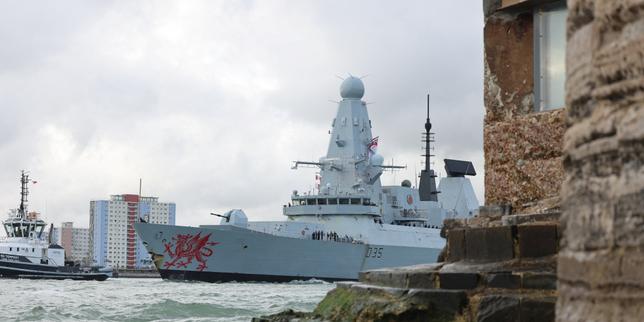
The steel under a sailor's boots feels different when the horizon stops being a postcard and starts being a threat. On the bridge of a British Type 45 destroyer, the air is filtered, cool, and hums with the electric nerve-center of a billion-pound machine. But outside that pressurized sanctum, the Gulf is a soup of humidity and predatory intent. The crew knows the math even if they don't discuss it over mess-deck sausages. They know that while their ship is a masterpiece of European engineering, it is also a very lonely piece of chess on a very crowded board.
For decades, the Royal Navy was the ghost that haunted the world's oceans, a force defined by the "Global Britain" mantra. It was the gold standard. When a British frigate appeared on the horizon, it wasn't just a ship; it was a sovereign promise of stability. Today, that promise is fraying at the edges. If a full-scale conflict were to ignite in the Persian Gulf tomorrow, the harsh reality is that the British fleet would find itself gasping for air, potentially more vulnerable than its neighbors across the English Channel.
The French Navy, often the subject of lighthearted ribbing in British naval bars, currently holds a hand of cards that might actually win the game.
The Math of a Shrinking Shield
Consider a hypothetical scenario in the Strait of Hormuz. A swarm of low-cost, explosive-laden drones buzzes toward a multi-billion-pound destroyer. This isn't science fiction. It is the new tax on doing business in the Middle East. To defend itself, the ship must fire missiles that cost millions of pounds each.
The problem isn't the quality of the British missile. The Sea Viper is a terrifyingly accurate predator. The problem is the magazine. A Type 45 destroyer carries 48 missile cells. In a sustained saturation attack—the kind Iran is perfected at orchestrating—those 48 cells can be emptied in minutes. Once they are gone, the ship is a floating target.
The Royal Navy’s surface fleet has been whittled down to a skeletal 19 frigates and destroyers. On any given day, a significant portion of those are tied up in maintenance or undergoing refits because they were run too hard for too long. When you factor in the ships needed for North Atlantic patrols, Caribbean drug busts, and escorting the Queen Elizabeth-class carriers, the number of hulls available for a hot war in the Gulf drops to a terrifyingly low digit.
France, meanwhile, has maintained a more balanced, "all-rounder" fleet. Their FREMM frigates and the Charles de Gaulle carrier group provide a depth of technical redundancy that the UK has sacrificed on the altar of high-end, niche capability. The French didn't just build ships; they built a sustainable rhythm of replenishment and repair that keeps more of their hardware in the water when the shooting starts.
The Ghost in the Engine Room
To understand the British predicament, you have to look at the "inter-cooler" crisis. The Type 45 destroyers, the pride of the fleet, were designed for a world that didn't quite exist. Their advanced integrated electric propulsion systems were engineering marvels, but they had a fatal flaw: they hated the heat.
In the lukewarm waters of the English Channel, they were Ferraris. In the 35°C waters of the Persian Gulf, the engines would occasionally shudder and die. Total darkness. No power. No radar. No defense. While the Ministry of Defence has spent years and millions on the "Power Improvement Project" to swap out these engines, the rollout has been agonizingly slow.
Imagine being a commander in the Strait, knowing that your ability to see the incoming threat depends on an engine that might decide the water is too salty and too warm to keep spinning. It creates a psychological weight that no manual can account for. The French navy, using more traditional—if less "revolutionary"—propulsion systems, doesn't face this specific nightmare. Their ships might be slower, but they are reliable in the heat of the moment.
The Invisible Logistics Chain
War isn't just about who has the biggest gun. It’s about who can keep that gun firing for the second week, the second month, and the second year. This is where the Royal Navy’s "thinness" becomes a liability.
The British have bet heavily on two massive aircraft carriers. They are magnificent, terrifying symbols of power. But a carrier is a queen on a chessboard; she requires a ring of protectors to survive. Because the UK has so few frigates and destroyers, the act of deploying a carrier group effectively strips the rest of the world of British naval presence.
If a conflict with Iran broke out, the Royal Navy would have to decide between protecting the carrier or protecting the merchant tankers. They don't have enough hulls to do both effectively. This "démunie"—this deprivation—isn't about a lack of courage or training. British sailors are among the best-drilled in the world. It is a failure of industrial foresight.
The French navy operates with a different philosophy. They have maintained a presence in the Indian Ocean through permanent bases and a fleet that emphasizes "availability" over "prestige." Their logistical tail is shorter, and their ability to sustain a presence without exhausting their entire national inventory is, quite frankly, superior right now.
The Human Cost of the Gap
A ship is just a hunk of metal without the people inside. But people wear out faster than steel. Because there are so few ships, the crews that remain are pushed to the breaking point. "Double-hatting" roles, extended deployments that stretch from six months to nine, and the constant stress of knowing there is no backup over the horizon—this takes a toll.
When a sailor looks at the radar and sees a swarm of 50 contacts, they need to know that if they miss one, there is a second layer of defense. In the current British configuration, that second layer is often missing. The French, by contrast, have invested in a wider variety of short-range defense systems and electronic warfare suites that provide a "layered" security blanket. It isn't just about having the best missile; it's about having the most options.
The gap between the UK and France isn't just a matter of "who would win in a fight." It’s about who can endure a crisis. The British fleet is like a world-class sprinter entered into a marathon. They are fast, they are elite, but they are gasping for air after the first mile. The French are the seasoned hikers, carrying a heavier pack but moving with a steady, relentless pace that gets them to the finish line.
The sea is an unforgiving critic of national policy. It doesn't care about the soaring rhetoric of "Global Britain" or the heritage of Nelson. It only cares about displacement, magazine depth, and the reliability of a diesel generator in 40-degree heat. Right now, as the sun sets over the dunes of the Iranian coast, the Royal Navy is looking at its reflection in the water and seeing a ghost of its former self, while the French fleet quietly prepares for a long, ugly fight that they actually have the tools to finish.
The silent tragedy of a modern navy is that you don't know it's broken until the first missile is in the air. By then, the math is already done. The sailors in the Gulf aren't looking for a fair fight; they are looking for a chance. And as the numbers dwindle, that chance gets smaller with every passing tide.
Would you like me to analyze the specific missile defense capabilities of the French FREMM versus the British Type 45?