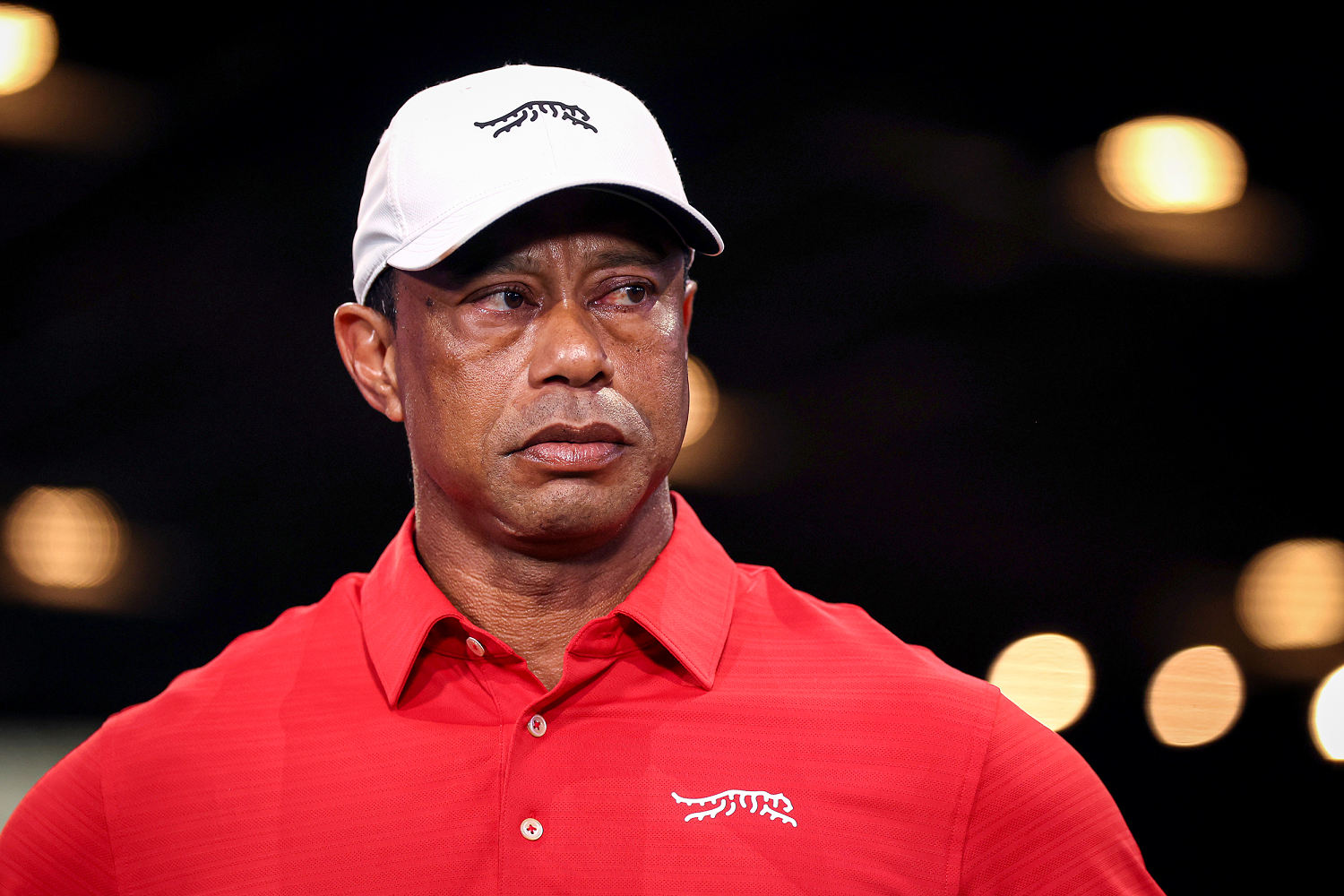
The dashcam footage doesn't show a champion. It shows a man lost in the dark, not just on a Florida roadway, but within the confines of his own skin. When the flashing blue and red lights reflected off the hood of that black Mercedes, they didn't just illuminate a suspected DUI. They exposed the crumbling infrastructure of a legend.
Tiger Woods, a name once synonymous with an almost supernatural composure, sat slumped behind the wheel. The world knows him as the man who bent the will of the Augusta greens to his favor. But in that moment, the only thing bending was his sense of reality. He wasn't drunk on alcohol—the breathalyzer confirmed a 0.00 reading. He was drowning in a cocktail of prescribed relief.
Pain is a silent architect. It builds walls around a person until the only way to see over them is through the haze of a pill bottle. For years, Tiger’s body was a high-performance machine pushed far beyond its mechanical limits. We cheered for the violent, snapping torque of his swing, never stopping to consider the toll that torque took on a human spine. By the time he was found asleep at the wheel in Jupiter, the surgeries had piled up like wreckage. Four back operations. Four knee surgeries. The man wasn't just playing golf; he was a walking anatomical battleground.
The Chemistry of a Quiet Crisis
Vicodin. Soloxex. Vantix. Torix.
Names that sound like characters in a science fiction novel, yet they are the daily companions for millions of people living with chronic trauma. Tiger released a statement following the arrest, admitting he was seeking professional help to manage his medications and treat his sleep disorder. It was a rare moment of public vulnerability from a man who had spent his entire life behind a mask of stoicism.
When you are the greatest in the world, the world expects you to be indestructible. You aren't allowed to hurt. You aren't allowed to be tired. So, you take something to dull the ache in your lower back so you can play with your kids. Then you take something else because the first thing keeps you awake at night. Eventually, the chemicals begin to argue with one another. The resulting fog isn't a choice; it’s a side effect of trying to survive your own success.
Consider a hypothetical athlete, let's call him "The Ghost." He wins everything. His face is on every billboard. But every morning, he has to roll out of bed onto the floor because his nerves are screaming. He takes a pill to stand up. He takes a pill to stop the shaking. He takes a pill to quiet the noise in his head. To the public, he is a titan. To his bathroom mirror, he is a fragile collection of symptoms. This isn't a metaphor for Tiger Woods; it is the lived reality of the modern gladiator.
The Weight of the Return
The stakes in this narrative aren't about tournament trophies or endorsement deals. They are about the preservation of a human life. When Tiger announced he was entering an intensive treatment program, the cynical voices in the gallery spoke of "brand management" and "PR pivots." They missed the point entirely.
Seeking help is the most terrifying thing a person can do when they have been conditioned to believe that weakness is a sin. For a golfer, the game is played in the silence between the shots. It is a sport of extreme isolation. You are alone with your thoughts for five hours a day, under a microscope, with no teammates to deflect the pressure. When that pressure becomes unbearable, the isolation becomes a prison.
The invisible stakes here involve the millions of people who see themselves in Tiger’s glassy-eyed mugshot. It is the construction worker who can't lift his arm without a Percocet. It is the office manager who can't sleep without a sedative. By admitting he lost his way in the pharmacy of his own medicine cabinet, Tiger did something far more difficult than hitting a 6-iron to three feet. He admitted he was out of control.
A Different Kind of Mastery
We often get the story of recovery backward. We think it’s a straight line—a steady climb from the valley back to the peak. It isn't. It’s a messy, oscillating struggle where some days the only victory is staying hydrated and keeping the lights off.
The "Tiger Effect" used to be about television ratings and prize money. Now, it has the potential to be about something much more substantial: the de-stigmatization of the "accidental addict." Most people don't set out to lose their grip on a Florida highway at 3:00 AM. They set out to stop the hurting. They follow a prescription. They trust the process until the process betrays them.
The journey Tiger is embarking on isn't toward another Green Jacket. It is toward a morning where he can wake up and feel the floor beneath his feet without needing a chemical bridge to get there. It is a quest for a different kind of quiet. Not the quiet of a hushed crowd at the 18th hole, but the quiet of a mind that no longer needs to be sedated to find peace.
He didn't just fall from grace. He fell into the reality that the rest of us inhabit—a world of physical limitations, mental fatigue, and the desperate hope that tomorrow might hurt a little less than today. The man in the dashcam video looked like he was at the end of his rope. By reaching out for professional help, he might have just found the strength to tie a knot and hang on.
The road back to the fairway is long, but the road back to himself is even longer. It’s a path through the woods that doesn't involve a golf club, just the terrifying, necessary work of clearing the brush.
The blue and red lights have faded. The car has been towed. All that remains is the man, the medicine, and the long, sober walk toward the sun.