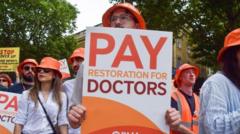
The air in a surgical ward at 3:00 AM has a specific, weighted silence. It is not the peaceful quiet of a sleeping home. It is a vibrating, anxious stillness, punctuated only by the rhythmic hiss of a ventilator or the distant, sharp beep of a monitor demanding attention. For a junior doctor—someone like "Sarah," a composite of the thousands currently weighing their future—this is the hour when the adrenaline of the day shift finally evaporates, leaving only the cold reality of a bank balance that doesn’t match the weight of the lives in her hands.
Sarah isn't a radical. She didn't spend a decade in elite schooling and grueling residency because she wanted to hold a picket sign. She did it because she wanted to heal. But when she looks at her paycheck, she realizes she is earning less per hour than the barista who sold her a flat white on the way to the hospital.
This is the invisible friction behind the headlines. When we read that the British Medical Association (BMA) has agreed to "resume talks" with Health Secretary Wes Streeting, it sounds like a bureaucratic chess move. It sounds like two suits sitting across a mahogany table in Whitehall, arguing over decimals.
The reality is far bloodier.
The dispute isn't just about a 35% pay restoration claim. It is about the fundamental collapse of a social contract. For years, the government banked on the "vocational" nature of medicine—the idea that because doctors care, they will tolerate being overworked, underpaid, and undervalued. They bet that the moral injury of seeing a patient wait twelve hours in a corridor would be enough to keep doctors at the bedside, no matter how much their real-terms pay eroded.
They bet wrong.
The Architect and the Anatomy
Wes Streeting inherited a house on fire. As the new Health Secretary, he stepped into a department where the relationship between the state and its most vital workforce had turned toxic. The previous administration had reached a stalemate that felt less like a negotiation and more like a siege. The BMA’s junior doctors’ committee—now often referred to as resident doctors to reflect their actual level of expertise—had staged strike after strike, totaling 44 days of industrial action over twenty months.
The cost of those strikes isn't just measured in the £3 billion of lost productivity or the millions of canceled appointments. It’s measured in the cumulative exhaustion of a nation.
Streeting’s approach has been a calculated shift in tone. He didn't start with a threat; he started with a phone call. By inviting the BMA back to the table immediately after the election, he signaled that the era of the "closed door" was over. But an open door is not the same thing as an open checkbook.
The math is brutal. The BMA argues that since 2008, the pay for junior doctors has fallen by roughly 26% when adjusted for inflation. They aren't asking for a "raise" in the traditional sense; they are asking for the clock to be turned back to a time when a medical degree guaranteed a middle-class life rather than a struggle to pay rent in a London borough.
Streeting, meanwhile, is operating under the shadow of a Treasury that is obsessively counting every penny. He has to find a way to offer enough to stop the exodus of talent to Australia and Canada without triggering a wave of similar demands from every other public sector union.
The Human Cost of the Stalemate
Imagine a transplant coordinator sitting in a darkened office, crossing out names. Because of a strike day, a surgery that was months in the making is deferred. The organ, a miracle of logistics and tragedy, must go elsewhere. The patient, who had worked up the courage to face the knife, has to go home and wait.
This is the "invisible stake" that both sides carry to the table. The doctors feel the guilt of the abandoned patient. The politicians feel the pressure of a plummeting approval rating.
When the BMA agreed to these new talks, it wasn't a surrender. It was a tactical pause. They have seen "talks about talks" before. They have heard the platitudes about the NHS being the "religion of the British people." They know that you can't pay a mortgage with applause on a Thursday night.
The shift in language is subtle but vital. By moving from "Junior Doctor" to "Resident Doctor," the union is reclaiming the narrative of expertise. They are reminding the public that these are not "students" or "apprentices." They are the surgeons, registrars, and specialists who run the hospital while the consultants are in clinic. They are the ones making life-and-death decisions at 4:00 AM while the rest of the country sleeps.
The Australia Factor
Why is this negotiation so desperate? Because the exit ramp has never been easier to find.
Ten years ago, moving to Australia for a medical career was a grand adventure for a few. Today, it is a standard career path. Every hospital breakroom in the UK has a story about a colleague who left for Perth or Melbourne. They send back photos of sun-drenched beaches, yes, but more importantly, they send back stories of being able to afford a home, of having enough staff on the ward to actually take a lunch break, and of being treated like a professional rather than a line item on a budget.
If Streeting fails to move the needle significantly, he isn't just facing more strikes. He is facing a brain drain that will take decades to repair. You cannot train a doctor in a weekend. If the current cohort leaves, the NHS becomes a shell.
Consider the logic of the investment. It costs the British taxpayer hundreds of thousands of pounds to put a single student through medical school. To then lose that person over a pay dispute worth a fraction of that investment is a staggering failure of business logic. It is like building a Ferrari and then refusing to buy the oil needed to keep the engine from seizing.
The Shadow at the Table
There is a third party in these talks who never speaks: the patient.
The patient doesn't care about the intricacies of the "pay review body" or the specific wording of the 2016 contract. The patient cares about the lump they found last Tuesday. They care about the pain in their hip that prevents them from picking up their grandchildren.
For the patient, the "resumption of talks" is a flicker of hope. It suggests that perhaps, just perhaps, the system might stop fighting itself and start fighting the disease.
But hope is a fragile thing in the modern NHS. The backlog stands at nearly 7.6 million cases. Even if a deal is signed tomorrow, the road to recovery is years long. The strikes have exacerbated the problem, but they did not create it. The "productivity" issue that Streeting often mentions is a symptom of a system where the computers don't work, the buildings are crumbling, and the staff are too tired to innovate.
The Language of Compromise
What does a "win" look like?
For Streeting, it’s a multi-year deal. He needs to buy time. If he can offer a path to pay restoration—not all at once, but staged over several years—he might be able to satisfy the BMA’s mandate while keeping the Chancellor happy.
For the doctors, it’s about more than the percentage. It’s about "exception reporting"—the process by which they log the unpaid overtime they work every single day. It’s about the cost of exams and professional indemnity, which can eat thousands of pounds out of their post-tax income. It’s about dignity.
The danger of these talks is the "veneer of progress." It is easy to issue a joint statement saying the meetings were "constructive." It is much harder to find the £2 billion to £3 billion required to truly settle the score.
If the talks collapse again, the escalation will be scorched-earth. The BMA has shown it can maintain discipline and resolve over a long period. They are not a group that scares easily. They spend their lives looking at things most people can't bear to see; a political standoff is nothing compared to a trauma bay.
The Silence Before the Storm
As the negotiators gather, the hospitals continue to churn. In a small town in the north of England, a resident doctor is currently finishing a twelve-hour shift. They are checking a patient's potassium levels one last time before handing over their bleep. They are thinking about the rent increase notice they found in their mailbox this morning.
They are waiting for a sign.
They are waiting to see if the government finally understands that the NHS is not a collection of buildings or a set of targets. It is a collection of people. And those people have reached their limit.
The talks with Streeting are the last best hope for a negotiated peace. If they fail, the sound you hear won't be the chanting of protestors on a picket line. It will be the sound of suitcases being packed, the quiet click of a door closing as another doctor leaves a system that refused to value them until it was too late.
The table is set. The chairs are pulled out. The world is watching to see if "constructive" actually means "change."
Somewhere in a quiet ward, Sarah is still awake. She is waiting to find out if she still has a future in the country she calls home, or if she is just another statistic in the slow-motion collapse of an icon.