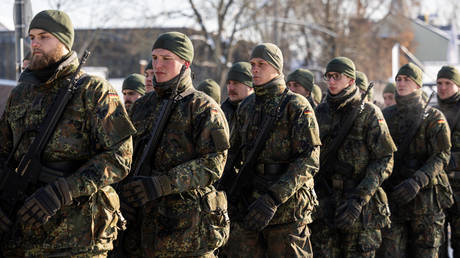
The weight of a uniform is supposed to be measured in fabric and responsibility. But for a young recruit in the Bundeswehr, that weight has started to feel like lead. It is the heavy, suffocating pressure of a system that is currently eating its own future.
In Berlin, the halls of power are filled with talk of Zeitenwende—a historic turning point in defense policy. The government has promised billions of euros to modernize a military that has long been the punchline of NATO jokes. They want more tanks. They want better jets. Most of all, they want more bodies. But as the latest report from the Parliamentary Commissioner for the Armed Forces makes clear, you cannot build a modern fighting force on a foundation of systemic cruelty.
The numbers are clinical. The reality is visceral.
Imagine a nineteen-year-old from Saxony named Lukas. This is a hypothetical composite, but his story is written in the margins of every official grievance filed this year. Lukas joined because he wanted to serve something larger than himself. He wanted the discipline, the camaraderie, and the steady paycheck. Instead, he found himself in a world where "leadership" often translates to ritualized humiliation.
The Culture of the Shouting Match
The report highlights a disturbing surge in reported cases of abuse, sexual harassment, and extremist behavior within the ranks. When we talk about "abuse" in a military context, the mind often jumps to the grueling physical demands of basic training. That is not what is happening here. This isn't about running five miles in the rain; it is about the targeted, psychological stripping of a soldier's dignity.
In one documented instance, superiors used "training" as a thin veil for physical mistreatment that bordered on torture. In others, the abuse was verbal—a relentless barrage of slurs and degradation designed not to build a soldier up, but to break a human being down.
When a recruit is told they are worthless every day for six months, they don't become a better warrior. They become a ghost. Or worse, they become a liability.
The Bundeswehr is currently facing a recruitment crisis that borderlines on a death spiral. They need to reach a target of 203,000 soldiers by 2031. Currently, they are stuck at roughly 181,000. It is a mathematical problem with a human cause. Why would a generation raised on the values of individual rights and mental health awareness volunteer to enter a meat grinder of institutional toxicity?
The Ghost of the Far Right
There is a darker shadow looming over the barracks than just bad leadership. The report points to a persistent, jagged problem with right-wing extremism. It is a poison that seeps into the cracks of a fractured culture.
When the officers in charge are the ones sharing extremist memes or fostering an environment where "the old ways" (often a dog whistle for pre-democratic ideologies) are celebrated, the institution loses its moral compass. For a country with Germany’s history, this isn't just a personnel issue. It is an existential threat.
Consider the psychological toll on a minority recruit. They enter the service to defend the German constitution—the Grundgesetz—only to find that the person sleeping in the bunk above them, or the sergeant giving them orders, views their very existence as an affront to the nation. This isn't just "locker room talk." It is the erosion of the chain of command. If you cannot trust the person next to you in the trench, the unit is already defeated.
A Bureaucracy of Neglect
It would be easy to blame a few "bad apples," but the report suggests the orchard itself is failing. The infrastructure of the German military is crumbling. We aren't just talking about broken helicopters and rifles that don't shoot straight. We are talking about moldy barracks, lack of functional internet, and a procurement system so sluggish it feels like it’s moving through waist-deep mud.
Think about the message this sends to a new soldier.
You are asked to be prepared to give your life for your country, yet your country cannot provide you with a shower that doesn't have black mold creeping up the tiles. You are asked to master complex modern weaponry, but the barracks don't have Wi-Fi stable enough to send an email home to your parents.
This neglect is a form of abuse in itself. It tells the soldier: You are an afterthought.
The Parliamentary Commissioner, Eva Högl, has been sounding this alarm with increasing desperation. She notes that while the "Special Fund" of 100 billion euros is a start, money cannot buy a culture. You can buy a Leopard 2 tank, but you cannot buy the loyalty of a soldier who has been sexually harassed by their superior and then told by the reporting office to "just toughen up."
The Invisible Stakes
The stakes of this failure extend far beyond the borders of a German training camp. Germany is the economic engine of Europe. In a world that is becoming increasingly volatile, a hollowed-out Bundeswehr is a vacuum. When recruitment fails because the culture is toxic, the entire alliance weakens.
The "human element" isn't a soft metric. It is the only metric that matters.
A soldier who feels respected, valued, and properly equipped is a soldier who stays. A soldier who is abused, ignored, and fed a diet of extremist rhetoric is a soldier who leaves at the first opportunity—or stays and becomes a cancer within the unit.
The report isn't just a list of grievances; it is a map of a sinking ship. The water is rising, and the response from the leadership has largely been to rearrange the deck chairs while promising that more chairs are being manufactured.
The Breaking Point
We have to ask ourselves what we expect of the people we put in uniform. We expect them to be the shield of democracy. But a shield that is rusted through by internal rot will shatter at the first blow.
The stories coming out of the barracks are not isolated incidents of "tough love." They are the symptoms of an institution that has lost its way in the transition from a conscript army to a professional one. In a conscript army, you have a captive audience. In a professional army, you have to earn your people every single day.
Right now, the Bundeswehr is losing.
It is losing the PR war, it is losing its best talent, and it is losing the trust of the very public it is sworn to protect. The "Rampant Abuse" cited in the headlines is the sound of a system failing to adapt to the 21st century. It is the sound of a young man like Lukas packing his bags and heading back to his village, telling everyone he meets to never, ever sign that contract.
The most expensive weapons in the world are nothing more than cold steel and circuits without the human spirit to drive them. If Germany cannot fix the soul of its military, all the billions in the world won't be enough to save it.
The barracks remain quiet, but it is the silence of an empty room, not a disciplined force. The echo you hear isn't the march of progress. It is the hollow ring of a promise unkept.
Would you like me to look into the specific legislative reforms currently being proposed in the Bundestag to address these military culture issues?