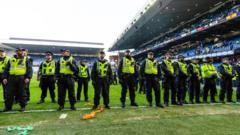
The rain in Glasgow doesn't just fall. It seeps. It finds the gaps in your collar and the cracks in the pavement, turning the city into a grey, shimmering reflection of its own restless energy. On a Sunday afternoon in the East End, that energy wasn't just restless; it was jagged. It was the kind of atmosphere that makes the back of your neck prickle long before the first whistle blows.
Think of a young officer—let’s call him David. It’s his third year on the force. He didn't grow up in a household divided by colors. To him, the "Old Firm" was a logistical headache he’d read about in briefing notes. But as he stands outside the stadium gates, the reality of it hits him in the chest. It’s a wall of sound. It’s the smell of cheap lager and flares. It’s the sight of grown men, faces contorted in a brand of tribalism that defies logic, screaming at a bus as if it contains a literal invading army. You might also find this related coverage insightful: The Invisible Tenth Man on the Roster.
By the time the sun begins to dip, the "beautiful game" has left behind a very ugly wake.
The Morning After the Fever
When the Chief Constable stands before the cameras, the words are usually measured. They talk about "unacceptable scenes" and "disproportionate resources." But if you listen to the exhaustion behind the official statement, you hear a different story. You hear the frustration of a city leader who has watched millions of pounds in taxpayer money vanish into a ninety-minute vacuum of hostility. As extensively documented in latest articles by Sky Sports, the implications are worth noting.
The statistics are cold. Arrests for sectarian breach of the peace. Assaults on officers. Vandalism that turns public transport into a wreckage of broken glass and torn upholstery. But the real cost isn't found in a spreadsheet. It’s found in the diverted resources. While three hundred officers are tasked with keeping two sets of fans from tearing each other apart, a domestic abuse call in a suburb twenty miles away waits an extra ten minutes for a response. A burglary scene goes unvisited for an hour longer.
This is the invisible stake. When the two biggest clubs in Scotland meet, the rest of the country holds its breath, and the safety of the many is pawned to manage the fury of the few.
The Architecture of Enmity
It is easy to blame the alcohol. It is even easier to blame the historical ghosts of religion and politics that haunt the West of Scotland. But the police chief’s criticism points toward a more modern failure: a vacuum of responsibility.
Imagine a massive corporation that attracts 50,000 people to a venue, profits immensely from their presence, and then effectively says, "What they do once they step off our property is no longer our concern." That is the friction point. The clubs argue they cannot control the streets. The police argue that the clubs' culture fuels the fire that the officers then have to extinguish.
It’s a circular argument that leaves the public caught in the middle. We see the heavy-handed policing and complain about a "nanny state." Then we see the boarded-up shop windows and the blood on the Gallowgate and ask why the police weren't more prepared.
We are asking for a miracle: a high-octane, hate-fueled rivalry that somehow remains polite.
The Human Toll Behind the Shield
Go back to David, our hypothetical officer. During the match, a coin clipped his forehead. It wasn't a life-threatening injury, just a stinging reminder of his place in this ecosystem. To the man who threw it, David wasn't a person with a mortgage, a wife, or a daughter who wants him to play hide-and-seek when he gets home. He was a uniform. He was an obstacle. He was "them."
This dehumanization is the engine of the Old Firm disorder. It spreads like a virus from the stands to the streets. We see it in the way fans treat the city's infrastructure. In their minds, they aren't smashing a bus window; they are marking territory. They aren't ruining a stranger's commute; they are "celebrating" or "mourning" a result that, in the grand scheme of a human life, should be trivial.
The Chief Constable’s anger isn't just about the budget. It’s about the fact that in 2026, we are still using nineteenth-century policing tactics to manage a twenty-first-century sport. We are still treating a football match like a potential riot because, quite frequently, that’s exactly what it becomes.
The Myth of the Neutral Observer
There is no such thing as a neutral observer in Glasgow on derby day. Even those who hate football are drafted into the drama. They are the ones checking the train schedules twice to avoid the "fan specials." They are the parents keeping their kids out of the city center parks. They are the shopkeepers who lock their doors at 3:00 PM, sacrificing a Saturday’s profit for the sake of their windows.
The clubs often point to their community work, their charities, and their global reach. And those things are real. They do immense good. But that good is shadowed by the dark reality of the matchday experience. When the Chief Constable calls for the clubs to "do more," he isn't asking for another glossy brochure. He is asking for a fundamental shift in how these institutions account for the behavior they profit from.
Consider the logistics of a "controlled" environment. If a music festival saw this level of disorder, its license would be revoked before the stage was even dismantled. If a nightclub had a fraction of this violence, it would be shut down by Monday morning. Yet, football occupies a sacred space where the usual rules of corporate liability seem to melt away.
The Breaking Point
The tension between the police and the clubs has reached a tipping point because the public's patience is wearing thin. We are living in an era of tightened belts and crumbling services. Every time a "Category C" match requires a thousand officers on overtime, a library loses a month of funding or a pothole remains a hazard for another season.
The police chief’s critique is a plea for a new social contract. It’s a demand that the passion of the fans be decoupled from the pathology of the mob.
But as the final sirens fade and the fans disperse into the damp Glasgow night, the fundamental question remains unanswered. Can you have the fire of the Old Firm without the smoke that chokes the city? Can you have the intense, bone-deep loyalty that makes the rivalry famous without the jagged edge of hatred that makes it dangerous?
David finishes his shift at midnight. He wipes the dried blood from his forehead and drives home through streets that look normal again, though the air still feels heavy. Tomorrow, the headlines will argue about VAR decisions and red cards. The radio shows will be flooded with voices defending their side and blaming the other.
The broken glass will be swept up. The bruises will fade. But the city remains weary, waiting for the next time the whistle blows and the war begins again.