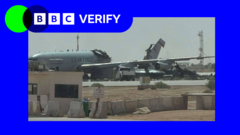
New imagery surfacing from Prince Sultan Air Base in Saudi Arabia has confirmed what Pentagon bean-counters and frontline maintainers have feared for years. A U.S. Air Force E-3 Sentry, the flying nerve center of modern air warfare, sits crippled on the tarmac with visible, extensive damage to its airframe. While initial whispers suggested a routine mishap, the reality is far more damning. This isn't just about one broken airplane; it’s a flashing red light on the dashboard of American power projection in the Middle East.
The E-3 Sentry, commonly known as AWACS (Airborne Warning and Control System), is an aging Boeing 707 airframe topped with a massive, rotating radar dome. It is the quarterback of the sky. Without it, fighter jets are fighting blind, and commanders lose the "god’s eye view" required to deconflict crowded airspace. The images showing structural failure or severe environmental degradation on this specific tail number point to a systemic collapse in fleet readiness that the Air Force has tried to mask with aggressive maintenance schedules and cannibalized parts. Meanwhile, you can read other events here: The Cold Truth About Russias Crumbling Power Grid.
The Brutal Reality of a 1970s Platform in a 2026 Conflict
We are asking airframes built during the Nixon and Ford administrations to operate in some of the most unforgiving environments on Earth. The heat in the Saudi desert doesn't just make life miserable for the ground crews; it literally bakes the sensitive electronics and composite materials that keep the E-3 aloft. When you combine 120-degree Fahrenheit temperatures with fine, abrasive sand, you aren't just flying a mission—you are sandblasting the multimillion-dollar radar arrays every time the engines start.
This damaged jet at Prince Sultan Air Base represents a failure of the "sustainment at all costs" strategy. For decades, the U.S. has relied on the E-3 because there was no viable successor ready to take the mantle. This has resulted in a fleet that is perpetually exhausted. The maintenance-man-hours per flight-hour for the E-3 have skyrocketed, frequently requiring over 50 hours of work on the ground for every single hour spent in the air. When a bird goes down in a forward operating base like this, the logistical tail required to fix it is massive. You aren't just flying in a spare part; you are often flying in a team of specialized structures experts and engineers who have to perform "surgery" in a hangar that feels like an oven. To explore the bigger picture, we recommend the detailed article by The New York Times.
Why the E-7 Wedgetail Cannot Arrive Fast Enough
The Air Force is currently sprinting to replace the Sentry with the Boeing E-7 Wedgetail. However, the damaged airframe in Saudi Arabia proves that the transition is happening far too slowly. The Wedgetail is based on the modern 737 Next Generation airframe, which boasts significantly better fuel efficiency and, more importantly, an Active Electronically Scanned Array (AESA) radar. Unlike the E-3’s rotating "mushroom" that relies on mechanical parts and hydraulic fluid—both of which fail spectacularly in desert heat—the E-7’s radar is fixed. It has no moving parts to jam or leak.
The gap between the E-3’s retirement and the E-7’s full operational capability is what military analysts call a "capability bathtub." We are currently sitting at the bottom of that bathtub. Every time an E-3 suffers "heavy damage" on a foreign runway, the bathtub gets deeper. We are losing the ability to monitor hostile drone activity from Houthi rebels or track Iranian provocations in real-time because our primary sensor is literally falling apart under the strain of its own age.
The Hidden Cost of Forward Deployment
Operating out of Prince Sultan Air Base (PSAB) is a strategic necessity, but a tactical nightmare for heavy ISR (Intelligence, Surveillance, and Reconnaissance) assets. The base serves as a critical hub for deterring regional aggression, yet the infrastructure for maintaining long-range, heavy-payload aircraft is often temporary or insufficient compared to a stateside depot like Tinker Air Force Base.
When an E-3 suffers structural damage in a place like PSAB, the options are grim:
- Patch and Dash: Attempt a temporary structural repair to get the aircraft back to a more robust facility. This is incredibly risky with a pressurized 707 hull.
- On-Site Overhaul: Ship in heavy tooling and create a makeshift depot environment. This keeps the aircraft out of the fight for months.
- Scrapping in Place: If the damage to the wing box or main keel is too severe, the aircraft becomes an expensive source of spare parts for the rest of the dwindling fleet.
The "heavy damage" reported suggests we might be looking at the third option. If the airframe has suffered a catastrophic failure of the landing gear housing or a major structural crack due to fatigue, it is likely that tail number will never fly again. In a fleet of only 31 aircraft—many of which are already sidelined for maintenance—losing even one jet is a 3% reduction in total global capacity.
The Invisible Enemy: Heat and Micro-Particulates
We often talk about missiles and electronic warfare, but the biggest threat to the U.S. presence in the Middle East is physics. The E-3's engines, the TF33-PW-102, are ancient low-bypass turbofans. They are thirsty, loud, and incredibly sensitive to "hot and high" conditions. Taking off from a desert runway with a full fuel load and a massive radar dome creates immense stress on the wing roots.
Furthermore, the cooling requirements for the mission crew in the back of the jet are astronomical. The radar generates an incredible amount of heat, which must be dissipated to keep the computers from melting. In the Saudi heat, these cooling systems are pushed to their absolute breaking point. When the cooling fails, the mission ends. If the cooling fails while the radar is active, the hardware can be permanently damaged in minutes.
Geopolitical Fallout of a Blind Spot
Our adversaries are watching these satellite images just as closely as we are. Iran, Russia, and various proxy groups in the region understand that American air superiority is not an innate right; it is a service provided by aging machines. If the U.S. cannot keep its "eyes in the sky" operational, the deterrent effect of our carrier strike groups and land-based fighter wings is halved.
Fighters like the F-15E Strike Eagle, also heavily utilized in the region, rely on the AWACS to tell them where the threats are before they enter the engagement zone. If the AWACS fleet is grounded due to structural failures, the U.S. must rely on ground-based radar or smaller, less capable assets like the E-2D Hawkeye (if a carrier is nearby). Neither can match the range or the command-and-control capacity of a fully functional Sentry.
The Budgetary Trap
The Pentagon is in a bind. Do they pour hundreds of millions of dollars into "life extension" programs for the remaining E-3s, or do they cut their losses and pray the E-7 Wedgetail arrives before a major shooting war starts? The damage at Prince Sultan Air Base suggests that "life extension" may be a fantasy. You cannot "extend" the life of metal that has reached its fatigue limit. You can only replace it, and at some point, the cost of the replacement exceeds the value of the platform.
We are seeing the results of a decade of deferred modernization. We chose to spend money on other priorities, assuming the E-3 would just keep flying because it always has. Now, the bill is coming due in the form of cracked spars and scorched electronics on a Saudi tarmac.
A Dangerous Transition Period
The next 36 months will be the most vulnerable period for U.S. air power in recent history. As more E-3s are retired or succumb to structural failure, the pressure on the remaining crews and airframes will only increase. This creates a death spiral: fewer planes mean the ones that are left have to fly more often, which leads to more frequent failures, which leads to even fewer planes.
Grounding the fleet for a total safety inspection would be the responsible move from a maintenance perspective, but it is a non-starter from a strategic one. The U.S. cannot afford to go "dark" in the Middle East right now. So, the Air Force will continue to patch these 50-year-old jets, crossing their fingers that the next structural failure happens on the ground and not at 30,000 feet over a combat zone.
The photos of the damaged jet are not an anomaly; they are a preview. If you want to know how the next conflict begins, look at the equipment that is breaking before the first shot is even fired. The Sentry is tired, the desert is harsh, and the replacement is still years away.
Check the tail numbers of the aircraft currently rotating through PSAB. If you see the same three or four jets doing all the heavy lifting, you'll know exactly how close we are to a total surveillance blackout.