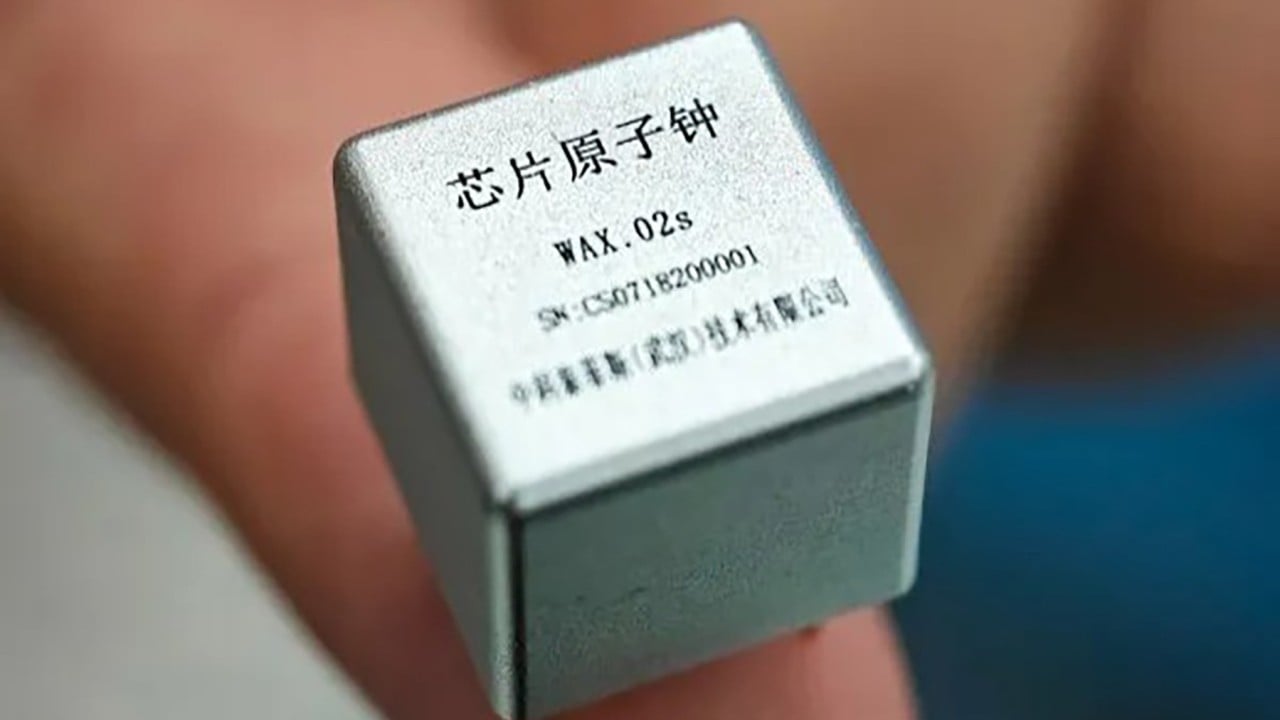
A silicon chip the size of a grain of rice sits on a workbench in a nondescript laboratory in Chengdu. It doesn’t look like a weapon. It doesn't hum with the menacing bass of a jet engine or glisten with the cold sheen of a missile casing. Yet, this tiny sliver of physics—a coherent population trapping (CPT) atomic clock—is the reason the geometry of modern warfare is shifting toward a terrifying, synchronized chaos.
To understand why China is obsessed with shrinking the measurement of time, you have to understand the specific nightmare of the "dark sky."
Imagine a pilot named Chen. In this hypothetical scenario, Chen is monitoring a screen as a hundred low-cost drones weave through a canyon. In the old world of electronic warfare, a single powerful jammer from an adversary could sever the link between these drones and the GPS satellites orbiting miles above. The moment that heartbeat from space is cut, the drones become blind. They drift. They collide. They turn into expensive scrap metal.
GPS is essentially just a very precise time signal. When a drone knows exactly what time it is, it knows exactly where it is. If the enemy takes away the satellite's clock, the drone loses its soul.
China’s solution isn't to build better shields against jamming. It is to give every single drone its own internal, unshakeable sense of time. They are putting the "master clock" inside the machine.
The Tyranny of the Quartz Crystal
For decades, we relied on quartz. You have it in your wristwatch. It’s reliable enough to get you to a meeting on time, but in the world of microsecond-precision required for high-speed data links and autonomous navigation, quartz is a vibrating mess. It shifts with the temperature. It drifts as the battery drains. If a swarm of drones relies on quartz to stay synchronized while GPS is jammed, they will lose their formation within minutes.
The gap between "here" and "ten meters to the left" is measured in nanoseconds.
Atomic clocks used to be the size of refrigerators. They required specialized cooling, massive power draws, and a team of scientists to keep them from drifting. They were treasures kept in the basement of national standards institutes. The breakthrough happening now in Chinese manufacturing is the brutal miniaturization of these monsters into "Chip-Scale Atomic Clocks" (CSAC).
By using a laser to excite rubidium atoms inside a tiny vapor cell, these devices achieve a level of stability that is hard for the human mind to grasp. We are talking about losing perhaps one second every ten thousand years. When you shrink that capability and mass-produce it for the cost of a high-end smartphone component, the "swarm" stops being a theoretical concept and becomes an inevitable reality.
The Math of Dehumanized Attrition
War has always been a balance of cost. If it costs a million dollars to build a missile, and your enemy can shoot it down with a ten-thousand-dollar interceptor, you lose the economic war before the first shot is fired.
The swarm flips the script.
By integrating these cheap, mass-produced atomic clocks into "disposable" drones, China is betting on the math of exhaustion. These drones don’t need to be stealthy. They don’t need to be armored. They just need to be synchronized.
When five hundred drones move as one body, they don't need a central brain. They use their internal clocks to "time-stamp" their communications with each other. This allows them to calculate their relative positions with surgical precision even when the GPS signal is a wall of static. They become a single, distributed organism. You can shoot down ten, fifty, or a hundred. The remaining four hundred simply adjust their timing, fill the gaps, and keep coming.
This isn't just about hardware. It's about the disappearance of the human bottleneck.
Consider the stress on a human operator trying to coordinate even three drones in a high-stress environment. The cognitive load is immense. But with autonomous synchronization driven by local atomic time, the "operator" is just a person who points at a map and says "go." The machines handle the rest. They don't get tired. They don't feel the paralyzing drift of indecision. They have the clock.
The Silent Factory
There is a specific kind of quiet in a facility where these sensors are born. It’s a clean-room silence, broken only by the rhythmic puff of HEPA filters. Here, the challenge isn't the physics—the world has known how to build atomic clocks since the 1950s—it’s the manufacturing.
The West has had CSAC technology for years, but it has largely remained a boutique item, expensive and reserved for high-end military hardware or underwater oil exploration. China's pivot is different. They are applying the same relentless scaling logic that allowed them to dominate the solar panel and EV battery markets.
They are moving from "laboratory grade" to "industrial grade."
This transition involves solving the "thermal problem." When you shrink an atomic clock, the heat generated by the laser can throw off the very atoms you’re trying to measure. Chinese researchers have been publishing a flurry of papers on specialized ceramic packaging and vacuum-sealing techniques designed to keep these chips stable in the brutal environment of a drone’s engine compartment.
It is a war of millimeters and milliwatts.
If they can drive the power consumption down to a fraction of a watt, these clocks can run on the tiny batteries of a loitering munition for hours. That is the threshold. Once an atomic clock consumes less power than a LED bulb and costs less than a tank of gas, the era of the "un-jammable" drone begins.
The Invisible Stakes of the Second
We often think of the arms race in terms of bigger explosions or faster planes. But the most profound shifts in power often happen in the realms we cannot see.
Time is the ultimate infrastructure.
If a nation can maintain a unified time-base across millions of independent nodes—ships, missiles, drones, even individual soldiers—without ever looking at a satellite, they possess a ghost network. It is a system that exists entirely within its own logic, immune to the external interference that would cripple a traditional military.
There is a psychological weight to this. For a defender, there is something deeply unsettling about an enemy that doesn't "break" when you cut its lines of communication. In previous wars, if you took out the command center, the army fell apart. If you jammed the radio, the units went quiet.
But the swarm, powered by its internal pulse, doesn't need to hear from home. It knows where it is. It knows where its brothers are. It knows exactly how many billionths of a second have passed since it was unleashed.
It is a terrifyingly patient form of intelligence.
The real story isn't the drone. It’s the tick.
We are witnessing the birth of a world where the most dangerous thing on the battlefield isn't a pilot with a steady hand, but a chip that never forgets the time. As these factories in the East ramp up production, the "grain of rice" on the workbench begins to look less like a component and more like a heartbeat.
It is a heartbeat that doesn't skip, doesn't race, and doesn't stop until the mission is over.
The silence of the dark sky used to be a sanctuary for those who could hide from the satellites. Now, that silence is being filled by the invisible, rhythmic clicking of a million tiny clocks, all counting down to the same moment, perfectly in sync, waiting for the signal to become the storm.