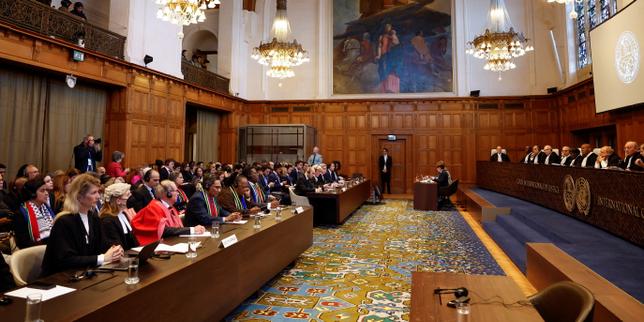
Lawyers love paper. They love the rustle of dossiers and the hushed, climate-controlled dignity of the Peace Palace. The current media obsession with the pile-up of interventions at the International Court of Justice (ICJ) regarding Gaza is a symptom of a grand delusion: the belief that adding more signatures to a legal brief changes the kinetic reality of a high-intensity urban conflict.
The "lazy consensus" suggests that a "battle of interventions" is taking place. It isn't. A battle involves a struggle for a definitive objective. What we are seeing in The Hague is a massive, multi-state virtue signaling exercise that weaponizes international law to cover for a lack of actual diplomatic or military leverage.
The Intervention Myth
The standard narrative claims that when countries like Germany, Nicaragua, or Colombia file "declarations of intervention" under Articles 62 or 63 of the ICJ Statute, they are significantly tipping the scales of justice.
This is structurally impossible.
The ICJ is not a criminal court. It does not issue arrest warrants for soldiers on the ground. It does not have a police force to enforce a ceasefire. It is a court of states, and its power is purely consensual. When South Africa initiated proceedings against Israel under the Genocide Convention, it wasn't a "legal masterstroke" to solve a humanitarian crisis. It was a strategic choice to use the only available forum where a state could be forced to answer for its actions in a public, adversarial setting.
Adding twenty more countries to the list of intervenors doesn't make the case twenty times stronger. It makes it twenty times slower.
The Sovereignty Trap
Imagine a scenario where every single member of the United Nations (UN) intervenes in a case.
According to the logic of the "battle of interventions," this would create an "unstoppable legal force." In reality, it would create a procedural nightmare that would delay a final judgment for a decade. The ICJ must rule on the admissibility of each intervention. It must allow the original parties to respond to each intervenor's claims.
Every state that jumps on the Hague bandwagon is actually slowing down the delivery of any meaningful legal clarity. This isn't a battle; it's a traffic jam.
The Flawed Premise of "International Law"
The media loves to ask, "Will the ICJ stop the war?"
This is the wrong question. It assumes that international law is a superior, external force that governs the behavior of nations like physics governs the behavior of planets.
It doesn't.
International law is a set of voluntary agreements. If a state believes its existential survival is at stake, it will ignore a court order from The Hague as easily as you ignore a terms-of-service update on a social media app.
- The Reality Check: In 2022, the ICJ ordered Russia to immediately suspend its military operations in Ukraine. Russia didn't. The war continued.
- The Hard Truth: The ICJ is a theater of diplomacy, not a theater of war.
The Intervention as a Proxy for Action
The "battle of interventions" is a way for states to look busy without actually doing anything.
It is far easier for a government to send a team of elite lawyers to The Hague than it is to cut off trade, impose sanctions, or provide meaningful humanitarian aid in a conflict zone. An intervention is a low-cost, high-visibility move. It allows a state to claim it is "fighting for justice" while its actual foreign policy remains stagnant.
Germany intervenes to "defend the legal order." Nicaragua intervenes to "protect the convention." They are not intervening for Gaza. They are intervening for themselves, for their own internal politics, and for their own standing in a shifting global order.
The Professional Legal Class's Delusion
I’ve seen legal teams spend millions on these filings. They obsess over the nuance of "intent" versus "conduct." They argue over the exact definition of a "protected group" under the 1948 Genocide Convention.
While they argue about the definition of $G$, where $G$ represents the specific intent to destroy a group, the $X$ and $Y$ of real-world casualties continue to climb.
$$G \neq \text{Action}$$
The legal process is a lagging indicator. It looks at what happened yesterday and tries to fit it into a framework designed eighty years ago. It is not a tool for real-time crisis management.
Why the Current Narrative is Toxic
By focusing on the "battle of interventions," we are training the public to believe that the solution to complex, multi-generational geopolitical conflicts can be found in a legal brief.
This is a dangerous lie.
It devalues the role of actual diplomacy, negotiation, and the hard work of building a sustainable peace. If you think a 50-page filing from the Maldives is going to change the mind of a commander on the ground in Rafah, you aren't paying attention.
Stop Watching the Courtroom
If you want to understand the trajectory of the Gaza conflict, look at the supply chains. Look at the energy corridors. Look at the shifting alliances in the Middle East.
The filings in The Hague are just noise. They are the background radiation of a dying international order that still thinks it can litigate its way out of a fire.
The real "battle" isn't happening in the Peace Palace. It’s happening in the halls of power where the real decisions about weapons, fuel, and food are made. Everything else is just a performance for the cameras.
Lawyers may have the last word, but they never have the first.