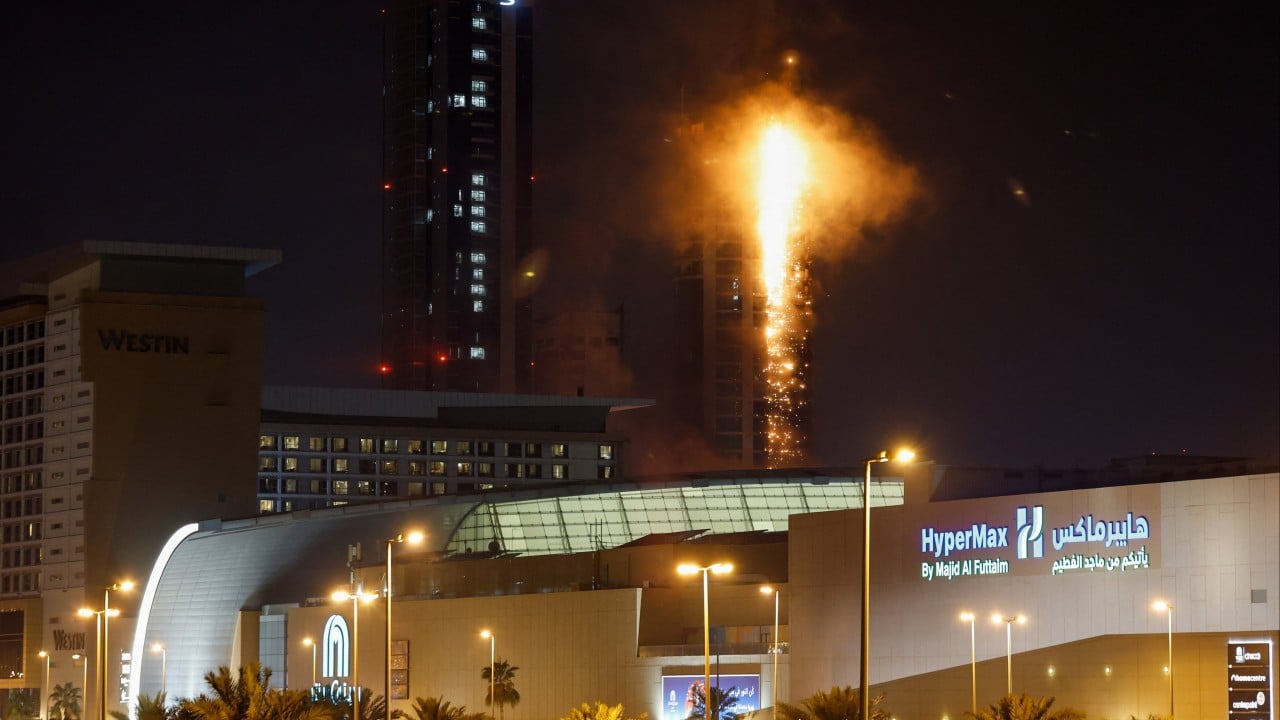
The headlines are screaming about a regional apocalypse. Analysts are dusting off maps of the Strait of Hormuz, tracing red lines from Iranian silos to Emirati desalination plants. They call it the "internationalisation of the battlefield." They claim the Gulf is now a shooting gallery where every billion-dollar glass tower in Dubai is a sitting duck for a cheap Fateh-110.
They are wrong.
The consensus view treats Iranian missile strategy as a binary toggle between "peace" and "total war." This is a fundamental misunderstanding of how asymmetric power functions in the 21st century. The threat isn't that Iran will level the Gulf; it's that they have successfully turned the threat of doing so into a permanent, low-cost psychological tax on global capital.
If you think Tehran wants to turn Riyadh or Abu Dhabi into a smoking crater, you haven't been paying attention to the math. They don't need a hot war. They need the theatre of one.
The Logistics of the Empty Threat
Let’s talk about the hardware. The West obsesses over the range and accuracy of the Haj Qasem or the Kheibar Shekan. We see 1,450km ranges and solid-fuel engines and panic. But military capability is not military intent.
Iran’s missile program is the ultimate "fleet in being." In naval theory, a fleet in being stays in port to exert influence without ever firing a shot. By merely existing, it forces the enemy to divert resources, change shipping routes, and pay massive insurance premiums.
The moment Iran actually launches a saturation strike on a major Gulf city, the game is over. Not for the Gulf, but for the Iranian regime. They lose their only leverage.
- Economic Suicide: If the oil stops flowing, the global response isn't a diplomatic wrist-slap. It’s the total kinetic dismantling of every Iranian refinery and port. The IRGC knows this.
- The Shield vs. The Sword: We hear about "the Gulf in the firing line," but we ignore the astronomical cost of the defense. Every time a $20,000 drone or a $100,000 short-range missile forces the activation of a $3 million Patriot interceptor, Iran wins a financial skirmish.
The "internationalisation" the media fears is already here—not as a rain of fire, but as a permanent state of high-cost readiness that drains Western and Gulf coffers while Iran spends pennies on the dollar.
Dismantling the People Also Ask Nonsense
The questions being asked in briefings and search engines show how deep the delusion goes.
"Can Iran shut down the Strait of Hormuz?"
Yes, for about forty-eight hours. Then the combined naval power of every nation that likes having electricity would turn the Iranian navy into a reef. Shutting the Strait is an act of desperation, not a strategic move. The real move is making everyone think you might do it on a Tuesday.
"Are Gulf states defenseless against Iranian missiles?"
Hardly. Between THAAD, Patriot PAC-3, and the integration of Israeli-made sensors, the Gulf is the most heavily defended airspace on earth. The "firing line" isn't a slaughterhouse; it's a testing ground. The real vulnerability isn't the missiles hitting a target; it's the market panic that happens five minutes after the launch.
The Asymmetry of Anxiety
I’ve spent years watching how markets react to Middle Eastern kinetic events. The pattern is always the same. A missile is fired. Brent crude jumps. The media runs a map with scary red circles. Then, forty-eight hours later, the price corrects because the "catastrophe" was just another calibrated signal.
Iran isn't trying to win a war; they are trying to manage a siege.
By "internationalising" the battlefield, they aren't looking for more enemies. They are looking for more stakeholders. If the UAE and Saudi Arabia feel the heat, they pressure Washington to de-escalate. That is the nuance the "retaliatory missiles" articles miss. The missiles are diplomatic tools that happen to have warheads attached.
The Precision Trap
We are told that Iranian precision-guided munitions (PGMs) change everything because they can now hit specific valves on a gas plant.
True. But consider the counter-intuitive reality: High precision makes war less likely, not more.
In the old days of "dumb" scuds, a launch was an erratic, desperate act. Today, Iran can put a missile through a specific window. This gives them the ability to "message" with surgical strikes—hitting an empty warehouse or a specific patch of desert—to show they could have hit the palace.
This is "kinetic diplomacy." It’s a high-stakes poker game where the cards are ballistic trajectories. The goal isn't to kill the opponent; it's to make him fold his hand and leave the table.
Stop Preparing for the Wrong War
The obsession with a "Great Gulf War" ignores the reality of the "Grey Zone War."
While analysts wait for a barrage of 1,000 missiles, they are missing the cyber-attacks on desalination plants, the harassment of tankers by small fast-attack craft, and the proxy pressure in Yemen and Iraq.
The "firing line" is a distraction.
If you are a business leader or a policy maker, quit looking at the missile silos. Look at the insurance rates. Look at the maritime chokepoints. Look at the way regional players are quietly hedging their bets and talking to Tehran behind closed doors.
The missiles don't have to fly to be effective. They just have to be visible on satellite imagery.
The Gulf isn't in the firing line; it's in the middle of a masterclass in coercive leverage. If you're waiting for the "big one," you’ve already lost the actual conflict happening right under your nose.
Build better bunkers if it makes you feel safe, but realize the real war is being fought in the spread of your credit default swaps.
Stop checking the radar and start checking the ledger.


