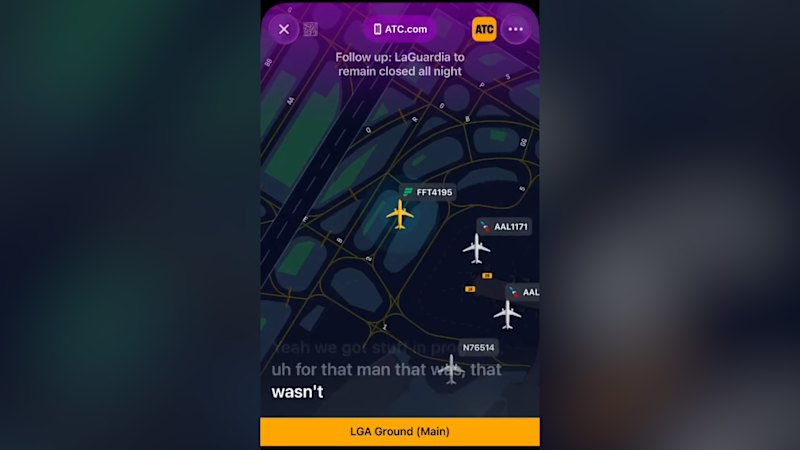
The headlines are predictable. A wingtip clipped at LaGuardia. A harrowing "near miss" at Newark. The media acts as if these are tremors preceding a tectonic shift into chaos. They scream for "modernization" and "overhaul." They treat the Federal Aviation Administration (FAA) like a failing tech startup that just needs a fresh round of funding and a better UI to stop planes from bumping into each other.
They are dead wrong.
The push for a total overhaul of the Air Traffic Control (ATC) system is not the solution. It is the hazard. By obsessing over "seamless" automation and digital oversight, we are stripping away the last vestige of safety that actually works: human friction. We have become so terrified of a 10-foot error on a taxiway that we are building a system fragile enough to cause a mid-air catastrophe.
The Myth of the "Near Miss"
Every time two planes get within a mile of each other, the press calls it a "near miss." In reality, these are usually "near successes." The system worked. The alarms blared, the pilots reacted, or the controllers stepped in.
The "lazy consensus" suggests that these incidents are proof of a crumbling infrastructure. In truth, they are the byproduct of a system being pushed to its absolute physical limits by consumer demand. You want $49 flights to Orlando? You get a sky packed so tight that the margin for error is measured in seconds.
We are told that NextGen—the FAA’s multi-billion dollar modernization plan—will fix this by moving from ground-based radar to satellite-based GPS tracking ($ADS-B$). It sounds logical. Radar is old; satellites are new. But here is the nuance the "tech-will-save-us" crowd ignores: GPS is a single point of failure. If you jam a ground-based radar, you lose one site. If you spoof or degrade GPS signals—something we are seeing with alarming frequency in Eastern Europe and the Middle East—you blind the entire "modern" fleet.
Stop Trying to "Fix" the FAA
The calls for privatizing ATC or "overhauling" the bureaucracy miss the fundamental nature of high-reliability organizations. The FAA is slow because it has to be. In software, you "move fast and break things." In aviation, when you break things, people die in 4K resolution.
The current system relies on a concept called Functional Redundancy. It’s messy. It involves humans talking over radio frequencies that sound like they’re from 1940. It involves "strips" of paper. Modernists hate this. They want sleek tablets and automated handoffs.
But paper doesn't have a software bug. A radio frequency doesn't experience a "server timeout." When you replace these "clunky" methods with a unified digital architecture, you create a systemic risk. You move from "isolated incidents" to "system-wide blackouts." We saw a preview of this with the NOTAM (Notice to Air Missions) failure in 2023. One corrupted file grounded the entire country. That is the "modernization" you are rooting for.
The Pilot Shortage is a Quality Crisis
The competitor article likely moans about the "controller shortage" and "pilot fatigue." This is a surface-level observation. The real crisis is the Automation Paradox.
As we make the ATC system more "advanced," we make the humans operating it less capable. When the computer does 99% of the work, the human brain drifts into a low-arousal state. When that 1% emergency happens, the controller or pilot is no longer "in the loop." They are a spectator trying to jump into a moving car.
I have spent years watching flight decks transition from active navigation to "mode monitoring." We are training a generation of pilots who are world-class at clicking a mouse but would struggle to fly a raw-data approach in a crosswind. By "overhauling" the ATC system to be more automated, we are accelerating this rot. We are building a system that requires a God-like level of perfection from the software because the humans have been relegated to "monitor" status.
The False Idol of Efficiency
The Newark and LaGuardia incidents are symptoms of Complexity Bottlenecks.
The industry wants to increase "throughput." That is the buzzword for "stuffing more aluminum into the same amount of air." To do this, you have to reduce separation standards. You go from 3 miles of separation to 2.5 miles. You use "wake turbulence recategorization" to launch planes faster.
We are told this is "data-driven efficiency." In reality, it is the erosion of the Safety Buffer. Every time we "modernize," we use the new precision to justify narrower margins. If a GPS can track a plane to within 3 meters, the logic goes, why do we need a mile of space?
This is a gambler's logic. It assumes the technology will always work at 100% capacity. It leaves zero room for the "Black Swan"—the bird strike, the burst tire, the sudden microburst. We are trading our safety margin for five minutes of reduced taxi time. It is a bad trade.
The Contradiction of Safety Culture
We claim to have a "Just Culture" in aviation, where people can report mistakes without fear. But the moment a wingtip touches, the pitchforks come out. This creates a hidden danger: Selective Reporting.
Controllers are terrified of the "modern" system because every move they make is now digitally recorded and analyzed by an algorithm. If they deviate from a "standard profile" to ensure safety, they get flagged for a "quality assurance" review. This leads to "compliance-based safety" rather than "risk-based safety." They follow the book to save their jobs, even when their gut tells them a collision is brewing.
The Newark "near miss" wasn't a failure of technology; it was likely a success of a human being breaking "standard procedure" to prevent a disaster. But the "overhaul" advocates want to remove that human agency. They want a "seamless" system where the computer handles the conflict.
Imagine a scenario where a software logic error—similar to the $MCAS$ issue on the Boeing 737 MAX—is baked into the ATC ground-control logic. If that system decides two planes are safe when they aren't, there is no one left to say "No."
How to Actually Fix Aviation
If you want to stop the "near misses," you don't buy more satellites. You do the one thing the airlines and the government refuse to discuss: Reduce the Load.
- Mandatory Minimum Separation Increases: Stop trying to squeeze 60 landings an hour out of a runway designed for 40.
- Analog Backups: Mandate that every "modernized" facility maintains a fully functional, staffed analog backup system that is used for one shift every week. Use it or lose it.
- Human-Centric Design: Stop building interfaces that "simplify" the sky. Controllers need to feel the complexity. They need to be active participants, not "system overseers."
- End the Growth Fetish: We have reached "Peak Sky." The obsession with year-over-year passenger growth is incompatible with 100% safety.
The industry is lying to you. They are telling you that "innovation" will make you safer. In reality, they are using innovation to make the system more profitable while masking the fact that the safety buffer is thinner than it has ever been.
The next time you hear about a "near miss," don't pray for a new ATC system. Pray that there was a grumpy, old-school controller in the chair who was willing to ignore his computer screen and look out the window.
The "clunky" past isn't our problem. The "seamless" future is.
Stop looking for more tech. Start looking for more friction.
Would you like me to analyze the specific technical failure points of the $ADS-B$ transition compared to traditional $SSR$ (Secondary Surveillance Radar)?