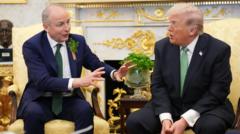
The air inside the Oval Office carries a specific, heavy stillness. It is the scent of old floor wax, expensive stationary, and the crushing weight of global consequence. For an Irish Taoiseach, this room represents the ultimate high-wire act. Every March, the leader of a small island nation of five million people walks into the most powerful office on earth, armed with nothing but a bowl of shamrocks and a century of soft power.
But this particular meeting was different. The shamrocks weren't just a gift. They were a shield.
Leo Varadkar did not just walk into a meeting with Donald Trump; he walked into a political minefield where the grass was literal and the stakes were existential. To the casual observer, the St. Patrick’s Day visit is a quaint tradition of green ties and forced smiles. To the diplomat, it is a brutal exercise in survival. Ireland’s economy is a delicate ecosystem built on the presence of American tech giants. One wrong word, one slip of the tongue regarding trade or taxes, and the foundation of Irish prosperity could tremble.
The tension was visible in the way the sunlight hit the gold curtains. Trump, a man who views the world through the lens of leverage and dominance, sat across from a leader who represents a country that survives on cooperation and European integration. They are two different languages trying to find a common syntax.
The Geography of a Handshake
Consider the mechanics of the room. When the Taoiseach sits in that yellow armchair, he isn't just representing a government. He is representing the thousands of Irish families whose mortgages are paid by Google and Apple. He is representing the undocumented Irish in Queens and South Boston who live in the shadows, hoping for a legislative miracle that never seems to come.
Varadkar’s task was to navigate a president who had spent months railing against the very multilateralism that Ireland calls home. The "bruises" mentioned by critics weren't physical, but they were no less real. They were the potential for a public snub, a tweet that could devalue a currency, or a policy shift that could bring the hammer down on the "Double Irish" tax structures that fueled Dublin’s cranes and glass skyscrapers.
The Irish leader had to be a ghost. He had to be present enough to honor the diaspora but invisible enough to avoid becoming a target for the President’s populist ire. It is a peculiar kind of Irish magic: the ability to be in the room with a giant without being stepped on.
The Ghost at the Banquet
Away from the cameras, the real conversations happen in the hallways. Imagine a hypothetical junior diplomat, let's call him Sean, standing near the Roosevelt Room. Sean’s job isn't to talk; it’s to listen for the tone. Is the President bored? Is he agitated? Does he mention the border in Northern Ireland?
For Ireland, the border is not a line on a map. It is a scar that is only partially healed. When Trump spoke of walls and hard boundaries, he touched a nerve that vibrates through every village from Derry to Cork. Varadkar had to explain the complexity of the Good Friday Agreement to a man who prefers the simplicity of a "deal."
The difficulty lies in the fact that you cannot "win" a conversation with a superpower. You can only manage the loss. Every diplomatic win for Ireland in Washington is actually just the absence of a catastrophe. Success is defined by the plane ride home where nothing has changed. In the world of high-stakes geopolitics, "no news" is the greatest victory a small nation can claim.
The Currency of Sentiment
We often think of international relations as a series of spreadsheets and treaties. It isn't. It is a series of stories. The reason the Irish PM gets this annual audience—while leaders of much larger nations wait years for a phone call—is because of the narrative of the Irish-American identity.
It is a story of famine, ships, police officers, and poets. This sentiment is the only currency the Taoiseach has to spend in the Oval Office. But sentiment is a volatile market. If the Irish leader pushes too hard on liberal values or climate change, he risks devaluing that currency with a conservative administration. If he stays too silent, he faces a revolt from the voters back home who want him to "speak truth to power."
It is a lonely position.
Varadkar chose a path of calculated politeness. He spoke of the economic ties that go both ways. He reminded the room that Irish companies employ thousands of Americans in the Rust Belt. He reframed the relationship not as a small country begging for crumbs, but as a partnership of mutual benefit. He leaned into the one thing Donald Trump respects: a balance sheet.
The Silence of the Shamrock
The cameras flashed, the bowl of green clover was exchanged, and the doors closed. The media looked for the "bruises"—the expected clash over trade or the expected lecture on immigration. But they didn't find them. Varadkar had performed a vanishing act. He had navigated the ego of the presidency without sacrificing the dignity of his office.
Critics might call it dodging. They might say he should have been louder, more defiant, more "Irish" in the rebellious sense of the word. But those critics don't have to worry about the corporate tax rate or the peace process in the North. They don't have to carry the hopes of the undocumented into a room where the walls are literally closing in.
As the motorcade pulled away from 1600 Pennsylvania Avenue, the tension in the Irish delegation didn't disappear; it just shifted. The bruises were avoided, but the pressure remains. It is the permanent condition of the small state: to be eternally grateful for the seat at the table, while always checking to see if there is a knife under the tablecloth.
The shamrocks will wilt by the end of the week. The green ties will be put back in the closet. But the memory of that stillness in the Oval Office lingers—a reminder that in the game of giants, the most powerful thing you can be is the person they don't see as an enemy.
The jet climbed over the Atlantic, heading back toward the gray-blue mists of Dublin. Below, the ocean remained indifferent to the handshakes and the headlines, a vast expanse separating two worlds that are destined to be forever linked by blood, money, and the desperate need to keep the peace.
The lights of the White House faded into the distance. The Taoiseach leaned back in his seat, the silence of the cabin a sharp contrast to the roar of the Washington press corps. He had survived another March. The bridge was still standing, even if the wind was picking up.
In the end, diplomacy isn't about the grand gesture. It is about the quiet art of remaining relevant in a world that is constantly looking for someone to forget.