The canopy of the Colombian Amazon does not look like a forest from the air. It looks like an ocean of broccoli, frozen in a mid-growth explosion, stretching until the curve of the earth swallows the emerald light. It is beautiful. It is also a tomb. When the engine of a Cessna 206 fails over this terrain, the pilot doesn't have a runway. They have a choice: die in the air or vanish into the green.
On a Tuesday that began like any other humid morning in Araracuara, seven people boarded a flight destined for San José del Guaviare. They were mothers, children, and pilots. They were people with lives rooted in the red dirt of the rainforest. Then, the silence began. Not the peaceful silence of a siesta, but the heavy, suffocating silence of a radio frequency that suddenly goes dead.
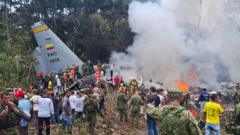
The wreckage was eventually found, a jagged splinter of white metal nose-down in the mud, but the math didn't add up. Sixty-six people have died in similar aviation incidents across these provinces in recent years—a staggering statistic that turns every bush flight into a game of aerial roulette. But in this specific crash, the rescuers found three bodies.
Four were missing. Four children.
The eldest was thirteen. The youngest was an infant, barely eleven months old, a tiny soul who had spent more time in a cradle than on solid ground. In the logic of the modern world, they should have been dead. In the logic of the jungle, they were simply transitioning from one home to another.
The Invisible Stakes of the Understory
To understand why this matters, you have to stop thinking like a tourist and start thinking like a survivor. When the plane clipped the trees, it didn't just drop; it was swallowed. The search crews—a desperate alliance of elite Colombian Special Forces and indigenous trackers—weren't just looking for a crash site. They were looking for ghosts.
They found a hair tie. Then, a small pair of scissors. Later, a half-eaten fruit that bore the distinct marks of human teeth.
These aren't just "facts." They are the breadcrumbs of a miracle fueled by terror. Consider the psychological weight on a thirteen-year-old girl, Lesly, suddenly responsible for three younger siblings in a place where every leaf can be poisonous and every shadow might have teeth. This is the ultimate human-centric narrative: a child forced to become a god of her own small, shivering tribe.
The jungle at night is not dark. It is a kaleidoscope of predatory eyes and bioluminescent fungus. It screams with the sound of cicadas and the territorial roars of howler monkeys. To a city dweller, this is a nightmare. To the Huitoto children, it was a library. They knew which seeds were edible because their grandmother had told them stories about the forest's mercy. They knew how to build a shelter out of palm fronds because it was woven into their DNA.
The Cost of the Green Wall
We often talk about the Amazon as the "lungs of the planet," a phrase so overused it has lost all meaning. But for the people living in the Guaviare and Caquetá departments, the Amazon is a wall. There are no highways. There are no trains. If you need medicine, if you need to see family, if you need to escape the lingering shadows of guerrilla conflict, you fly.
You fly in planes held together by prayers and old bolts.
The death of sixty-six people in these corridors isn't just a series of "accidents." It is a systemic failure of infrastructure that forces the most vulnerable people into the most dangerous skies. When we see the headlines about the search for the four missing soldiers of the forest, we are seeing the tip of a very dark iceberg. The "invisible stakes" are the thousands of indigenous people who risk their lives every single day just to reach a doctor or a market.
The search itself became a collision of two worlds. On one side, you had the military, equipped with thermal imaging, high-tech drones, and satellite mapping. On the other, you had the indigenous elders, who burned tobacco and spoke to the spirits of the trees, asking for the children to be released.
One group looked for heat signatures. The other looked for permission.
The Geometry of Hope
Imagine the fatigue.
The soldiers hiked through mud that reached their knees, battling trench foot and swarms of insects that look for any patch of exposed skin. They broadcast a recording of the children’s grandmother from helicopters, her voice booming over the trees: "Stay still. Don't move. We are looking for you."
Can you feel the vibration of that voice in the humid air? A grandmother’s plea, amplified by the machinery of war, searching for a baby in a million acres of thorns.
The rescuers found footprints. Tiny, bare impressions in the soft earth. They were moving. The children weren't waiting to be saved; they were navigating. They were walking away from the death of the plane and toward the life of the river.
This is where the standard news reports fail us. They focus on the "search for four missing," as if they are inanimate objects lost in a warehouse. But these were active protagonists. The thirteen-year-old was practicing a form of leadership that most CEOs couldn't imagine under the best conditions. She was rationing flour salvaged from the wreck. She was findind clean water. She was keeping a baby quiet in the territory of the jaguar.
The Long Shadow of the Search
As the days turned into weeks, the hope began to sour. The "standard" survival window for a plane crash is seventy-two hours. After forty days, the narrative usually shifts from rescue to recovery. The forest is a fast recycler. It breaks down bodies and metal with equal indifference.
But the trackers didn't stop. They found a small footprint next to the print of a dog—Wilson, a Belgian Malinois search dog who had gone missing from his handler. The dog had found the children. For a brief moment in the heart of the darkness, a discarded military dog and four lost children formed a pack.
It is a story that feels like a fable, yet it is etched in the dirt of the Caquetá.
When they were finally found—gaunt, dehydrated, and covered in insect bites—they weren't crying. They were tired. They were four small figures sitting in a clearing, having survived an ordeal that would have broken most adults in forty-eight hours.
The tragedy is the sixty-six who didn't make it. The miracle is the four who did.
The real story isn't about a plane crash. It’s about the resilience of a culture that understands the earth better than we understand our own phones. It’s about the fact that we have built a world where a mother has to board a deathtrap Cessna just to get her children to safety, only to have the sky drop her into the mouth of the wild.
The forest has closed back over the site of the wreck. The vines are already wrapping around the rusted fuselage. Soon, you won't be able to see it from the air at all. But for those four children, the green silence will never be silent again. It will always carry the echo of their grandmother's voice, the hum of a failing engine, and the heavy, rhythmic breathing of a jungle that tried to keep them, but ultimately let them go.
Wilson, the dog, was never found. He remains there, a ghost in the undergrowth, a reminder that in the Amazon, every rescue requires a sacrifice.