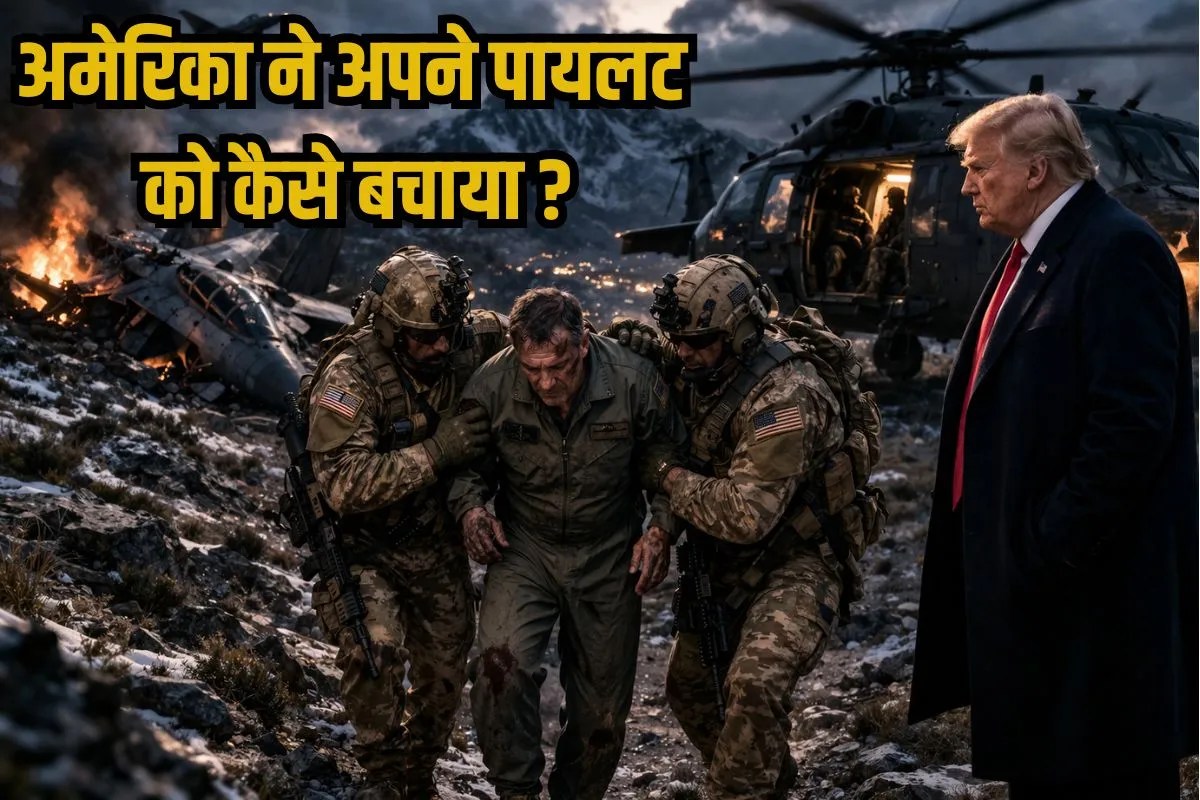
Military history is written by the victors, but it’s edited by the public relations departments of the intelligence community. The narrative surrounding the rescue of American pilots or personnel from hostile Iranian territory is usually served as a high-stakes thriller involving stealth, precision, and the inevitable triumph of Western technology. The truth is uglier. Most of these "miracle" extractions are actually the result of massive diplomatic payoffs, intelligence failures that forced the rescue in the first place, and a desperate attempt to salvage a PR disaster before it hits the news cycle.
We are told that these operations are surgical. We are led to believe that a few Tier 1 operators and a low-frequency helicopter can bypass the entire integrated air defense system of a sovereign nation like Iran. This is a fairy tale. When an extraction happens, it isn’t just because of a night-vision-clad hero. It’s because a massive, invisible machine of back-channel bribes, geopolitical horse-trading, and "unintended" sanctions relief paved the way.
The Logistics of Failure
The common misconception is that the "Action Plan" starts when the boots hit the ground. Real insiders know the action plan started months prior, usually when the pilot was sent into a mission with outdated electronic warfare suites or restrictive rules of engagement.
Take the classic rescue blueprint. You’ve got the extraction platform—usually a modified MH-53 or an MH-60M Black Hawk. These machines are incredible, but they aren't magic. In the high-altitude, hot-climate terrain of the Iranian plateau, physics is a brutal adversary. Air density drops. Lift becomes a luxury. Every pound of extra fuel or armor becomes a liability.
When the public hears "Operation Detail," they think of the fast-roping. They don't think about the Density Altitude calculations that determine whether that bird can even clear a ridgeline.
$$DA = HP + [1.25 \times (OAT - ISA)] + (Pressure \space Factor)$$
If the math doesn't check out, the mission is a suicide pact. The "heroism" often hides the fact that the planners were gambling with a 10% margin of error on fuel and weight. We call it "boldness" when it works and "tragedy" when the rotors clip a sand dune.
The Myth of Stealth vs. The Reality of Noise
The media loves the word "stealth." In reality, there is no such thing as a silent helicopter. You can mask the infrared signature. You can shape the blades to change the acoustic frequency. But you cannot move five tons of metal through the air without vibrating every window within a three-mile radius.
The "success" of these rescues often hinges on the incompetence of the adversary rather than the invisibility of the rescuer. Iran’s radar coverage is notoriously spotty in the mountainous regions, a fact that planners exploit ruthlessly. But calling it "stealth technology" is a lie. It’s "topographical masking." You fly in the dirt, hugging the terrain so closely that the radar can't distinguish your $100 million aircraft from a goat on a hillside.
I have seen missions scrapped because a single shepherd was in the wrong place at the wrong time. If he has a cell phone, your "stealth" operation is over. The reliance on high-tech gadgets has made us forget that the most effective early warning system in the world is still a human being with eyes and a radio.
Intelligence is an Oxymoron
The biggest lie in the competitor's breakdown is the idea of "Perfect Intelligence." They want you to believe we knew exactly which room the pilot was in.
Intelligence is never a photograph; it’s a mosaic where 40% of the pieces are missing and 20% are from a different puzzle. Every rescue operation is a calculated "guess." We use SIGINT (Signals Intelligence) to track cell phone pings and MASINT (Measurement and Signature Intelligence) to detect the specific electronic footprint of Iranian guard units.
But when you actually go in? You’re flying blind. You are betting that the "reliable source" isn't a double agent looking for a payout or that the target hasn't been moved in the six hours it took to get the "Go" order from the White House. The "Action Plan" is actually a series of "What If" scenarios that usually end in "shoot your way out."
The Financial Cost of "Priceless" Lives
Let’s talk about the money. Not the cost of the fuel, but the cost of the silence.
Whenever a pilot is "rescued" from a country like Iran without a massive firelight, you should be looking at the international banking records. Check the frozen assets. Look at the "humanitarian" aid packages announced three weeks later.
Extraction is rarely a purely military event. It is a choreographed theatrical performance designed to allow both sides to save face. The US gets its hero back. Iran gets a quiet infusion of cash or a lifting of a specific trade restriction. The public gets a feel-good story. The only thing that actually happened was a transaction.
Stop Asking "How" and Start Asking "Why"
The competitor article focuses on the "how"—the gear, the planes, the bravery. That’s the wrong question. The right question is: Why was the pilot there in the first place, and why was the rescue the only option left?
We have become obsessed with the tactical at the expense of the strategic. We celebrate the "rescue" because it distracts us from the strategic failure that led to the capture. If your foreign policy requires constant, high-risk Special Operations to retrieve personnel, your foreign policy is broken.
Relying on the "Action Plan" is a sign of weakness, not strength. It means your primary deterrents failed. It means your diplomatic levers snapped. It means you are now playing a high-stakes game of chicken with a $50 million airframe and the lives of twenty Rangers.
The Fallacy of the Surgical Strike
The term "surgical" implies cleanliness. There is nothing clean about a rescue in hostile territory.
When you trigger a rescue, you are essentially initiating a small-scale invasion. You are violating sovereign airspace. You are likely killing local conscripts who were just standing guard. You are creating a geopolitical ripple effect that lasts decades.
We use these terms to sanitize the violence. We call it "extraction" instead of "armed kidnapping." We call it "neutralizing threats" instead of "killing the locals who noticed us."
If you want to understand the "Operation Detail," stop looking at the night vision footage. Look at the debris left behind. Look at the burned-out shells of the equipment we had to thermite because it broke down. Look at the diplomatic cables that follow the "rescue."
The Actionable Truth
If you are a student of military history or a tech enthusiast, stop buying the "Action Plan" hype. Here is how you actually evaluate a rescue operation:
- The Time Lag: If the rescue happened more than 48 hours after capture, it wasn't a "raid." It was a negotiated release with a tactical escort.
- The Gear Abandoned: If the team leaves behind sensitive tech (like the tail rotor in the Bin Laden raid), they were panicked, not surgical.
- The Follow-up Sanctions: If sanctions are eased within 90 days, the pilot was bought, not saved.
Special Operations are the ultimate "break glass in case of emergency" tool. But when the government starts using that tool for every minor mishap, the tool gets blunt. We are currently in an era of "Rescue Inflation," where every minor extraction is turned into a Hollywood script to justify bloated defense budgets and hide the fact that our "cutting-edge" tech is often defeated by a $500 drone or a well-placed RPG.
The next time you read a breathless account of a pilot being "snatched from the jaws of the enemy," remember that the jaws were likely held open by a massive checkbook, and the "snatch" was a carefully timed walk to a waiting helicopter.
Reality isn't a movie. It's a ledger. And the US is currently paying a premium for the illusion of invincibility.
Stop worshiping the "Action Plan." Start questioning the necessity.