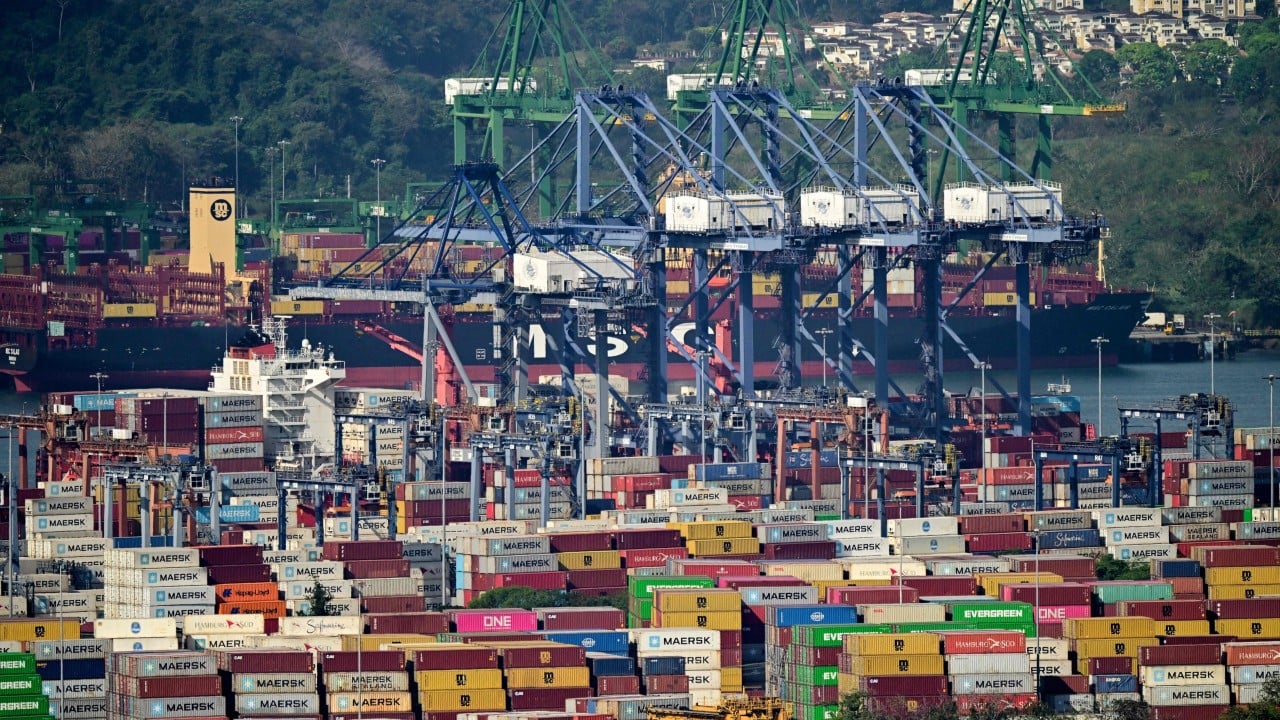
The narrative of Chinese retreat from the Panama Canal is a convenient fiction for Western headlines. While a US-led consortium led by BlackRock recently moved to claw back a 21-year concession at the ports of Balboa and Cristobal, the broader reality of global maritime logistics is far more surgical. Beijing is not retreating; it is diversifying.
A comprehensive analysis of global infrastructure data reveals that even as China faces a constitutional blockade in Panama, its state-backed firms are aggressively deploying US$23.9 billion into 363 seaports across the globe. This capital is not being scattered blindly. It is being injected into a highly specific "anti-decoupling" web designed to ensure that no single geopolitical flashpoint—including the Panama Canal—can ever again hold the Chinese supply chain hostage.
The Panama Mirage
The recent ruling by the Panamanian Supreme Court to void the contract of CK Hutchison’s subsidiary was touted as a "reclaiming" of the canal. For the Trump administration, it served as a symbolic victory in a region where Washington’s influence had long been ebbing. However, viewing the Panama exit as a defeat for China is a fundamental misunderstanding of the long game played by Beijing’s "maritime silk road" strategists.
In reality, the Panama Canal has become a bottleneck of diminishing returns. Extreme droughts in the past two years have led to draft restrictions and slot auctions that saw transit fees spiral into the millions of dollars. For a nation that moves 95% of its international trade by sea, relying on a century-old ditch controlled by an increasingly hostile neighbor is no longer a viable risk.
By allowing the US-led consortium to take the heat in Panama, China has freed up capital to pivot toward more strategic, high-depth "greenfield" projects. The most significant of these is the Port of Chancay in Peru. Completed in late 2024 with a primary investment of over US$1.3 billion, Chancay is the first Chinese-controlled deep-water port on South America’s Pacific coast. It cuts shipping times to Shanghai by 20 days, effectively bypassing the need for North American transit points entirely.
The US$23.9 Billion Safeguard
The US$23.9 billion currently in play across global seaports represents a hard-nosed hedge against Western economic isolation. This investment isn't just about moving containers; it's about controlling the underlying architecture of global trade.
When a Chinese state-owned enterprise (SOE) like COSCO or China Merchants Port Holdings acquires a stake in a terminal, they aren't just buying concrete and cranes. They are securing:
- Logistics Sovereignty: The ability to prioritize Chinese vessels during periods of global congestion.
- Data Dominance: Implementation of LOGINK, a state-sponsored logistics management platform that provides granular visibility into the movement of goods, including those belonging to foreign militaries and competitors.
- Operational Integration: Deploying Chinese-made ZPMC cranes and automated terminal systems that ensure the hardware of global trade is inseparable from Chinese software.
The scale of this "Concrete Empire" is staggering. While the US focuses on individual chokepoints, Beijing has methodically built a network that spans the Strait of Malacca, the Suez Canal, and now the South Atlantic. These are not merely commercial ports; they are "dual-use" facilities. Under the 2017 National Defense Law, Chinese firms are required to support national intelligence and military logistics if called upon. A commercial dock in the Middle East or Africa can become a refueling station for the People's Liberation Army Navy (PLAN) with the stroke of a pen.
Weaponizing the Ledger
The mechanism of this expansion often relies on the "brownfield" acquisition model—buying into existing, struggling ports rather than building from scratch. This is where the US$23.9 billion does the most work. By providing liquidity to debt-strapped nations in the Global South, China gains long-term concessions that are virtually impossible to unwind without causing national bankruptcy.
Take the current situation in Sri Lanka or the expansion projects in West Africa. These aren't just infrastructure deals; they are fiscal anchors. When the United States or the EU attempts to counter with their own infrastructure initiatives, they find the "prime real estate" of the maritime world already leased out for 99 years.
The Myth of Neutrality
The Western financial world often views port investment through the lens of IRR (Internal Rate of Return). For Beijing, the return is measured in strategic depth. If a port in Greece or Germany operates at a loss for a decade, it is still considered a success if it secures a permanent gateway for Chinese EVs or semiconductors into the European heartland.
This fundamental difference in accounting is why the US-led "Build Back Better World" or the Global Gateway initiatives have struggled to keep pace. Private equity firms like BlackRock demand quarterly profits. COSCO answers to a five-year plan.
The Technological Chokepoint
Beyond the physical berths, the real battle for the world's seaports is being fought in the digital layer. The US$23.9 billion investment includes the rollout of 5G-enabled "Smart Ports."
In ports from Piraeus to Abu Dhabi, Chinese technology manages the flow of every TEU (Twenty-foot Equivalent Unit). This creates a massive information asymmetry. While the US might "control" the Panama Canal’s water, China increasingly controls the digital "brain" of the global shipping fleet. If a trade war escalates, the ability to "darken" a port’s digital infrastructure is a weapon as potent as any naval blockade.
A Fragmented Horizon
The exit from Panama is not a signal of weakness, but a recalibration. Beijing has recognized that the era of globalized, frictionless trade is over. We are moving into a world of "fortress trade," where supply chains are guarded by bilateral loyalties and physical ownership of the docks.
The US$23.9 billion is the price of admission for this new era. It buys a world where China is no longer a guest in the global commons, but the landlord of the routes that matter. The West may have won the battle for the canal, but they are losing the race for the horizon.
As Washington celebrates its legal victory in the Panamanian Supreme Court, the first mega-vessels are already docking at Chancay, unloading Chinese goods that will never see a US customs officer or a Panamanian pilot. The map of the world is being redrawn, not with ink, but with reinforced concrete and state-backed credit.
Watch the cranes. They tell the real story.