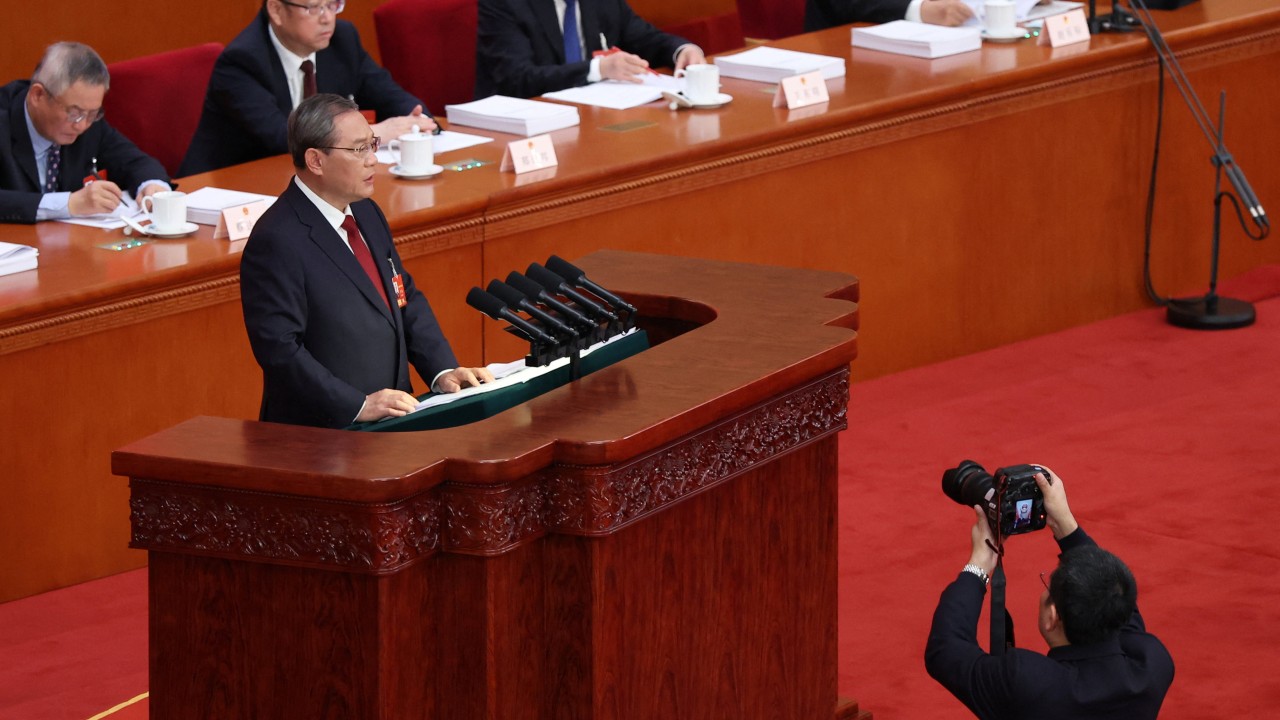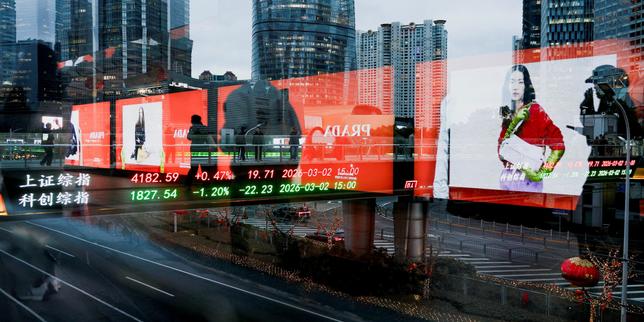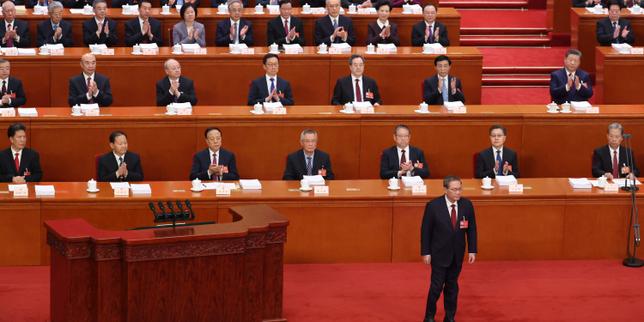
In a small, neon-lit noodle shop in the Haidian District of Beijing, a young software engineer named Chen stares at his phone. He isn't looking at social media. He is looking at his bank balance and then at a news notification about the National People’s Congress. For years, the narrative of his life followed a predictable upward arc: study hard, get a tech job, buy an apartment, contribute to the relentless growth of the world’s second-largest economy.
Now, the air feels different. It’s heavier.
The economic engine that hummed perfectly for four decades is sputtering, and the Chinese leadership knows it. They aren't just looking at the next fiscal quarter; they are sketching a blueprint for the next half-decade. It is a plan born of necessity, flavored with a dash of desperation and a massive dose of ambition. They call it "new quality productive forces." To Chen, it sounds like a lifeline. To the rest of the world, it represents a fundamental shift in how global power will be calculated in the 2030s.
The Ghost of Real Estate Past
For a long time, China built its way to prosperity. If you needed growth, you poured concrete. You built high-rises in cities most Westerners couldn't name. You paved highways that stretched into the horizon. This property-heavy model accounted for roughly a quarter of the country’s GDP.
But you can only build so many empty apartments before the floor drops out.
The crisis in the property sector hasn't just hurt developers like Evergrande; it has bruised the psyche of the Chinese middle class. When your wealth is tied up in bricks and mortar that are suddenly losing value, you stop spending. You stop buying the new car. You skip the weekend trip to Shanghai. You save every yuan because the future no longer looks like a guaranteed win.
This is the "uncertainty" the headlines mention. It’s not an abstract graph on a Bloomberg terminal. It is the silence in a shopping mall on a Saturday afternoon. To fix this, the leadership isn't reaching for the old concrete-and-steel playbook. They are pivoting toward something invisible, something microscopic, and something infinitely more complex.
The Silicon Salvation
Beijing’s new five-year vision is obsessed with "ultratechnology." This isn't about making better smartphones or faster delivery apps. It is about the foundational layers of the modern world: semiconductors, artificial intelligence, quantum computing, and green energy.
Consider the semiconductor. It is the oil of the 21st century. Without it, the modern world grinds to a halt. Currently, China finds itself squeezed by international export controls, blocked from the most advanced chips that power AI. The response? A massive, state-led "all-in" bet on self-reliance.
They are pouring billions into domestic laboratories. The goal is simple: ensure that no foreign power can flip a switch and turn off the Chinese economy.
This isn't just about defense. It’s about the next industrial revolution. By dominating the production of electric vehicle batteries, solar panels, and wind turbines, China aims to be the indispensable green lung of the global economy. They want to be the ones who sell the world the tools it needs to survive climate change.
If they succeed, the geopolitical map gets redrawn. If they fail, they are left with a lot of expensive, proprietary hardware that can't talk to the rest of the planet.
The Wallet in the Room
Technological dominance is only half the battle. You can build the most advanced AI in the world, but if your citizens are too scared to buy a cup of coffee, your economy will eventually starve.
This brings us back to Chen and his noodle shop.
The government is desperately trying to trigger a "consumption recovery." They want people to spend. But consumption is a matter of confidence. You don't spend when you are worried about your pension, your healthcare, or your child's education.
To turn the tide, the state is looking at ways to bolster the social safety net. They are talking about "silver economy" investments to care for a rapidly aging population and "urban renewal" that focuses on living quality rather than just building more towers.
The tension is palpable. The state wants to direct capital into high-tech manufacturing, but it also needs to put money into the pockets of everyday people. Balancing these two needs is like trying to tune a violin while a thunderstorm rages outside. If they lean too hard into tech, the people suffer. If they give too much in stimulus, they risk the kind of inflation and debt that has crippled other nations.
The Invisible Stakes
Why should a factory worker in Ohio or a designer in Milan care about a five-year plan from Beijing?
Because the world is a closed loop.
If China successfully transitions from a "world's factory" to a "world's laboratory," the cost of everything changes. The competition for talent will intensify. The standards for environmental technology will be set in Shenzhen, not Silicon Valley.
More importantly, if China fails to reignite domestic consumption, the global economy loses one of its biggest customers. A stagnant China means stagnant global growth. We are all, in a sense, sitting in that noodle shop with Chen, waiting to see if the balance hits the right note.
The plan is laid out. The targets are set. But maps are not the territory. The next five years won't be defined by the speeches given in the Great Hall of the People. They will be defined by whether a hundred million people like Chen decide to finally close their savings apps and start dreaming again.
The lights in the shop flicker, a small reminder of the vast, aging infrastructure that still underpins the digital dreams of a superpower. Chen finishes his bowl, pays with a flick of his wrist on a digital wallet, and walks out into the Beijing night. The air is cold, but the cranes are still moving. Only now, they are building data centers instead of luxury condos.
It is a gamble of historic proportions. The stakes aren't just trillions of dollars; they are the very definition of what a modern superpower looks like in an age of scarcity.