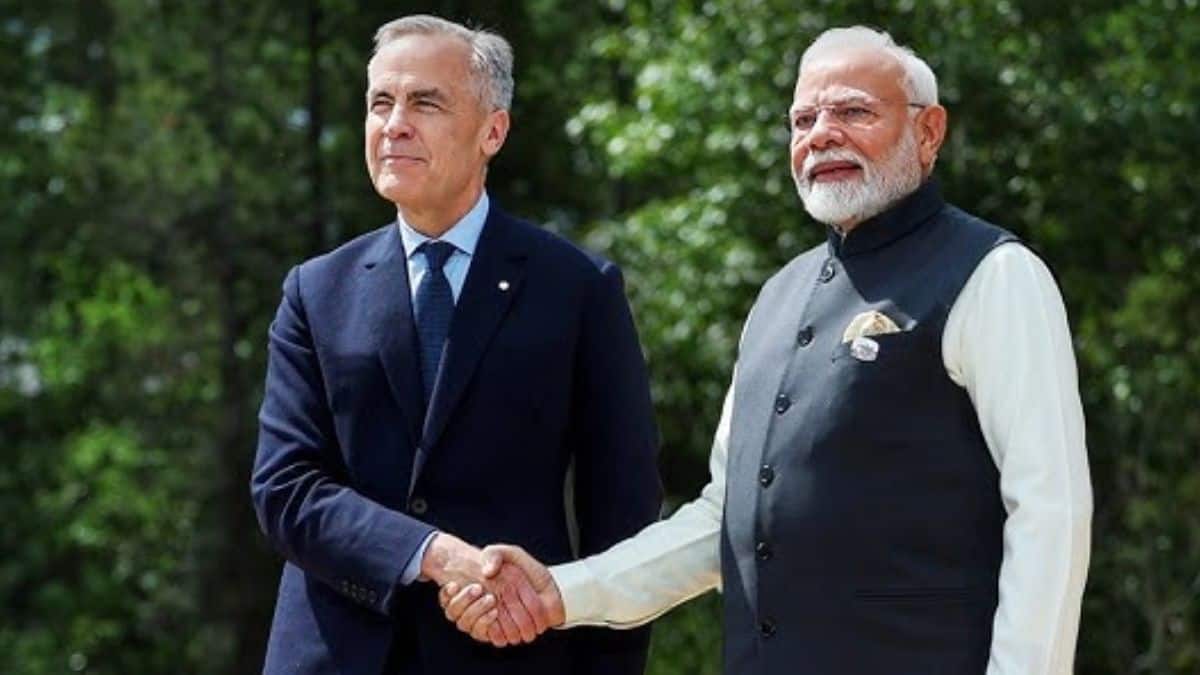
Mark Carney arrived in Mumbai on Friday not merely as a Prime Minister on a state visit, but as the liquidator of a failed foreign policy. His four-day mission to India represents the most aggressive diplomatic repair job in modern Canadian history, aimed at burying the ghost of Justin Trudeau’s "credible allegations" and securing the $2.8 billion uranium deal that Ottawa can no longer afford to lose. The stakes are higher than a simple trade reset. Canada is currently staring down the barrel of a trade war with a volatile Washington, and the math in Ottawa has changed: India is no longer an optional partner, but an existential necessity.
For two years, the relationship between the world’s most populous nation and the G7’s northernmost power was characterized by mutual contempt, expelled diplomats, and the total freezing of a Comprehensive Economic Partnership Agreement (CEPA) that had been in the works since 2010. The 2023 assassination of Hardeep Singh Nijjar in British Columbia, and the subsequent public accusations by the Trudeau government, didn't just strain ties; they shattered the institutional trust required for large-scale capital flows.
Carney’s presence in Mumbai’s boardrooms—meeting first with Tata Group Chairman Natarajan Chandrasekaran—signals that Canada is moving from a posture of moral lecturing to one of pragmatic survival.
The Trump Accelerator and the Middle Power Resistance
The timing of this pivot is not accidental. The "Trump Accelerator" is now the primary driver of Canadian foreign policy. With the United States threatening tariffs and weaponizing trade routes, Carney has spent the early months of 2026 crafting what he calls the "middle-powers resistance." The logic is cold and calculated. If Canada remains tethered exclusively to the American consumer, it remains a hostage to the whims of the White House.
By diversifying toward India, Australia, and Japan, Carney is attempting to insulate the Canadian economy from the shocks of a fractured North American trade bloc. This is a radical departure from the Trudeau era, which often prioritized diaspora politics and ideological alignment over raw economic interest. Carney, the former Governor of the Bank of England and the Bank of Canada, speaks the language of the "Maple 8"—the massive Canadian pension funds like CPP and OTPP that have quietly kept over $100 billion invested in Indian infrastructure even while their governments were shouting at each other.
The shift is palpable in the rhetoric coming out of Ottawa this week. Senior officials are now briefing reporters that the "foreign interference" and "transnational repression" issues that once dominated headlines are "no longer ongoing." It is a convenient, if somewhat sudden, clearing of the air. As one official put it, "We wouldn't be taking this trip if we thought these activities were continuing." It is the diplomatic equivalent of a "no-fault" divorce settlement, allowing both parties to move on without admitting prior wrongdoing.
Uranium and the Nuclear Necessity
The center of this visit isn't just a handshake in New Delhi; it's a massive, decade-long uranium supply contract. India’s appetite for civilian nuclear energy is ballooning as it attempts to decouple its growth from coal. For India, Canada is a stable, high-volume supplier of the fuel needed to power its next generation of reactors. For Canada, the deal represents a guaranteed multi-billion dollar revenue stream that bypasses the friction of the U.S. border.
The Energy Equation
| Sector | Opportunity for Canada | Benefit for India |
|---|---|---|
| Uranium | $2.8 Billion+ 10-year contract | Energy security for nuclear expansion |
| LNG | Diversification away from US market | Reduced reliance on Russian imports |
| Critical Minerals | Strategic export of lithium and potash | Feedstock for "Make in India" EV goals |
| AI/Tech | Collaborative R&D in ethical AI | Scaling "Global South" digital models |
Beyond the heavy metals, the relaunch of the CEPA negotiations aims to double bilateral trade to $70 billion by 2030. This isn't just about selling more lentils or wood pulp. It’s about creating a legal and tax framework that protects Canadian institutional investors. The "Maple 8" have become the silent architects of Indian modernization, owning everything from airports in Bengaluru to renewable energy grids in Rajasthan. They require the "predictable protections" that only a formal trade treaty can provide—protections that were nearly sacrificed on the altar of the Nijjar investigation.
The Security Mechanism and the Doval Doctrine
The most delicate part of this reconstruction happened behind closed doors in early February 2026, when Indian National Security Advisor Ajit Doval visited Ottawa. The result was a "joint work plan" that effectively depoliticized the security rift. By moving the thorny issues of transnational crime, violent extremism, and "organized crime" into a structured security mechanism, Carney has managed to strip them from the daily political discourse.
This allows the two Prime Ministers to talk about "people-to-people ties" and "economic complementarities" while the intelligence agencies deal with the darker undercurrents in private. It is a return to a more traditional, perhaps more cynical, form of statecraft.
However, the path forward is far from smooth. In Canada, voices within the Sikh diaspora continue to call for the extradition of Indian officials they believe were involved in the 2023 killing. Former Liberal cabinet minister Herb Dhaliwal has publicly warned that Canada "cannot abandon its values for trade purposes." This tension remains the most significant internal threat to Carney’s reset. One poorly timed protest or a new leak from the security services could reignite the very fire Carney is trying to douse.
Looking Past the G7
Carney’s "Great Northern Pivot" is a recognition that the G7 is no longer the only table that matters. In his 2026 Davos address, he warned that "middle powers must act together, because if we're not at the table, we're on the menu." India, as the leader of the Global South and the world’s fastest-growing major economy, is the ultimate table-setter.
The Canadian Prime Minister is betting his political capital on the idea that Canadians care more about their pension stability and the price of energy than they do about the diplomatic grievances of the past decade. If he succeeds, he will have transformed Canada from a struggling American satellite into a diversified global player. If he fails, he will have alienated his domestic base without securing the Indian market he so desperately needs.
The meetings at Hyderabad House on Monday will decide whether this is a genuine strategic renewal or just a temporary ceasefire in an ongoing cold war.
Would you like me to analyze the specific impact of the proposed CEPA on Canadian agricultural exports to India?