The pump handle in a small village outside Novosibirsk is cold, slick with the remnants of an early spring sleet. For Yuri, a man whose life is measured in the hectares he can plow before the sun dips below the horizon, that handle is more than a tool. It is a lifeline. When he pulls the trigger and hears nothing but the hollow cough of an empty tank, the world stops. It doesn't matter what the global bourses say about Brent crude or Urals blends. If the fuel doesn't flow, the seeds don't meet the soil.
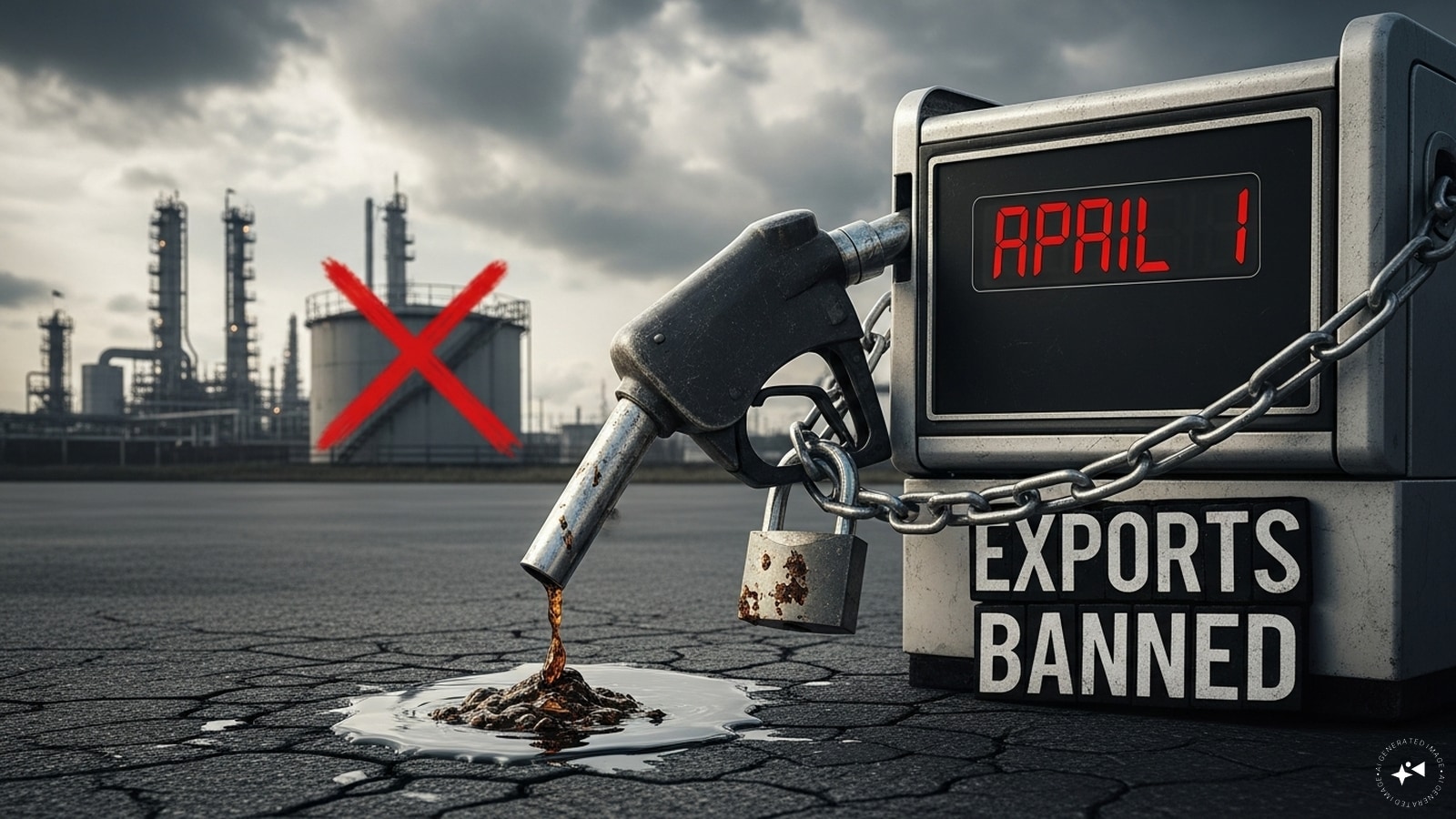
Russia is a land built on the myth of its own abundance, a place where the earth bleeds oil and gas like an infinite spring. Yet, starting April 1, 2026, the gates are swinging shut. The Kremlin has announced a sweeping ban on gasoline exports, a move designed to keep the lifeblood of the nation within its own borders. To the outside observer, it looks like a simple policy shift. To the person standing at the pump, it is a frantic attempt to keep the lights on and the bread affordable.
Consider the physics of a superpower under pressure.
When a nation is the second-largest exporter of oil in the world, the idea of a shortage feels like a paradox. It’s like a baker starving in a room full of flour. But the flour is being shipped to distant kitchens while the baker’s own oven sits cold. The Russian government has watched the domestic price of 92-octane and 95-octane fuel creep upward, fueled by a complex cocktail of refinery maintenance, logistical bottlenecks, and the insatiable pull of international markets where the ruble’s weakness makes every liter sold abroad worth its weight in gold.
By slamming the door on exports, the state is making a choice. They are choosing the farmer over the financier. They are choosing the commuter in Vladivostok over the buyer in South Asia.
The mechanics of this ban are not merely bureaucratic. They are a response to a looming shadow: the spring sowing season. Agriculture is a hungry beast. It requires millions of tons of diesel and gasoline to move the machinery that feeds a nation of 140 million people. If the price of fuel spikes in April, the price of a loaf of bread spikes in August. This is the "inflationary ghost" that haunts every hallway in the Ministry of Energy. They know that a citizen might forgive a geopolitical standoff, but they will never forgive a gas station that asks for half a week's wages for a full tank.
But why now?
The timing is far from accidental. We have to look at the scars on the infrastructure itself. Over the last year, the Russian refining complex has taken a series of hits—some metaphorical, some literal. Technical outages at major plants like Nizhny Novgorod have squeezed supply. When a refinery goes offline, it isn't like flicking a light switch. It is a massive, temperamental organism of steel and heat that takes weeks to stabilize. While those towers are silent, the reservoir of available fuel drains.
The ban is a tourniquet. It is meant to stop the bleeding while the internal system repairs itself.
There is a certain irony in the way we view energy. We talk about "barrels" and "pipelines" as if they are abstract data points on a Bloomberg terminal. We forget the heat. We forget the smell of exhaust on a frozen morning. For the Russian government, the "domestic market" isn't a chart. It’s a volatility index of public mood. By ensuring that supply remains plentiful at home, they are artificially depressing the price. They are creating a temporary oasis of stability in a desert of global uncertainty.
Imagine a haulage driver named Viktor. He drives a Scania truck across the Ural Mountains, carrying spare parts and consumer goods. For Viktor, fuel is 40% of his operating cost. If the price jumps 10%, his profit doesn't just shrink—it evaporates. He stops driving. The parts don't arrive. The shop shelves go bare. This is the "cascading failure" that policy makers fear most. The export ban is a wall built to prevent that first domino from falling.
The world outside will feel the ripple, of course. While Russia has found new homes for its energy in the wake of Western sanctions—primarily in the "Global South"—any withdrawal of volume from the global pool creates tension. Buyers who relied on Russian gasoline will now have to scramble, bidding up the price of fuel from the Middle East or North America.
It is a zero-sum game played with combustible liquids.
There is a deep, unsettling tension in this strategy. By cutting off exports, the government is also cutting off its own flow of hard currency. They are sacrificing the very dollars and yuan they need to fund the state in exchange for domestic peace. It is a gamble of the highest order. It assumes that the refineries can come back online quickly and that the "price stabilization" will hold long enough to get through the summer heat.
What happens if the tourniquet stays on too long?
If the export ban persists beyond its intended window, the refineries face a different problem: oversupply at home with nowhere to put it. Storage tanks have a finite capacity. If you can't sell it abroad and you can't store more of it, you have to slow down production. Sizing down a refinery is a dangerous, expensive dance. It risks long-term damage to the very equipment that provides the fuel in the first place.
The Russian energy sector is currently walking a tightrope over a canyon of its own making. On one side is the risk of civil unrest due to rising costs; on the other is the risk of industrial stagnation due to isolation.
The ban, scheduled to take effect as the ice begins to melt and the mud of rasputitsa takes hold of the roads, is a signal of a nation turning inward. It is a confession that for all the talk of "global influence" and "energy superpowers," the most important battle is always the one happening at the local corner station.
As the sun sets over the Siberian plains, the lights of the refineries twinkle like fallen stars. They are beautiful, but they are fragile. They represent the only thing keeping the modern world from sliding back into the agrarian dark. The people waiting in line at the pumps don't care about the intricacies of the April 1 decree. They only care if the needle on their dashboard moves when they turn the key.
The silence of an empty tank is the loudest sound in the world.
Would you like me to analyze the potential impact of this ban on European fuel prices or examine the specific Russian refineries currently undergoing repairs?