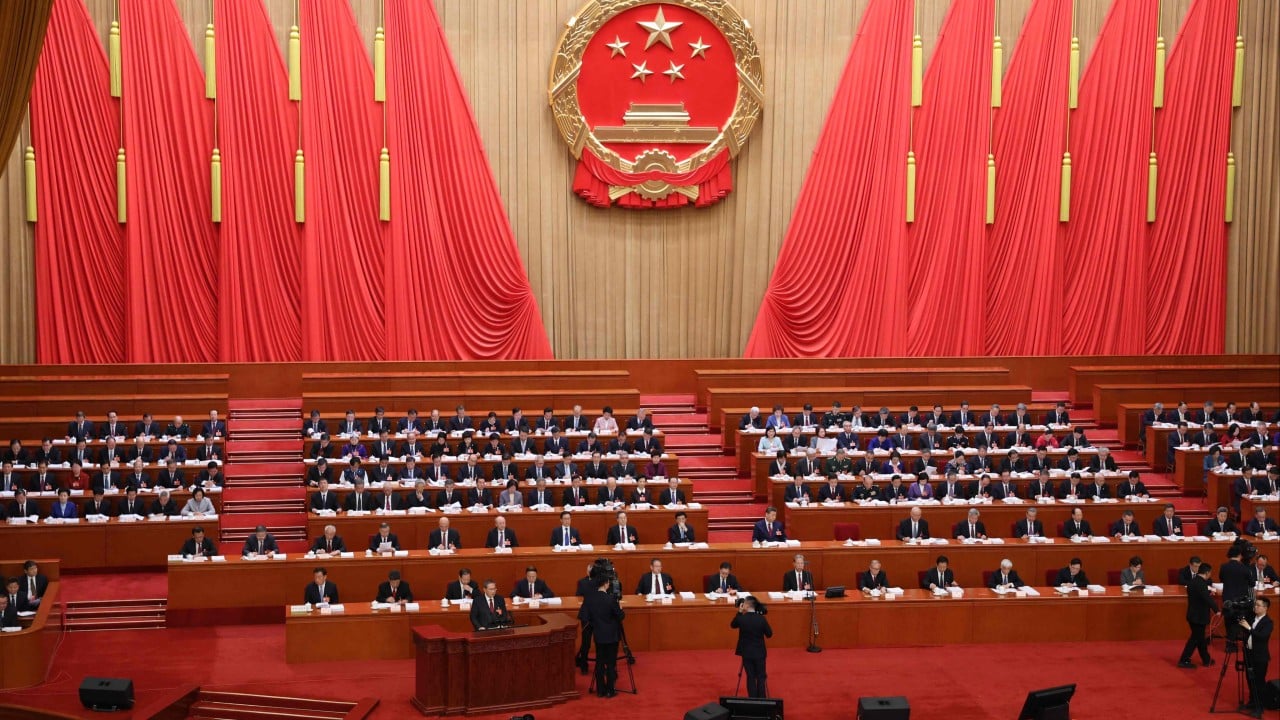
China has officially signaled that the era of explosive, debt-fueled expansion is over. By trimming its annual growth targets and shifting its state-directed capital toward a singular focus on artificial intelligence, Beijing is attempting a high-stakes pivot that the West has yet to fully compute. This isn’t just a cooling economy; it is a calculated transformation from a manufacturing superpower into a cognitive one. The goal is no longer to be the world’s factory, but to own the operating system that runs the 21st century.
The End of the Five Percent Illusion
For decades, the global markets relied on a predictable ritual: China would set a growth target, and through a combination of infrastructure spending and property development, they would hit it. That cycle has broken. The decision to lower growth expectations reflects a grim realization within the State Council. They can no longer paper over the cracks of a massive property crisis and a shrinking workforce with more concrete and steel.
Instead, the leadership is diverting every available yuan into "New Quality Productive Forces." This is bureaucratic shorthand for high-end technology, specifically AI, semiconductors, and quantum computing. They are betting that gains in algorithmic efficiency can offset the drag of an aging population. If a factory can produce twice as much with half the human staff because of an AI-optimized supply chain, the GDP numbers matter less than the technological sovereignty gained.
Silicon Sovereignty in the Crosshairs
The trade talks between Washington and Beijing have moved far beyond soybeans and steel. We are now in a period of "Economic Statecraft" where the primary currency is the GPU. The United States has weaponized the supply chain, restricting the flow of high-end Nvidia chips and lithography machines. Beijing’s response has been to treat AI development as a Manhattan Project-level priority.
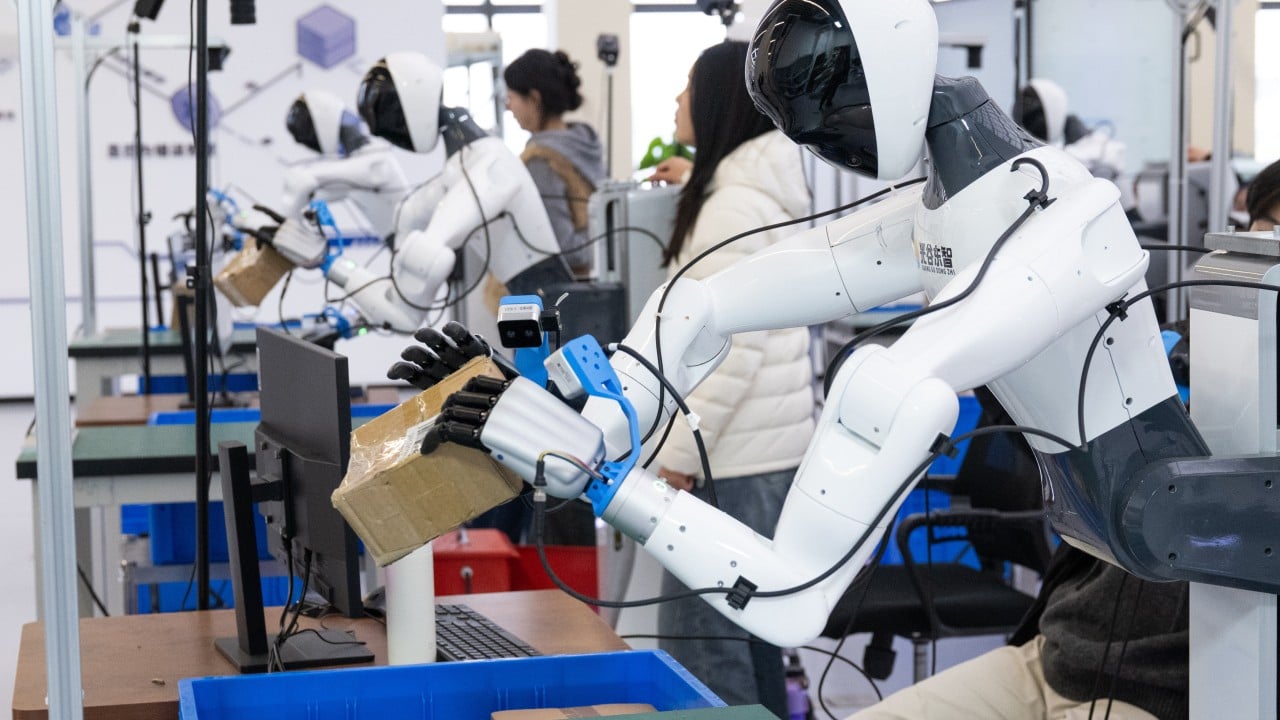
They are not just building chatbots. The Chinese strategy focuses on "Industrial AI"—applying machine learning to heavy industry, power grids, and maritime logistics. While American firms battle over advertising revenue and social media engagement, Chinese state-backed firms are integrating AI into the physical world. This creates a divergence. The West is winning the "Creative AI" race, but China is sprinting toward the "Physical AI" finish line.
The Compute Gap
The hardware bottleneck is real. Despite massive subsidies, Chinese domestic chipmakers like SMIC are still generations behind TSMC. This gap forces Chinese engineers to be more efficient with their software. Because they cannot simply throw more hardware at a problem, they are forced to innovate in model compression and architecture. This "scarcity-driven innovation" might actually give them a long-term edge in edge computing—running powerful AI on small, low-power devices rather than massive, energy-hungry server farms.
A Controlled Burn of the Property Market
To understand why the growth target was cut, you have to look at the wreckage of the real estate sector. For years, property accounted for roughly 30% of China's GDP. It was a giant Ponzi scheme built on pre-sold apartments and local government debt. The government is now allowing this sector to undergo a "controlled burn."
They are intentionally starving the developers of credit to force capital into the technology sector. It is a brutal transition. Household wealth, which is mostly tied up in apartments, is evaporating. This has led to a collapse in consumer confidence. People aren't buying cars or luxury goods because they feel poorer. The state’s gamble is that the long-term survival of the Communist Party depends on technological dominance, even if it means five years of domestic stagnation and social friction.
The Trade Talk Paradox
Every time US and Chinese officials sit across from each other, the tension is palpable. The US wants a level playing field and an end to state subsidies. China view these subsidies as essential for national security. There is no middle ground here.
We are seeing the birth of "Two Hemispheres" of technology. One side runs on American standards, Western chips, and open-source models. The other runs on Chinese closed-stack systems, domestic hardware, and state-monitored data. For global corporations, this is a nightmare. You can no longer have a single global product. You need a "China-for-China" strategy and a "Rest-of-World" strategy. The cost of doing business is doubling because of this duplication.
The Data Fortress
China’s biggest advantage is its data. The country has fewer privacy restrictions and a massive, digitized population. This provides a "petri dish" for AI training that is unmatched in the West. By capturing every transaction, movement, and interaction of 1.4 billion people, the state can train models on real-world behavior at a scale that would be illegal in Europe or the US. This data isn't just for surveillance; it's the raw fuel for the next generation of medical diagnostics, autonomous transit, and predictive maintenance.
The Strategy of Forced Sufficiency
Washington's export bans were intended to slow China down. In the short term, they worked. In the long term, they may have backfired by removing any incentive for China to rely on the global market. When you tell a superpower they can't buy your products, you give them no choice but to build their own.
We are seeing the emergence of a domestic supply chain that is increasingly "de-Americanized." From the chemicals used in chip manufacturing to the software used for circuit design, China is systematically replacing every Western component. This isn't about trade anymore; it's about divorce.
Why the Growth Target Matters to You
When China cuts its growth target, it sends a deflationary wave across the planet. Demand for Australian iron ore drops. Demand for German precision machinery drops. Demand for Brazilian soy drops. The world has grown accustomed to a China that buys everything in sight to keep the construction cranes moving. That China is gone.
The new China is a competitor, not a customer. They want to export their AI-driven EVs, their green energy tech, and their industrial software to the Global South, bypassing the Western markets entirely. They are building a new trade architecture—the Belt and Road 2.0—which is focused on digital infrastructure rather than just bridges and roads.
The Risk of the Pivot
This transition is not guaranteed to succeed. Moving an economy of 18 trillion dollars from property to AI is like trying to turn an aircraft carrier in a bathtub. There is a high risk of a "middle-income trap," where growth stalls before the technology sector is large enough to support the rest of the country.
The youth unemployment rate in China is a flashing red light. Millions of college graduates are entering a market that wants AI engineers, not generalists. If the state cannot create enough high-value jobs to replace the ones lost in the old economy, they face the prospect of "lying flat"—a generation that has given up on the climb.
The Reality of the New Cold War
This isn't a Cold War fought with nuclear silos in the Dakotas or the Urals. It is fought in the clean rooms of Hsinchu, the labs of Shenzhen, and the data centers of Northern Virginia. The weapon of choice is the algorithm.
China’s lower growth target is a sign of maturity, not just weakness. It is an admission that the old ways are dead and a declaration that they are playing a longer, more dangerous game. They are willing to sacrifice short-term wealth for long-term power. The question for the West is whether we have the stomach for that kind of sacrifice.
If you are waiting for China to return to the high-growth days of the 2010s, you are waiting for a ghost. The pivot is here. The focus is fixed. The only variable left is who can iterate faster in a world where the chip is the new oil.
Analyze your supply chain for exposure to the "Two Hemispheres" split. If your business relies on a unified global tech standard, you are already behind the curve.