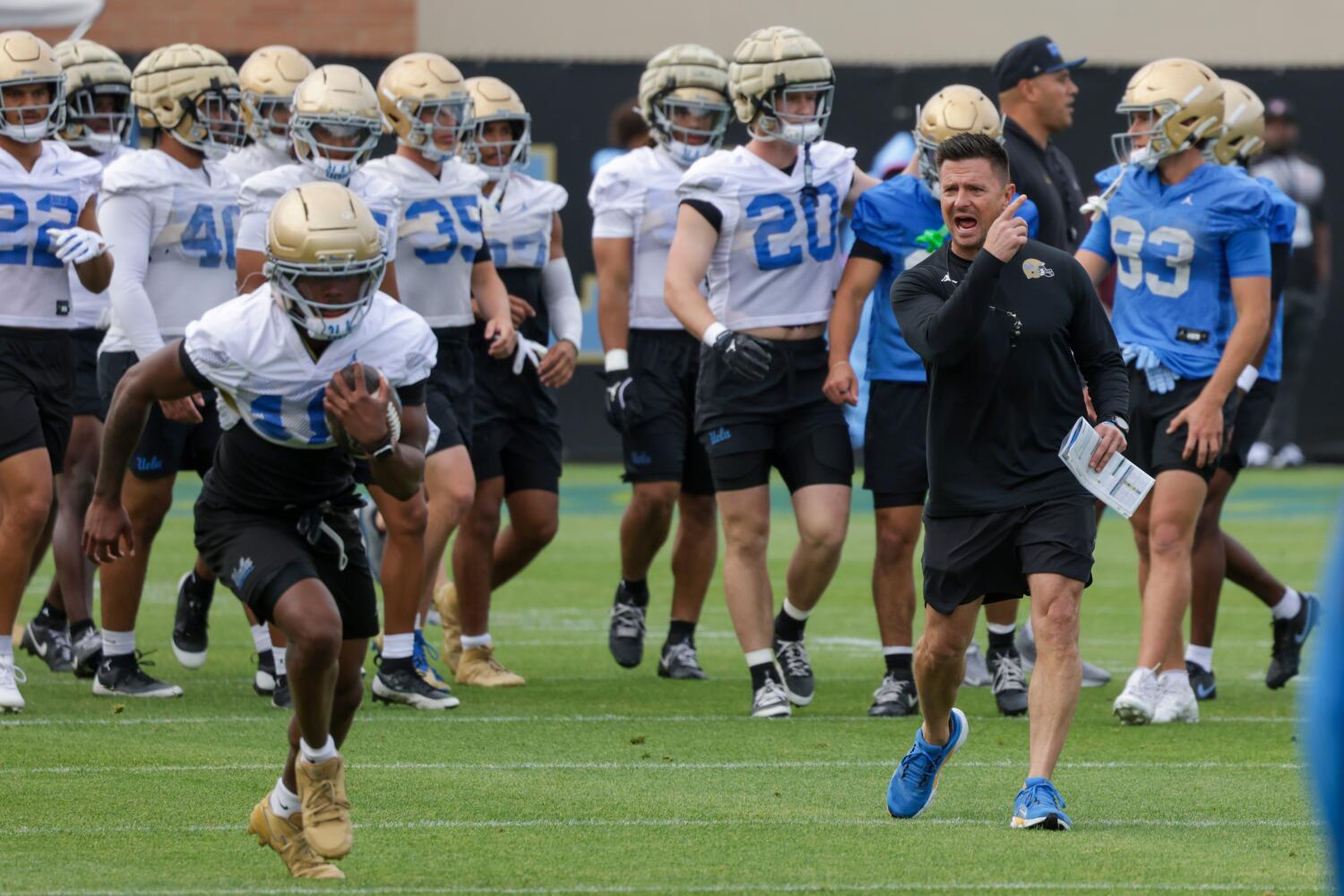
The air in Westwood usually smells like eucalyptus and expensive dreams. But on a Tuesday morning at the Wasserman Football Center, the scent is different. It is the sharp, metallic tang of sweat meeting fresh-cut grass, the smell of a machine being disassembled and rebuilt while the engine is still running.
Bob Chesney stands in the center of it all. He is not screaming. He is not throwing a clipboard. He is watching the feet of a nineteen-year-old kid who is currently vibrating with the fear of doing something wrong.
In the old world of college football, a missed assignment was a sin. If a linebacker took a false step, he was relegated to the film room purgatory, a casualty of the "perfection or bust" philosophy that has burned out more athletes than it ever minted as stars. But as the UCLA Bruins open their spring practice, Chesney is preaching a different kind of sermon.
He is grading them on their heartbeat, not their stat sheet.
The Weight of the Blue and Gold
To understand why this matters, you have to understand the ghosts that haunt the Rose Bowl. UCLA isn't just a football program; it’s a legacy wrapped in the heavy velvet of John Wooden’s shadow and the jagged expectations of a city that only loves a winner. For a young athlete, that weight is physical. It makes your hands tighten. It makes your breath shallow.
When you are afraid to fail, you play slow. You think instead of react. You become a statue in a game that belongs to the fluid.
Chesney walked into this environment knowing that the quickest way to lose a locker room is to demand a standard that ignores the human being under the helmet. He looked at a roster full of talent and saw a group of men who were playing as if they were walking on eggshells.
His response? Smash the shells.
Consider a hypothetical player—let’s call him Elias. Elias is a sophomore safety with NFL speed and a brain that won't stop over-analyzing the safety rotation. In the previous regime, Elias might have hesitated on a blitz, worried about the gap he was leaving behind. That hesitation is the difference between a sack and a forty-yard completion.
Chesney’s spring ball isn't about telling Elias where to stand. It’s about telling Elias that if he’s going to miss the tackle, he’d better miss it while sprinting at a hundred miles per hour.
The Anatomy of the Full Tilt
There is a specific kind of violence in football that has nothing to do with the collision itself. It is the violence of intent.
During the opening sessions of spring practice, the coaching staff wasn't looking at the scoreboard. They were looking at the GPS trackers stitched into the back of the jerseys. They were looking at the "effort grades." In Chesney’s economy, a "perfect" play executed at eighty percent speed is a failure. A catastrophic tactical error executed with unbridled, ferocious effort is a building block.
"We want them to feel the freedom to mess up," the ethos suggests.
This isn't participation-trophy logic. It’s high-level psychology. By removing the immediate penalty for tactical imperfection, Chesney is actually accelerating the learning process. When the brain isn't hijacked by the "fight or flight" response triggered by a screaming coach, it actually retains information faster.
The Bruins are being taught to embrace the mess. The grass stains on the front of the jerseys are more important than the clean tape on their wrists. They are being invited to find the limit of their own physical capabilities, a limit that is usually several yards past where the mind tells them to stop.
The Invisible Stakes of April
People ask why spring ball matters. The stands are empty. The lights aren't on. The bands are silent.
But April is where the culture is forged in the dark. If you wait until September to decide you are a team that plays with relentless effort, you have already lost. The identity of a program is a muscle. You have to tear the fibers in the spring so they can grow back thicker by the autumn.
Chesney is essentially performing a factory reset on the UCLA psyche. He is trying to strip away the "cool" of Los Angeles and replace it with something grittier, something more primal.
It is a gamble.
In a world of NIL deals and the transfer portal, players have more power than ever. They can leave if they don't like the vibe. They can opt out if the pressure gets too high. But Chesney’s approach offers them something rare in the modern era: the permission to be raw. He isn't asking them to be professionals yet. He is asking them to be gladiators who haven't learned the rules of the arena but are more than willing to bleed for the man standing next to them.
The Ghost in the Machine
Watch the drills closely. You see a defensive end overshoot his mark. In years past, that player might have put his head down, waiting for the whistle and the inevitable lecture. Now? He turns and chases the play forty yards downfield, even after the whistle has blown.
He gets a chest bump from a GA. He gets a nod from Chesney.
The message is clear: The mistake is fine. The surrender is not.
This philosophy creates a feedback loop. When a player sees his teammate sprinting to cover for a missed gap, he feels an obligation to match that energy. It becomes a contagion of effort. It moves through the ranks until even the walk-ons are hitting the sleds like their lives depend on it.
This is how you bridge the gap between a "good" team and a "dangerous" one. A good team executes the play. A dangerous team creates chaos that the opponent can’t plan for. You can’t scheme against a group of players who aren't afraid of the consequences of their own aggression.
The sun begins to dip behind the hills of Bel Air, casting long, distorted shadows across the turf. The practice ends not with a lecture, but with a huddle that feels less like a meeting and more like a pact.
The Bruins aren't perfect. Not even close. Their footwork is still a little heavy, and their timing on the deep ball is a fraction of a second off. But they are moving with a terrifying, singular purpose.
Bob Chesney walks off the field, his eyes already scanning the horizon. He knows that perfection is a moving target, a mirage that disappears the closer you get to it. But effort? Effort is a choice.
He has given his players the keys to the kingdom by telling them they are allowed to break the lock. As the players head to the showers, dragging their pads, there is a lightness in their step that wasn't there in March. They are no longer playing to avoid the mistake.
They are playing to find out just how loud the roar can get when they finally let go of the railing.