The crunch of a dry leaf underfoot is a sound of peace. In the rolling green stretches of the North Hampshire downs, near the quiet village of Hannington, that sound is a promise. It is the promise that the world is still natural, still slow, and still yours to wander.
But lately, the sound has changed. It has become sharper. More dangerous. In related developments, we also covered: The Sabotage of the Sultans.
Imagine a Sunday morning, the kind where the mist clings to the hedgerows like wet wool. A local walker, perhaps someone who has lived in these parts long enough to remember when the post was delivered by horse, turns a familiar corner on a woodland track. They expect to see the usual—foxgloves, damp moss, maybe the flick of a deer's tail. Instead, they find a shimmering, jagged sea of green glass.
Someone is haunting these woods with Sauvignon Blanc. USA Today has provided coverage on this fascinating issue in great detail.
The Audacity of the Empty Bottle
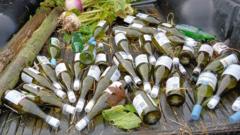
This isn’t your typical fly-tipping. We aren’t talking about a rusted fridge or a stained mattress dumped in a moment of desperate laziness. This is specific. It is repetitive. It is, quite frankly, bizarre. Over the past few months, hundreds of empty bottles of white wine have been systematically abandoned along the quiet lanes and bridleways surrounding Hannington.
They arrive in waves.
One week, it’s a neat pile of twenty bottles tucked under a bush. The next, it’s forty scattered across a gateway. They are almost always the same brand—a crisp, mid-range Sauvignon Blanc that you’d find in any local supermarket for about eight pounds. To the casual observer, it’s an eyesore. To the people who live here, it’s a riddle that has begun to rot the communal sense of safety.
The facts are as cold as the wine once was. Fly-tipping is a criminal offense under the Environmental Protection Act 1990. In the UK, local councils spend millions of pounds every year clearing up waste that people are too cheap or too careless to dispose of properly. But the "Sauvignon Smuggler" of Hannington doesn't fit the profile. This isn't a rogue tradesman dodging a commercial waste fee. This is a pattern of consumption being vomited back into the landscape.
The Invisible Stakes of a Broken Neck
Why does it matter? It’s just glass, right?
Ask the farmer who has to drive a tractor worth six figures through those lanes. A single shard of a shattered wine bottle can slice through a heavy-duty tire like a razor through silk. That’s a three-thousand-pound repair bill because someone couldn't find a recycling bin.
Ask the dog walker. A golden retriever doesn't know that the sparkling object in the grass is a jagged trap. One curious paw-step leads to a frantic trip to the vet, a trail of blood on the kitchen floor, and a lingering fear of the very woods that used to provide solace.
Then there are the wilder stakes. This area of Hampshire is home to owls, badgers, and deer. When a bottle is left in the sun, it can act as a magnifying glass. Under the right conditions, that discarded vessel of New Zealand's finest can focus a beam of sunlight onto dry tinder. A forest fire in Hampshire sounds like a rarity until the smoke is billowing toward your thatched roof.
The emotional weight, however, is what truly burdens the villagers. There is a specific kind of violation that comes with someone repeatedly using your home as their personal bin. It feels intimate. It feels like a taunt.
The Anatomy of a Mystery
Let’s consider a hypothetical figure. We’ll call him The Commuter.
The Commuter works a high-pressure job in London or Basingstoke. He drives home through the winding backroads to avoid the motorway traffic. He’s tired. He’s stressed. He cracks a bottle of wine to take the edge off the drive—a dangerous, selfish habit in itself. By the time he nears Hannington, the bottle is empty. He doesn't want his partner to see it in the car. He doesn't want the clink of glass in the household recycling to betray how much he’s drinking.
So, he lowers the window.
The bottle flies. It thuds into the soft verge. He feels a momentary sense of relief, a shedding of evidence. But the evidence doesn't disappear. It accumulates.
This isn't just a story about litter. It’s a story about the hidden cracks in our social fabric. It’s about the secrets we carry and the way we expect the "great outdoors" to swallow our sins. We treat the hedgerows as a void, a place where things go to vanish. But the earth isn't a void. It's a ledger. And right now, Hannington’s ledger is screaming.
The Community Strikes Back
Villagers aren't sitting idly by. In small towns, gossip is a tool of forensic science. People are noting times. They are checking dashcam footage. They are talking about the specific brand of wine—noting which local shops stock it and who might be buying it in bulk.
The local council has been notified, and the police are aware, but the reality of rural policing is that a few dozen wine bottles rarely trigger a forensic team. The burden falls on the residents. They are the ones donning high-vis vests and carrying heavy bin bags into the brambles. They are the ones picking up the pieces of someone else's Saturday night.
There is a weary anger in the way they work. You see it in the set of their shoulders. Every bottle they pick up is a reminder that someone else thinks their time is more valuable than the health of the land. It’s a reminder that common decency is, perhaps, not so common.
The Weight of the Shards
Is it possible to feel empathy for the culprit?
Perhaps they are struggling. Perhaps the bottles are markers of a life spiraling out of control. We often want to believe that "villains" are motivated by malice, but usually, they are motivated by a pathetic kind of convenience. However, empathy has a limit, and that limit is reached when the behavior puts others at risk.
The financial cost of fly-tipping in the UK is staggering, reaching upwards of £11 million for clearing large-scale incidents alone. But the cost to Hannington isn't just financial. It’s the loss of the "unspoiled." Once you know there is glass in the grass, you never walk the same way again. You stop looking at the canopy of the trees and start looking at your feet. Your world shrinks.
We live in an age of hyper-connectivity, yet we are increasingly disconnected from the physical consequences of our actions. We click a button, and a package arrives. We throw a bottle, and it "goes away." Except it doesn't.
The Sauvignon Blanc bottles of Hannington are a physical manifestation of a modern malaise—the idea that we are separate from our environment. That we can dump our excess, our waste, and our shame into the bushes and expect the world to remain pristine for our next visit.
The next time you’re driving through a quiet village at dusk, look at the verges. Look past the wildflowers and the long grass. You might see a glint of green. You might see a reflection of a society that has forgotten how to clean up after itself.
The ghost of Hannington isn't a spirit. It's a person with a car, a habit, and a complete lack of shame. And until they are caught, the woods will keep on bleeding glass.
Somewhere in a quiet kitchen tonight, a cork will pop, or a screwcap will crack. A bottle will be drained. And tomorrow morning, another shard will wait in the dew for an unsuspecting foot.
Would you like me to look into the specific local penalties for fly-tipping in Hampshire or help you draft a community awareness poster for this issue?