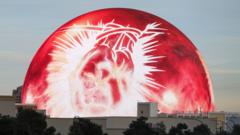
The desert wind outside the taxi window is hot, dry, and smells faintly of exhaust. But you aren’t looking at the sand. You are staring at a massive, unblinking iris that has replaced the horizon. It is a black orb, 366 feet tall, covered in 1.2 million puck-sized LEDs. One moment it is a tennis ball; the next, it is a swirling nebula. It is the Sphere, and it represents a terrifying, beautiful gamble on the future of how humans occupy space.
For a century, we have been a species of the rectangle. From the proscenium arch of the theater to the silver screen of the cinema, and finally to the glowing bricks in our pockets, we have viewed the world through four right angles. We are trained to look forward. We are trained to ignore the periphery.
But our bodies weren’t built for rectangles. Our eyes see in arcs. Our ears map the world in spheres. The sudden obsession with domes in the entertainment industry—from the MSG Sphere in Nevada to the rising husks of immersive venues in London and Saudi Arabia—isn’t just a trend in architecture. It is an admission that the flat screen has failed to capture the fullness of the human spirit.
The Death of the Frame
Consider a hypothetical concertgoer named Elias. Elias has spent his life watching his favorite bands through a three-inch screen held at arm’s length. He is at the show, but he is also viewing it through a crop. When he steps inside a geodesic dome, the frame vanishes. There is no "off-screen."
Inside these structures, the physics of light and sound change. In a traditional stadium, sound is a blunt instrument. It hits the back wall and bounces, creating a muddy slapback that forces engineers to crank the volume to deafening levels just to maintain clarity. In a sphere, the environment is controlled with surgical precision.
The Sphere in Las Vegas utilizes "beamforming" technology. Imagine 167,000 speaker drivers hidden behind a massive LED screen. Instead of sound washing over the crowd like a wave, it is directed like a laser. Elias could be sitting in Section 206 hearing a Spanish translation of the show, while the person in 207 hears the original English, with almost zero bleed between them. This isn't just a "better speaker." It is a fundamental rewiring of how we experience collective reality.
The stakes are invisible but massive. If you can control the precise coordinates of sound and fill 160,000 square feet of interior space with 16K resolution imagery, you aren't just showing a movie. You are hijacking the vestibular system. You are tricking the inner ear into believing the floor is moving, or that the air has suddenly chilled.
The Geodesic Ghost
We have been here before, though the scale was smaller. In the 1960s, Buckminster Fuller dreamed of a world covered in domes. He saw them as the most efficient way to enclose space, a mathematical triumph of strength over weight. He wanted to put a dome over Midtown Manhattan to regulate the weather.
He failed, mostly because humans like walls. We like to know where one room ends and another begins. We find comfort in the corners.
But the entertainment industry is currently betting billions that we are finally tired of corners. The "Future of Entertainment" is a phrase often tossed around to describe VR headsets, but headsets are lonely. They are plastic blindfolds that cut us off from the person sitting next to us. The dome offers the "VR experience" without the isolation. It is a return to the campfire, just with a much larger fire.
The math behind these structures is punishing. A dome is a series of triangles, but a digital dome is a nightmare of "equirectangular projection." Take a flat map of the Earth and try to wrap it around a basketball without it wrinkling or stretching at the poles. It requires staggering computational power to stitch images together so that a giant dragonfly looks anatomically correct whether it’s hovering ten feet from your face or "miles" away in the digital distance.
The Cost of Awe
There is a hollow feeling that comes with the spectacle. As I walked around the exterior of the Las Vegas structure, I realized it is essentially a $2.3 billion billboard. It consumes enough electricity to power a small city. When it displays a giant yellow emoji face that blinks at the passing traffic, it feels like a toy for a titan.
The human element gets lost in the sheer tonnage of the hardware. We have built a cathedral, but what are we worshipping?
If the content is just a high-resolution version of what we see on our phones, the dome will become a relic—a very expensive planetarium where people go to take selfies and then leave. The real challenge isn't the curved screen; it's the curved story.
Most filmmakers don't know how to tell a story without a frame. In a traditional movie, the director tells you where to look by cutting to a close-up. In a 360-degree environment, the director loses control. You might be looking at the protagonist’s face, but I might be looking at a bird flying "behind" us.
This shifts the burden of narrative onto the viewer. It makes the experience active rather than passive. It demands that we be present. In an age of infinite distractions, perhaps that is the most radical thing a building can do: force us to pay attention to everything, all at once.
The Sensory Breach
The true power of these spheres isn't found in the eyes, but in the skin.
During a high-end dome presentation, haptic seats can vibrate at frequencies that mimic the rumble of a thunderstorm or the subtle thrum of a heartbeat. Scent machines can pump the smell of pine or ozone into the air.
This is where the line between "watching" and "being" starts to blur. It’s a sensory breach. We are moving toward a future where entertainment is an environmental takeover.
I spoke with a sound engineer who worked on early immersive audio prototypes. He told me that when you get the acoustics of a sphere exactly right, the brain stops processing the sound as coming from a speaker. It processes it as an object in the room. If a virtual bee flies behind your left ear, your shoulder will twitch. It’s an involuntary biological response.
That is the "invisible stake." We are handing over our biological triggers to engineers. We are allowing them to play our nervous systems like a piano.
Beyond the Neon
If domes are the future, they won't stay in Las Vegas.
We are seeing the technology shrink. Small-scale "immersion rooms" are appearing in museums, hospitals, and schools. Imagine a history class where students sit inside a dome and watch the rise and fall of Rome in a time-lapse that surrounds them, or a therapy session where a patient with PTSD can revisit a traumatic site in a controlled, adjustable digital environment to desensitize the fear response.
The rectangle is a window. The sphere is a world.
But windows allow us to look out while remaining safe inside our own space. A world requires us to step in completely. As I stood in the shadow of that great glowing orb in the desert, I felt a strange sense of vertigo. Not because the images were moving, but because I realized how small our old screens have made us feel.
We have spent decades shrinking our reality to fit into our pockets. Now, the architecture is pushing back. It is demanding that we expand again. It is demanding that we look up, look around, and remember that the world has no edges.
The desert wind kicked up, blurring the line between the sand and the city. The giant eye on the Sphere turned into a spinning globe of blue water, and for a second, the heat of the sidewalk seemed to vanish. The illusion was perfect. The frame was gone. And for the first time in a long time, the horizon didn't feel like a boundary—it felt like an invitation.
The lights of the Strip began to flicker on, but they looked dim and flat against the brilliance of the dome. We are no longer content to just watch the story. We want to live inside the light.