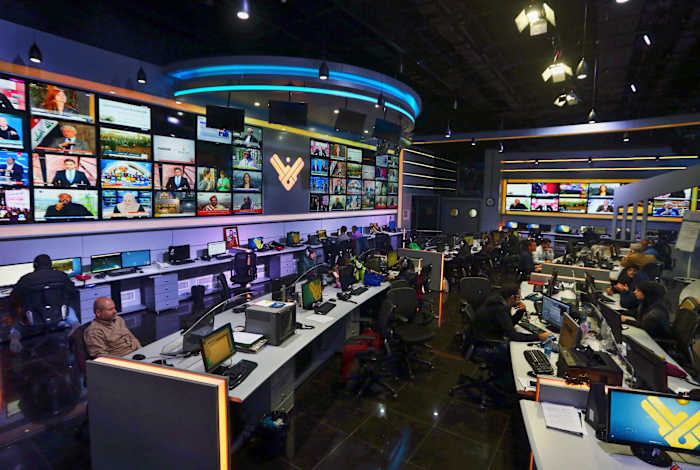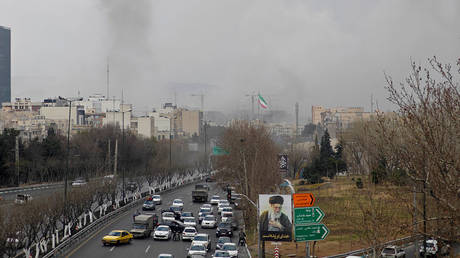
In a darkened room somewhere in the suburbs of Tel Aviv, a finger hovered over a key. It wasn't a trigger. Not yet. It was something much more intimate and, in many ways, more invasive. It was the "Enter" command that would strip away the digital skin of Tehran’s high-security corridors, turning the Iranian capital’s own defense infrastructure into a silent witness for the prosecution.
Before the explosion that rocked the Neshat complex in northern Tehran, the world was already being watched through its own eyes. We tend to think of modern warfare as a series of satellite coordinates and heat-seeking trajectories. We picture the heavy metal of drones. But the assassination of Ali Khamenei—an event that has reshaped the geopolitical map of the Middle East—didn't begin with a missile. It began with a pixel.
The Ghost in the Machine
Control is an illusion maintained by the lights being on and the doors being locked. For the security detail guarding the Supreme Leader, the cameras lining the perimeter of the Islamic Revolutionary Guard Corps (IRGC) guesthouse were the ultimate reassurance. They were the unblinking sentinels. They provided a 360-degree digital fortress that supposedly rendered the compound impenetrable.
Then the screens flickered.
It wasn't a crash. A crash is loud; a crash draws attention. This was a gentle hijacking. Weeks before the final operation, Israeli cyber-intelligence units had already bypassed the firewalls. They didn't just break in; they moved in. They sat quietly in the corners of the server rooms, watching the grainy footage of guards smoking cigarettes, noting the exact timing of the shifts, and mapping the heat signatures of the hallways.
Imagine being the technician responsible for those monitors. You see exactly what you expect to see. The courtyard is empty. The wind rustles the trees. The gate remains shut. But what you are seeing is a loop—a digital ghost story fed into your retina by a team of hackers a thousand miles away. While the IRGC guards watched a peaceful, prerecorded Thursday night on their monitors, the reality outside was shifting into a kill zone.
The Vulnerability of Everything
We live in a world where our convenience is our greatest liability. Every "smart" device is a double agent waiting for the right handler. In the case of Tehran, the very tools designed to ensure the safety of the regime became the roadmap for its decapitation.
The technical term is "lateral movement." Once you have the camera, you have the network. Once you have the network, you have the schedule. Once you have the schedule, you have the man. It is a terrifyingly linear progression. The hackers didn't need to plant a mole inside the building when they had already turned the building itself into a spy.
This isn't just about high-stakes international espionage. It is a cold reflection of our own reality. Your doorbell camera, your office security system, the city-wide "safe-zone" monitors—they are all nodes in a web that we don't truly control. We trade our privacy for a feeling of safety, never realizing that the lock on the front door is made of glass.
The Silent Count
The tension in those final hours wasn't held in the cockpits of F-35s. It was held in the silence of a basement lab where analysts watched the live-feed of a man who didn't know he was already dead. There is a specific, haunting psychological weight to this kind of surveillance. It is the god-complex of the digital age. To see without being seen is to hold the power of life and death in a cursor.
The FT report highlights the precision, but the precision is a byproduct of the intimacy. The hackers knew which floorboards creaked. They knew which lightbulbs were flickering. They waited until the target was in the exact center of the frame—not the frame on the IRGC’s wall, but the frame on their own high-resolution monitors.
Execution.
The blast was the period at the end of a very long, very quiet sentence. When the dust settled, the cameras were still there, staring blankly at the wreckage of a regime’s hubris. They had done their job perfectly. They had provided total visibility. Only, they had provided it to the enemy.
The Aftermath of the Unseen
In the wake of the assassination, Tehran scrambled. They tore down cameras. They ripped out wiring. They went back to analog messengers and handwritten notes. But you cannot un-ring the bell of the twenty-first century. The fear isn't that the enemy is at the gates; the fear is that the enemy is the gate.
We are entering an era where the most dangerous weapon isn't a bomb, but the access code to the room where the bomb is placed. The "hacked cameras" story is a memento mori for the digital age. It tells us that our walls are porous and our eyes are not our own.
Security. It’s a comforting word. We use it to sleep better at night. But as the smoke cleared over northern Tehran, the world was forced to confront a jagged truth: if they can see you, they can reach you. And if they are already inside the machine, you are just a guest in your own home, waiting for the screen to go black.
Somewhere, in another darkened room, another finger is hovering over a key.