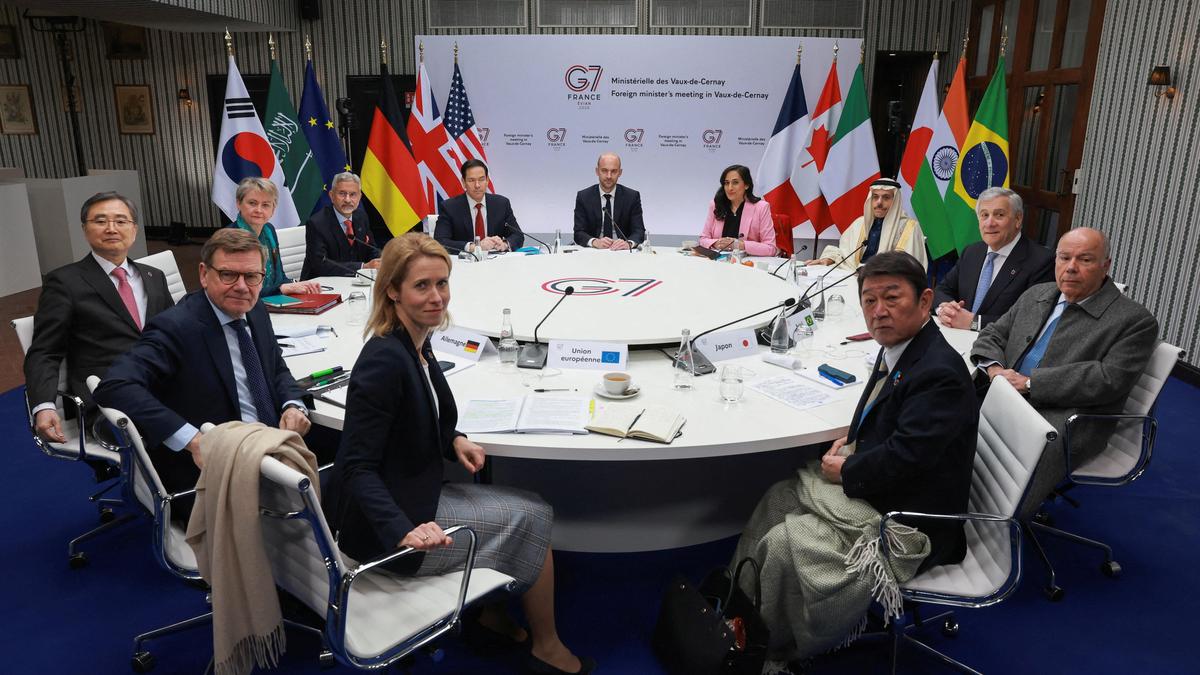
The air inside the Room of the Statues is usually heavy with the scent of old paper and the quiet weight of centuries-old diplomacy. But this week in Rome, the atmosphere felt brittle. It was the kind of tension that exists just before a long-standing marriage finally fractures—not with a shout, but with a weary, synchronized turning away.
Marco, a career staffer who has seen three decades of G7 summits, watched from the periphery as the American delegation moved through the corridors. In previous years, the arrival of a U.S. Secretary of State felt like the entry of a conductor into an orchestra pit. There was a shared sheet of music. Even when the notes were dissonant, there was a common language.
Now, the music has stopped.
The Salesman and the Skeptics
Marco observed Marco Rubio—the man tasked with being the face of the "America First" doctrine to a room full of people who felt increasingly second—as he attempted to bridge a chasm that might be too wide to leap. Rubio didn't come with the traditional olive branch of multilateralism. He came with a sales pitch.
The product? A hardline, potentially kinetic confrontation with Iran.
The audience? A group of European and Asian allies who are still nursing the metaphorical bruises from a week of social media broadsides and tariff threats from the American president.
Consider the physics of trust. It is built over decades of consistent, boring meetings, shared intelligence, and the mutual understanding that if one side is attacked, the others will bleed. When that trust is traded for leverage, the foundation of the G7 doesn't just crack; it liquefies. Rubio found himself in the unenviable position of asking for a massive commitment of political and military capital from partners who feel they have been treated as subordinates rather than stakeholders.
The Invisible Stakes of the Persian Gulf
Behind the closed doors of the summit, the talk isn't just about centrifuges or ballistic missiles. It is about the price of a gallon of gas in a small town in Bavaria. It is about whether a container ship can make it through the Strait of Hormuz without becoming a centerpiece in a global geopolitical chess match.
For the French and the Germans, Iran isn't a theoretical "bad actor" on a briefing map. It is a regional power that sits on the doorstep of their interests. They remember 2018. They remember the painstaking years spent crafting the JCPOA, only to see it dismantled by an executive order from Washington. To these diplomats, the American request for a "united front" against Tehran feels less like a strategic necessity and more like an invitation to a house fire started by the person asking for help.
The disconnect is visceral. Rubio speaks of "maximum pressure" and the moral imperative of stopping a revolutionary regime. The Europeans respond with the language of "strategic autonomy." It is a polite way of saying they are tired of being the junior partners in a venture they didn't sign up for.
The Echo of Insults
It is impossible to separate the policy from the personality. Just days before Rubio took the stage in Rome, the American president had once again taken to the digital square to belittle the very people Rubio was now trying to court. He questioned the value of NATO. He called European trade practices "predatory." He reminded the world that, in his view, the alliance is a protection racket where the clients are behind on their payments.
Imagine trying to convince your neighbors to help you build a fence after you’ve spent the morning throwing rocks at their windows.
The G7 partners—Canada, France, Germany, Italy, Japan, and the UK—are no longer just skeptical of the policy. They are skeptical of the partner. They wonder if a deal made with Rubio today will be invalidated by a post on X tomorrow.
This isn't just "dry" diplomacy. This is a crisis of identity for the West.
The Human Cost of a Miscalculation
If Rubio fails to sell this vision, the consequences aren't confined to a communiqué or a press release. They live in the real world.
If the U.S. moves toward a conflict with Iran without the backing of the G7, the global economy faces a shockwave that could dwarf the 2008 crisis. The "invisible stakes" are the livelihoods of millions. Without a unified diplomatic front, Iran has no incentive to return to the negotiating table. They see the division. They smell the hesitation.
A hypothetical scenario: An Italian freighter is seized in the Gulf. Under the old rules, a single call from Washington to London, Paris, and Berlin would result in a coordinated, overwhelming response. Under the new reality, that call might go to voicemail.
The allies are hedging. They are looking toward Beijing. They are looking toward their own borders. They are realizing that the American umbrella, which has kept them dry since 1945, might have too many holes to be reliable in a storm.
The Weight of the Silence
During the working lunch, the clinking of silverware was often the only sound in the room. Rubio leaned forward, his hands animated as he spoke of the "existential threat" posed by Tehran’s proxies. He pointed to the maps. He cited the intelligence.
The others listened. They nodded. But they didn't sign.
The British representative looked out the window toward the Tiber. Japan’s delegate checked his watch. There was a sense that they were all participating in a ghost play—a performance of an alliance that no longer functions the way the textbooks say it should.
The real tragedy of the Rome summit wasn't a failure to agree on Iran. It was the realization that the "G" in G7 no longer stands for a group of peers. It stands for a grievance.
Rubio is a skilled orator, perhaps one of the best his party has produced in a generation. But even the best salesman cannot sell a product that the customer believes is designed to explode in their hands. The "sceptical partners" aren't just being difficult. They are being survivalists.
They see a world where the old certainties have evaporated, replaced by a transactional volatility that makes long-term planning impossible. In that world, an Iran war isn't just a bad idea; it is a luxury they can no longer afford to support for a friend who doesn't seem to like them very much.
As the sun set over the Eternal City, the American motorcade sped away, leaving the European diplomats to huddle in small groups on the cobblestones. They weren't talking about Iran anymore. They were talking about what happens when the leader of the free world decides he no longer wants the job, but still expects everyone to follow his lead.
The statues in the room remained silent, their stone eyes staring at a world that was changing faster than the men inside could keep up with.
The fire is burning, the neighbors are watching, and the man with the bucket is standing all alone.