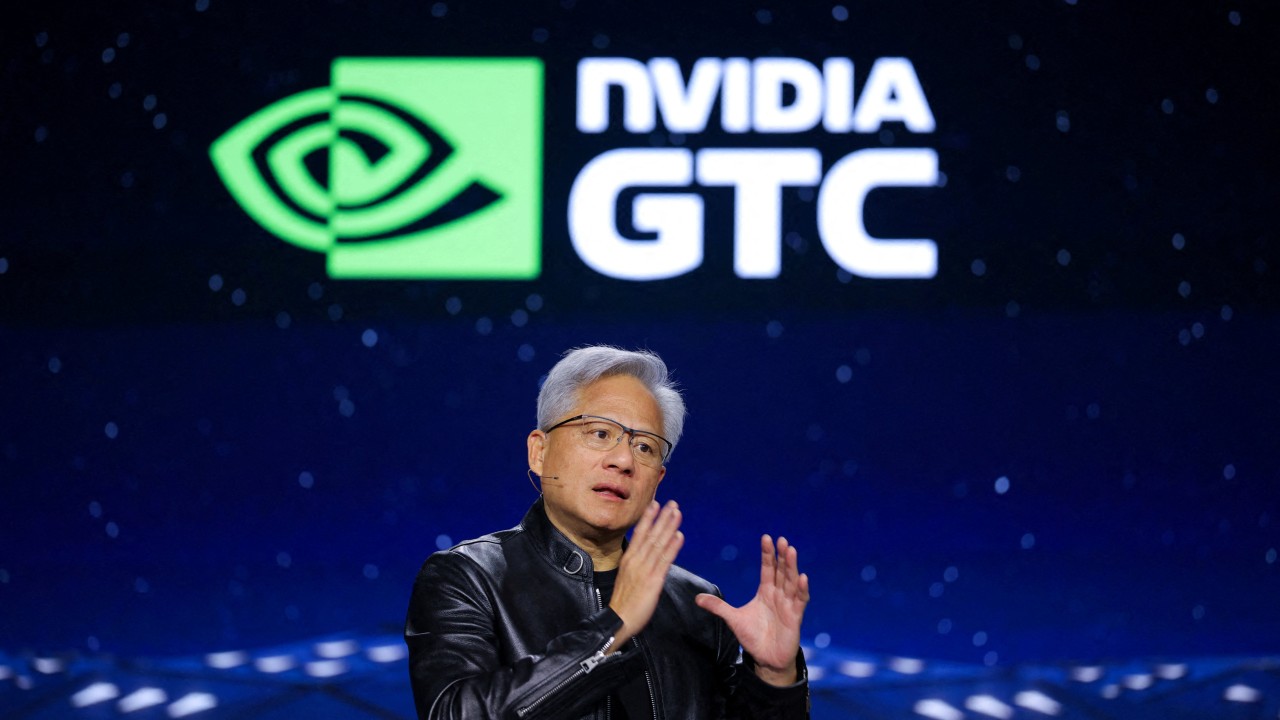
Jensen Huang wears a leather jacket like armor. In the sterile, high-stakes theaters of global trade, it is a deliberate middle finger to the suit-and-tie formality of the past. But lately, even the armor looks a little heavy. When the CEO of Nvidia stood before a crowd recently to confirm that his company is once again spinning up production for AI chips specifically designed for the Chinese market, he wasn't just talking about hardware. He was talking about survival in a world that is rapidly carving itself into two separate digital realities.
Imagine a specialized workshop. In one corner, you have the most advanced tools ever forged by human hands—silicon brains capable of simulating the birth of galaxies or the folding of proteins. In the other corner, you have a massive, hungry audience eager to use those tools. Between them, a heavy iron curtain has been dropped by regulators in Washington. Jensen Huang’s job is to find the narrowest of gaps under that curtain and slide something through that is just powerful enough to be useful, but just "dim" enough to be legal.
This is the strange, high-stakes dance of the H20, L20, and L2 chips. They are the "variants." To a purist, they are the shadows of the mighty H100s that power the giants of Silicon Valley. To a pragmatist, they are the only bridge left standing.
The Architect of the Narrow Path
To understand the tension, you have to look at the math. For years, the flow of silicon was a river. Nvidia poured its best work into China, and China poured billions back into Nvidia’s coffers. Then came the export controls. The US government, fearing that AI could be used to sharpen the edge of a rival military, effectively cut the line. They didn't just ban the chips; they banned the potential of the chips.
Suddenly, the world’s most valuable semiconductor company found itself holding the keys to a kingdom it was no longer allowed to enter.
Huang didn't retreat. He pivoted.
The new chips are a masterclass in compromise. Think of it like taking a Ferrari and installing a speed governor that prevents it from ever going over 55 miles per hour. It’s still a Ferrari. The leather is the same. The aerodynamics are there. But the raw, terrifying power that the authorities fear has been surgically removed.
For a CEO, this is a grueling tightrope walk. If he makes the chip too fast, the US government pulls the plug and issues a fine that would make a small nation tremble. If he makes it too slow, Chinese tech giants like ByteDance, Tencent, and Alibaba will simply walk away. They will look to homegrown alternatives like Huawei’s Ascend processors. They will decide that a mediocre domestic chip is better than a hobbled American one.
The Invisible Stakes at the Border
There is a human cost to these technical limitations that rarely makes it into the quarterly earnings calls. Somewhere in a laboratory in Shenzhen, a researcher is trying to train a medical AI to detect early-stage lung cancer. They need compute power. They need it in vast, staggering quantities. When the high-end chips are throttled, that training takes longer. A model that might have been ready in two weeks now takes two months.
In that gap, lives are shaped by the speed of a bus width and the bandwidth of a memory interface.
The struggle isn't just about "business." It’s about the fracturing of the human intellectual collective. For decades, the tech world operated on the assumption that the best ideas would win because the best hardware was available to everyone with a checkbook. We are now entering an era of "Splinternet" at the hardware level. We are building two different futures: one powered by unrestricted silicon in the West, and one powered by the "variants" and the ingenious workarounds of the East.
Huang knows this. He has admitted that the competition in China is fierce, and not just because of the regulations. The local players are hungry. They are building their own ecosystems. Every day that Nvidia spends "restarting" production of a nerfed chip is a day that a Chinese startup spends trying to make Nvidia obsolete.
The Mechanics of the Workaround
When Huang talks about restarting production, he is signaling to the markets that the "compliance" phase is over and the "execution" phase has begun. The H20 is the flagship of this new, restricted fleet. It is a strange beast. In some specific tasks, like moving data quickly between parts of a network, it is actually quite sophisticated. But when it comes to the raw "thinking" power—the FLOPS that define AI supremacy—it is a fraction of its American sibling.
It is a chip designed by lawyers as much as by engineers.
The complexity of this supply chain is almost impossible to grasp. A chip might be designed in California, using software from a different US state, manufactured in Taiwan using machines from the Netherlands, and then finally packaged and sent to a data center in Beijing—all while staying within a set of rules that change every few months.
One wrong move and the entire machine grinds to a halt.
Consider the engineers at Nvidia who spent their lives trying to make things faster. Now, a subset of them is tasked with the opposite: how do we make this slower in just the right way? It is a counter-intuitive form of brilliance. It’s like asking a poet to write a masterpiece using only four-letter words. It can be done, but the strain shows in the meter.
The Ghost in the Machine
There is a quiet desperation in the way the global market is reacting to these developments. Investors watch Huang's words for any sign of a thaw or a deeper freeze. The "variant" chips represent a multibillion-dollar gamble that the Chinese market still wants what Nvidia is selling, even if it’s a diluted version.
But there is a deeper question lurking beneath the spreadsheets.
What happens to the soul of an industry when it becomes a tool of geopolitics? Silicon was supposed to be the sand we turned into gold to lift everyone up. Now, it is the wall we build to keep others out. Huang is trying to be the gatekeeper who keeps the gate just a tiny bit ajar. He is a businessman, yes, but he is also a weaver trying to keep a global fabric from tearing completely in half.
The "variants" are more than just products. They are a confession. They are an admission that the era of a unified tech world is over. We are now in the age of the "good enough" for some, and the "best possible" for others.
The leather jacket remains zipped tight. The production lines are humming again in a new, cautious rhythm. The chips are moving across the water, carrying with them the hopes of a trillion-dollar company and the limitations of a divided world. Jensen Huang has found his gap under the curtain. For now, the bridge still holds, even if the toll to cross it is getting higher every single day.
The silicon is cooling. The crates are being packed. Somewhere, a data center is waiting for a shipment of chips that are exactly as powerful as the law allows them to be, and not a single transistor more.