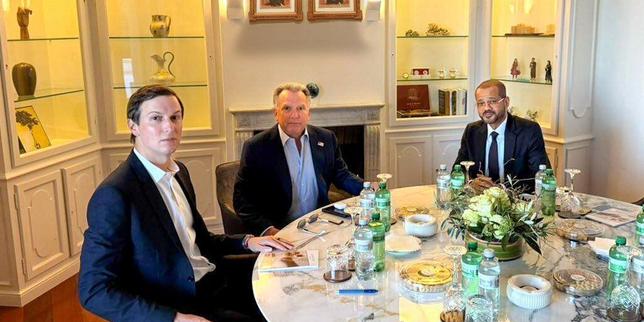
The air in Geneva during the autumn of 2003 didn’t smell like revolution. It smelled of old wood, expensive coffee, and the damp, metallic scent of Lake Geneva hitting the stone embankments. Inside the hotels, men in sharp suits paced over Persian rugs, their mobile phones chirping with the frantic energy of a world trying to prevent a war. Among them was Jonathan Powell. As Tony Blair’s Chief of Staff, Powell wasn't just a spectator; he was a mechanic in the engine room of global diplomacy, trying to tighten a bolt that had been loose for decades.
We often talk about the Iranian nuclear program as a series of cold, technical milestones—centrifuges, enrichment percentages, and heavy water reactors. But in those rooms, it was about the twitch of an eye or the way a negotiator held his pen. Powell’s recent reflections pull back a heavy curtain. He reminds us that there was a moment, long before the headlines of the 2015 JCPOA, when the trajectory of the Middle East nearly veered toward a different horizon.
Progress is a fragile thing. In 2003, it looked like a specific set of concessions.
The Architect in the Room
Imagine standing in a room where the floor is made of thin glass. On one side, you have an Iranian delegation desperate for domestic legitimacy and technological autonomy. On the other, a European trio—the UK, France, and Germany—acting as a buffer against a Washington administration that was, at the time, deeply skeptical of any talk that didn't involve "regime change."
Powell’s testimony confirms what many suspected: the Iranians were prepared to go further than the public ever knew. They weren't just offering glimpses of their facilities; they were discussing the very limits of their ambition. The "Geneva spirit" wasn't a myth. It was a tangible, electric tension where both sides realized they were inches away from a handshake that could have redefined the 21st century.
Why does this matter now? Because we tend to view history as an inevitable march of events. We assume that because tensions exist today, they were always destined to be this high. Powell’s account shatters that complacency. He describes a roadmap that was already being drawn—one where Iran’s nuclear program was boxed into a strictly civilian corner in exchange for the lifting of the suffocating shroud of sanctions.
The Weight of a Centrifuge
To understand the stakes, you have to understand the $U^{235}$ isotope. It is the heart of the matter. In a nuclear power plant, you need a low concentration of it—roughly 3% to 5%—to boil water and turn turbines. To make a bomb, you need to push that concentration toward 90%.
The gap between those two numbers is where diplomacy lives. The Iranians in Geneva were arguing for their right to the lower numbers. The Europeans were trying to build a cage that ensured they could never reach the higher ones. Powell watched as the technicalities of "breakout time"—the period it would take to rush to a weapon—became the rhythm of their lives.
Every time a technician in Natanz adjusted a valve, a diplomat in Geneva lost sleep. The fear wasn't just about a bomb. It was about a regional arms race that would turn the Persian Gulf into a tinderbox. If Iran crossed the line, their neighbors would feel forced to follow. The math was simple. The consequences were infinite.
The Invisible Saboteur
If the progress was real, why did it fail? Powell points toward a phantom that haunts every negotiation: the fear of looking weak at home.
In London and Paris, there was the pressure of the "Special Relationship" with a post-9/11 United States. In Tehran, there was the internal friction between the reformists, who saw a future integrated with the West, and the hardliners, who viewed every concession as a betrayal of the 1979 Revolution.
Consider the hypothetical case of a mid-level Iranian engineer in 2004. He has spent his life studying physics. He believes he is building a future of energy independence for his children. Then, he hears that his government might mothball his work to please people in Geneva he has never met. To him, this isn't about safety; it's about national pride. Now, imagine a voter in Ohio or a deputy in the Knesset. To them, that same engineer is a threat to their very existence.
Powell lived in the space between these two fears. He saw that the technical hurdles were solvable. The math worked. The monitoring systems were ready. The "invisible stakes" weren't the number of centrifuges, but the amount of trust that could be squeezed out of a history defined by mistrust.
A Ghost in the Machinery
The tragedy of the 2003–2005 period, as Powell frames it, is the "What If."
What if the West had been more willing to acknowledge Iran's right to peaceful energy sooner? What if Tehran had been more transparent before the satellites caught them? The progress recorded in Geneva wasn't just paper; it was a bridge. But bridges require anchors on both sides of the river.
When the negotiations eventually stalled and Mahmoud Ahmadinejad rose to power in 2005, the bridge didn't just collapse—it burned. The centrifuges started spinning faster. The sanctions grew teeth. The "cold facts" of the competitor’s article mention that progress was recorded. But the human story is that this progress was a heartbeat that flatlined because the doctors couldn't agree on the medicine.
Diplomacy is often mocked as a series of expensive dinners and vague communiqués. Powell’s perspective suggests it is more like a high-stakes poker game where the players are betting with the lives of millions. In Geneva, they had a winning hand. They just didn't have the nerve to play it.
The Echo of the Lake
Today, the hotels in Geneva still stand. The lake is still cold. The nuclear issue remains an open wound, scarred over by various deals and withdrawals, yet never truly healed. We see the echoes of Powell’s experience in every modern headline about uranium enrichment levels or drone exports.
The lesson isn't that diplomacy is easy. The lesson is that it is possible, but it has a shelf life. Opportunities in geopolitics are like isotopes; they have a half-life. If you don't use the energy when it's peaking, it decays into something toxic.
Powell confirms that the 2003 breakthrough was more than a fluke. It was a proof of concept. It showed that even the most bitter enemies could find a common language if the threat of catastrophe was loud enough. But it also serves as a haunting reminder: in the world of power, "almost" is the most dangerous word in the language.
We are still living in the shadow of those 2003 rooms. Every time a new round of talks begins, the ghosts of Geneva are there, hovering over the table, reminding the new generation of negotiators that the difference between a legacy of peace and a legacy of tension is often just a few inches of movement on a Persian rug.
The centrifuges continue to spin, humming a low, mechanical tune that drowns out the quiet voices of the men who once thought they had found a way to stop them.