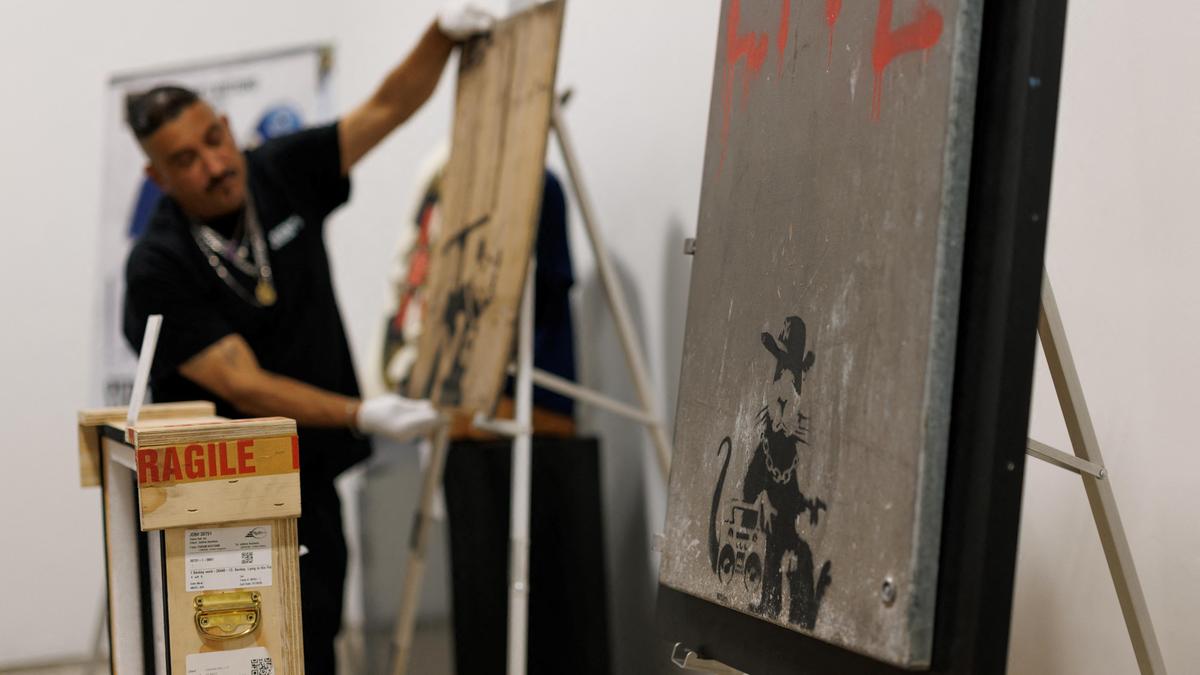
A damp brick wall in Bristol does not usually command a secondary market value of several million dollars. It is just a wall. It smells of wet soot and old rain. But when a silhouette appears on that wall overnight—perhaps a child clutching a balloon or a riot policeman with a face made of flowers—the molecular structure of the neighborhood changes. People stop. They stare. They pull out phones with shaking hands. They realize that a ghost has visited them.
For three decades, the world has been obsessed with unmasking this ghost. We call him Banksy.
The hunt for his identity has become a subculture of its own, a frantic digital and physical dragnet involving geographic profilers, forensic art historians, and jilted former associates. They want a name. They want a birth certificate. They want a face to pin to the legend so they can finally stop wondering. But as the search intensifies, we are discovering that the name is the least interesting thing about him. The chase is not actually about a man from Bristol named Robin Gunningham or anyone else. It is about our own desperate need to own the wind.
The Mathematical Net
Imagine a map of London or Bristol covered in tiny, glowing red dots. Each dot represents a confirmed piece of street art. In 2016, researchers at Queen Mary University of London decided to treat Banksy like a serial killer or a localized disease outbreak. They used a technique called geographic profiling.
The logic is cold and surgical. Even a phantom has to sleep. Even a legend has to buy milk. By analyzing the spatial coordinates of 140 artworks, the researchers identified "hot spots"—clusters of activity that point toward a home base. The math didn't lie. The clusters centered around a handful of addresses associated with a man who had been previously linked to the artist by investigative journalists.
The data suggested the mystery was solved. The "Man Behind the Mask" had been mathematically cornered. Yet, the world didn't exhale. The market didn't crash. The mystery didn't evaporate.
Why? Because knowing where a man lives does not explain how he managed to stay invisible in the most surveilled cities on Earth. It doesn’t explain how he sneaks into the British Museum to hang a mock cave painting of a stick man pushing a shopping cart. The facts provide a skeleton, but the skin and soul of the story remain elusive. We are looking for a person, but we are actually haunted by a process.
The Art of the Disappearing Act
To understand the stakes, you have to imagine the physical reality of the work. Street art is a high-speed heist. It is 3:00 AM. The air is biting. You have a heavy bag of stencils, several cans of high-pressure spray paint, and a lookout who is terrified of the police cruiser turning the corner two blocks away.
In this world, anonymity is not a marketing gimmick. It is a survival mechanism. If Banksy is caught, the legal ramifications involve massive property damage charges and potential jail time. More importantly, the spell is broken. The moment he becomes a middle-aged man with a mortgage and a favorite brand of cereal, the art becomes less about the message and more about the biography.
We live in an era of radical overexposure. We know what every celebrity eats for breakfast. We see their gym selfies and their messy public divorces. Banksy is the last holdout. He is the only person who has figured out how to be globally famous while remaining a total stranger. This creates a vacuum, and humans loathe a vacuum. We try to fill it with theories. We wonder if he is a collective of artists. We wonder if he is the lead singer of a famous trip-hop band. We wonder if he is a woman.
The Invisible Stakes
There is a specific kind of tension that exists when an artist refuses to be bought or branded. Consider the infamous 2018 Sotheby’s auction. The gavel fell on "Girl with Balloon" at $1.4 million. Seconds later, a shredder hidden inside the frame whirred to life. The painting began to self-destruct in front of a room full of the wealthiest art collectors in the world.
The room gasped. It was a prank. It was a tragedy. It was a masterpiece.
But look closer at the human element of that moment. The buyer didn't walk away. They kept the shredded remains, which actually increased in value, eventually selling for over $25 million. This is the irony of the Banksy hunt. The more we try to strip away his mystery, the more valuable the mystery becomes. We are trying to "solve" a puzzle that only gains power from being unsolved.
The invisible stakes are not about art history; they are about the soul of the public square. Banksy represents the idea that the city belongs to the people who walk its streets, not just the corporations that buy its billboards. When a new piece appears, it feels like a secret message from a friend. It is a reminder that someone is watching, someone is laughing, and someone is still out there, refusing to play by the rules.
The Cost of the Name
If the hunters eventually succeed—if a definitive, DNA-verified identity is splashed across every headline—something vital will die.
Think about the hypothetical "Real Banksy." Let's call him Mark. If Mark is forced into the light, he has to hire a publicist. He has to give interviews. He has to explain why he chose that specific shade of red for the balloon. The art stops being a mirror for our own frustrations and hopes and starts being "Mark’s opinion."
The search for Banksy has uncovered something much more profound than a name: it has revealed our collective discomfort with the unknown. We are so used to having the world's information at our fingertips that a single secret feels like an insult. We feel entitled to the man because we enjoy the work.
But the work only functions because of the shadow. The shadow allows the art to be universal. It allows a stencil in Bethlehem to carry the same weight as a stencil in Los Angeles. It removes the ego from the equation, leaving only the image and the viewer.
The Wall That Speaks Back
Last year, a new piece appeared on the side of a residential building. A crowd gathered within minutes. There were teenagers in hoodies, elderly women with shopping bags, and businessmen in tailored suits. They weren't arguing about geographic profiling or the mathematical probability of his identity.
They were talking about the image. They were laughing. They were feeling a brief, flickering moment of shared humanity in a world that usually feels fragmented and cold.
The investigators will keep digging. They will check flight records and credit card statements. They will use increasingly sophisticated AI to analyze the brushstrokes and the spray patterns. They might even find him. They might find the man who goes home at night, washes the silver paint off his cuticles, and goes to sleep.
But they won't find Banksy.
Banksy isn't a person. Banksy is the feeling you get when you realize the world is slightly more magical and slightly more rebellious than you were led to believe. He is the realization that a brick wall isn't just a boundary; it’s a canvas. He is the silence after the spray can clicks shut.
As long as we don't know who he is, he can be anyone. He can be the person sitting next to you on the bus. He can be the person who just walked past you in the rain. And in a world where everything is for sale and everyone is watched, that tiny sliver of mystery is the most valuable thing we have left.
The paint is still wet. The ladder is gone. The street is empty. And somewhere in the city, someone is walking home with paint under their fingernails, smiling at the sound of the morning sirens.
Would you like me to analyze the specific geographic profiling techniques used in the hunt for Banksy?