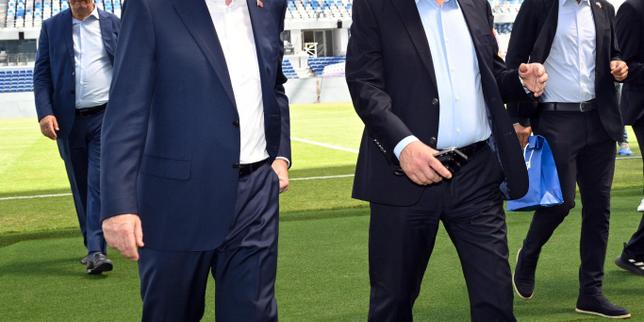
The grass on a World Cup pitch is supposed to be the most neutral soil on earth. For ninety minutes, borders dissolve into white lines and national anthems serve as the only permissible form of tribalism. But as the 2026 World Cup approaches, a strange, quiet tension has begun to leak into the blueprints of the tournament. Iran has announced a "boycott" of the event in the United States, yet they refuse to withdraw from the competition.
It sounds like a riddle. How do you skip a party you are actively fighting to attend?
To understand this, you have to look past the bureaucratic language of sporting federations and into the eyes of a player like "Arash." He is a composite of the many young men currently training in the heat of Tehran, but his dilemma is entirely real. Arash has spent four years—nearly fifteen percent of his entire life—sprinting until his lungs burn, all for a chance to stand in a tunnel in Los Angeles or New Jersey. He wants to hear the roar of a hundred thousand people. He wants to test his mettle against the best in the world.
But Arash is also a symbol. And symbols are heavy.
The Iranian government’s decision to boycott the "atmosphere" of the U.S.-hosted games while remaining in the bracket is a masterclass in political tightrope walking. They are essentially trying to participate in the sport without validating the host. It is a strike against the velvet ropes of diplomacy, a way to say, "We are here for the trophy, not for you."
The Shadow of the 1998 Miracle
History has a long memory in football. In 1998, Iran played the United States in Lyon, France. It was billed as the most politically charged match in the history of the sport. The world held its breath, expecting hostility, flying tackles, and perhaps a riot. Instead, the Iranian players walked onto the pitch carrying white roses. They handed them to the Americans. They took a joint team photo, arms draped over each other’s shoulders, smiling like brothers who had been separated by a fence they didn’t build.
Iran won that game 2-1. It remains the most celebrated victory in the nation’s history. Not because of the three points in the group stage, but because the players reclaimed the narrative from the politicians.
The 2026 "boycott" is an attempt to prevent that kind of spontaneous humanity from happening again. By labeling the participation as a boycott of the host nation's culture and politics, the authorities are trying to build a wall around their athletes. They want the performance without the connection. They want the goals, but they fear the white roses.
Consider the logistical nightmare this creates. A boycott usually means staying home. When the U.S. led a boycott of the 1980 Moscow Olympics, the athletes simply didn’t go. The lanes were empty. The medals were uncontested. This new version of a boycott is far more complex. It involves refusing to participate in promotional events, skipping gala dinners, and perhaps even avoiding the traditional cultural exchanges that make the World Cup a global festival.
The players become ghosts in the machine. They will arrive, they will play, and they will retreat into a self-imposed silence.
The Invisible Stakes of the Pitch
For the fans, the stakes are emotional. For the players, they are existential. In recent years, the Iranian national team—known affectionately as Team Melli—has found itself caught between a rock and a hard place. During the 2022 tournament in Qatar, the players remained silent during their national anthem as a show of solidarity with protesters back home. It was a moment of staggering bravery.
Now, they face a different kind of pressure. If they play in the U.S., every gesture will be scrutinized. A handshake with an American player could be seen as a betrayal by their government. A refusal to shake hands could be seen as a betrayal of the spirit of the game by the rest of the world.
This "boycott-but-not-withdraw" stance is a defensive crouch. It is an admission that the World Cup is too big to miss, but the United States is too complicated to embrace. The 2026 tournament is unique because of its scale, spanning the U.S., Canada, and Mexico. By focusing their ire on the U.S. portion of the hosting duties, Iranian officials are attempting to carve out a space where they can compete without conceding a single inch of ideological ground.
But football has a way of ruining the best-laid plans of bureaucrats.
The Physics of the Game
In physics, tension is the force transmitted through a string or wire when it is pulled tight by forces acting from opposite ends. The Iranian team is that wire. On one end is the weight of their government’s foreign policy and the strictures of a "boycott" designed to signal strength. On the other end is the kinetic, undeniable energy of the sport itself.
Imagine the opening whistle.
The ball moves. The politics of the visa office and the rhetoric of the state-run media outlets cannot keep up with a through-ball. When a striker is bearing down on the goal, he isn't thinking about the host nation’s foreign policy. He is thinking about the angle of his foot and the position of the goalkeeper. In those moments, the "boycott" vanishes. It has to. You cannot play elite football while looking over your shoulder.
The tragedy of this situation lies in the missed opportunities for the fans. The World Cup is one of the few times the Iranian diaspora, spread across North America, gets to see their heroes in person. Thousands of Iranians living in California, Texas, and New York have been waiting for decades for this. For them, the team is a bridge to a home they might not have seen in years. By "boycotting" the event while participating, the government is essentially trying to dim the lights on that bridge.
The Mechanics of Silence
There is a specific kind of loneliness in being an athlete in this position. Most players at the World Cup are celebrated as ambassadors. They are encouraged to soak in the atmosphere, to swap jerseys, to experience the host city. The Iranian players, under the cloud of this boycott, will likely be sequestered.
They will move from high-security hotels to armored buses to the pitch. They will be surrounded by minders whose job is to ensure that no "contamination" of Western influence occurs. It is a grueling way to experience the pinnacle of one’s career.
The irony is that the more the authorities try to make this about politics, the more the world focuses on the players' humanity. We find ourselves watching them not just for their footwork, but for their expressions. We look for the cracks in the facade. We wonder what they are thinking when the stadium lights hit them.
The 2026 World Cup will be the largest in history. More teams, more games, more noise. In that deafening environment, Iran’s "boycott" will be a strange, silent note. It is an attempt to participate in the global community while remaining apart from it.
But you cannot half-attend a World Cup. The gravity of the event is too strong. It pulls everyone in—the protesters, the politicians, the fans, and the players. You can refuse to attend the banquet, but you cannot refuse the sun when you walk out onto the grass.
When the first Iranian goal is scored on American soil in 2026—and it likely will be—the roar of the crowd will not be political. It will be the sound of thousands of people seeing themselves reflected in the struggle of eleven men who just want to play a game. At that moment, the boycott will be nothing more than a piece of paper in a file cabinet thousands of miles away.
The grass will stay green. The ball will stay round. And the ghosts will finally have to speak.