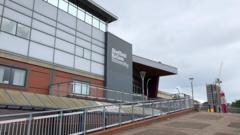
Dr. Aris Thorne spent seventeen years building a life out of paper and ink. His office, a cramped rectangle in a Victorian-era redbrick building, smells of damp binding and cheap coffee. On his desk sits a stack of final-year dissertations, each representing a student’s hope for a future that Aris no longer believes in. He recently received a generic email—the kind of digital cold-shoulder that modern HR departments specialize in—warning him that his "role is under review."
It is a polite way of saying the university is bleeding out, and he might be part of the discarded limb.
Across the United Kingdom, the ivory towers are cracking. We often think of universities as static monuments to wisdom, immune to the grubby fluctuations of the stock market. We are wrong. The modern university is a business, and right now, that business is failing. A perfect storm of stagnant tuition fees, a sharp decline in international student enrollment, and skyrocketing operational costs has left vice-chancellors staring at spreadsheets that simply do not add up.
The result is a looming wave of job cuts that threatens to gut the backbone of British higher education. But this isn't just about the loss of salaries or the closure of niche departments. It is about the slow death of the intellectual contract we made with the next generation.
The Math of the Abyss
To understand why Aris is packing his books into cardboard boxes, you have to look at the numbers, though the numbers are brutal. Domestic tuition fees for UK students have been frozen at £9,250 for years. While that sounds like a fortune to a nineteen-year-old, inflation has eroded its value to something closer to £6,000 in 2012 terms. Meanwhile, the heating bills for those drafty Victorian halls have tripled. The cost of pension contributions for staff has soared.
For a long time, the "international subsidy" kept the lights on. Students from Beijing, Lagos, and Mumbai paid three times the domestic rate, effectively bankrolling the local kids and the research labs. But recent visa restrictions and a changing global reputation have seen those numbers plummet. The golden goose didn't just stop laying; it flew away.
Now, university administrations are panicking. They are looking at "voluntary" redundancies, which are rarely truly voluntary, and compulsory cuts that target everything from the history department to the janitorial staff. The University and College Union (UCU) is currently balloting its members for industrial action. They are preparing for a strike, not because they want to walk out on their students, but because they feel they are being pushed off a cliff.
Imagine standing at the front of a lecture hall, trying to explain the complexities of the French Revolution while knowing that your own professional world is about to be guillotined.
The Invisible Stakes
When a university cuts jobs, the first thing to go isn't the prestige. It’s the time.
In a healthy system, a professor is a mentor. They are the person who notices when a quiet student in the back row finally "gets" a concept. They are the ones who spend hours in one-on-one tutorials, sharpening a student's ability to think critically. When you cut 10% of the staff, you don't just lose 10% of the lectures. You lose 100% of the "extra" time that makes education transformative rather than transactional.
Consider a hypothetical student named Sarah. She’s the first in her family to attend university. She struggles with imposter syndrome and a complex statistics module. In the old world, Aris would have seen her after class, walked her through the data, and convinced her she belonged there. In the new world—the world of "efficiency savings"—Aris is managing a caseload of 400 students instead of 150. He is drowning in administrative paperwork designed to prove his "value" to a committee that has never stepped foot in his classroom.
Sarah doesn't get that meeting. She falls behind. She drops out. The university loses her tuition, and the country loses her potential. This is the hidden cost of the "warning" issued by the University and College Employers Association (UCEA). They speak in terms of "sustainability" and "financial resilience." They rarely speak about Sarah.
The Strike Ballot as a Last Resort
The ballot for strike action is often painted as a nuisance. To the public, it looks like canceled classes and graduation delays. It looks like ego. But for the person holding the picket sign, it is a desperate attempt to signal that the machine is broken.
Staff are being asked to do more with less, while their real-term pay has dropped by roughly 25% since 2009. They are watching their colleagues disappear, only to have the workload redistributed among those who remain. It is a slow-motion collapse of morale.
The unions argue that the current funding model is a "death spiral." If you cut the staff, the quality of the education drops. If the quality drops, the university becomes less attractive to students. If student numbers fall, you have to cut more staff.
Where does it end?
It ends with "zombie universities"—institutions that exist on paper, charging top-tier prices for a hollowed-out experience. It ends with a two-tier system where only the ultra-wealthy elite institutions can afford to keep their poets and their philosophers, while the rest of the country is funneled into "skills-based" training centers that lack the soul of higher learning.
The Great Rebranding of Knowledge
There is a pervasive myth that universities are just factories for degrees. We’ve started treating a BA or a BSc like a product you buy off a shelf. You pay your money, you put in your hours, and you receive a piece of paper that guarantees you a slightly better salary in a cubicle somewhere.
If that’s all a university is, then job cuts are just a corporate restructuring. No big deal.
But a university is supposed to be a community of inquiry. It is one of the few places left in our society where the primary goal isn't profit, but the pursuit of truth for its own sake. When we allow that to be eroded by market logic, we lose something we can't easily buy back.
We are seeing a mass exodus of talent. Young researchers, the brightest minds of their generation, are looking at the precarity of the UK's academic job market and deciding to leave. They go to industry. They go to the US. They go to Germany. They go anywhere that doesn't feel like a sinking ship.
Aris watches his youngest PhD student, a brilliant woman specializing in sustainable urban planning, pack her bags for a private consultancy firm. She doesn't want to leave. She loves teaching. But she also wants to be able to pay her rent and know that her job will exist in six months.
"I can't build a life on 'maybe,'" she told him.
The Silence of the Halls
The halls are quieter now, and not just because it’s the end of the term. There is a weight in the air, a sense of an ending.
The employers’ associations warn that without these "painful adjustments," some institutions may face total insolvency. They aren't necessarily lying. The financial reality is grim. But the solution cannot be to simply cannibalize the very people who make the institution worth saving.
We are at a crossroads. We can choose to fund our universities as the public goods they are, acknowledging that an educated, critical-thinking populace is the bedrock of a functioning democracy. Or we can continue to treat them as failing businesses, trimming the "fat" until there is nothing left but the bone.
The strike ballot isn't just about pay or pensions or even job security. It is a referendum on what we value. It is a question asked of the government, of the public, and of the students: Is the ghost of a university enough for you? Or do you want the real thing?
Aris turns off his desk lamp. The room falls into shadow, leaving only the faint glow of the streetlights outside reflecting off the windowpane. He leaves the stack of dissertations for tomorrow. If there is a tomorrow.
He walks out the heavy oak doors, his footsteps echoing in a hallway that was once full of noise, debate, and the messy, beautiful friction of minds meeting. Now, it just feels like an empty corridor in a building that is slowly forgetting why it was built in the first place.
The ballot closes next week. The silence that follows will be the loudest thing of all.