The Persian Gulf is not a place for the claustrophobic. Between the jagged coast of Iran and the sandy reaches of the Arabian Peninsula, the water narrows into a choke point so tight you can almost smell the exhaust from the tankers crawling through it. This is the Strait of Hormuz. One-fifth of the world’s oil passes through this needle’s eye. When a massive vessel—a steel island worth hundreds of millions—slows down here, it isn't just a ship. It is a target.
For decades, the math of naval warfare in these waters was simple and terrifying. On one side, you had the massive, billion-dollar destroyers of the U.S. Navy. On the other, the Iranian Revolutionary Guard Corps (IRGC) utilized swarms of fast-attack boats. These are small, nimble, and manned by sailors willing to play a lethal game of chicken. It was an asymmetrical nightmare: a sledgehammer trying to swat a cloud of hornets.
But the silence in the Gulf is changing. The hornets are still there, but the sledgehammer is being replaced by something invisible, patient, and entirely empty.
The Sailor Who Isn't There
Imagine a young Lieutenant named Sarah. In the old world, Sarah would be standing on the bridge of a Mark VI patrol boat, squinting through salt spray at a fast-moving contact on the horizon. Her heart would be hammering against her ribs. Every closing meter would be a calculation of life and death. If she fires too early, she starts a war. If she fires too late, her crew dies in a drone-boat explosion.
In the new world, Sarah is sitting in an air-conditioned command center in Bahrain. She is three hundred miles away from the humidity and the smell of diesel. Before her is a wall of monitors. She isn't steering a ship; she is supervising a ghost.
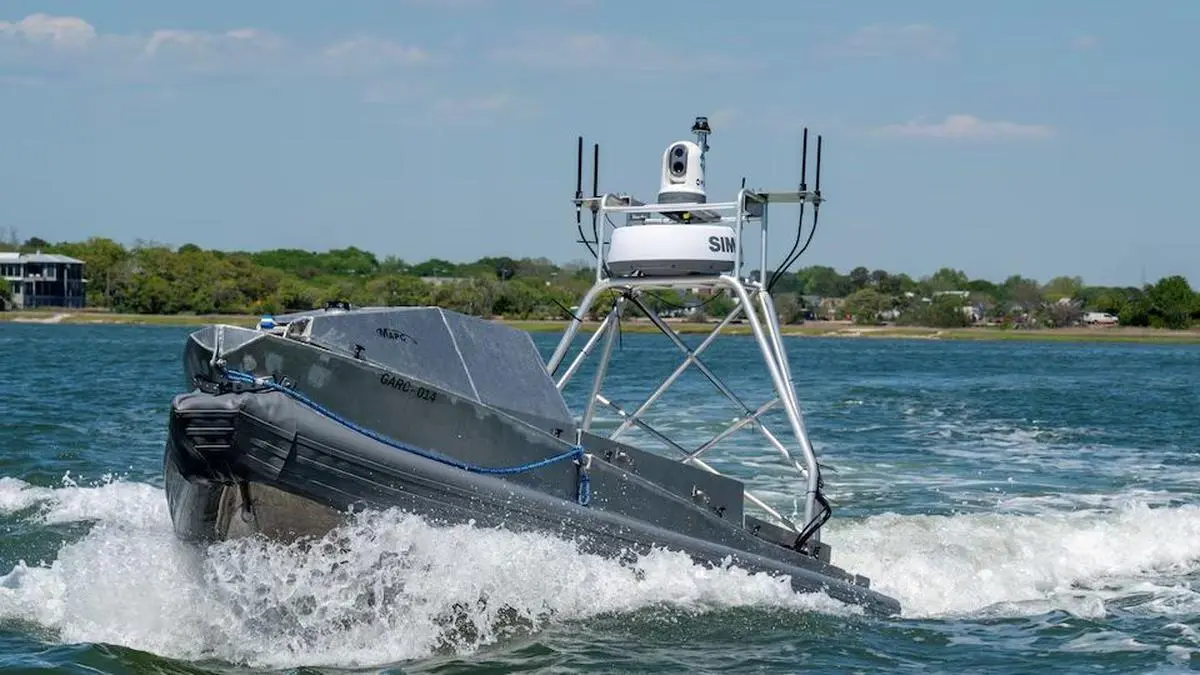
The vessel she’s watching is a Saildrone Explorer. It looks like a high-tech surfboard with a vertical wing. It has no engine. It moves by the wind and draws its power from the sun. It makes no noise. For weeks at a time, these uncrewed surface vessels (USVs) bob in the choppy waters of the Gulf, their cameras spinning 360 degrees, their sensors mapping every wave and every hull.
When an Iranian patrol boat approaches, the USV doesn't flinch. It doesn't have a pulse to quicken. It simply transmits high-definition video back to Sarah’s screen. The "human element" hasn't been removed from the conflict; it has been elevated. By taking the sailor off the water, the Navy has stripped the enemy of their greatest leverage: the threat of American casualties.
The Logic of the Unmanned
The shift toward USVs in the Middle East isn't just a shiny tech upgrade. It is a desperate necessity born of two brutal truths.
First, the U.S. Navy is shrinking. While the headlines talk about a 355-ship goal, the reality is a fleet struggling with maintenance backlogs and aging hulls. We cannot build enough traditional destroyers to be everywhere at once.
Second, the cost of a single Tomahawk missile can exceed $2 million. Using one to take out a $50,000 explosive motorboat is a losing mathematical equation. The Pentagon calls this "cost imposition." If it costs you more to defend than it costs your enemy to attack, you will eventually go broke or run out of ammo.
Enter Task Force 59.
Based out of Manama, Bahrain, this unit is the Navy’s experimental laboratory for the future of war. They don't buy these boats the way the military used to buy hardware—with twenty-year contracts and mountain-sized manuals. They treat them like software. They "lease" the capability. They use off-the-shelf sensors. They iterate.
The fleet includes various "species" of drones. There is the MANTAS T12, a low-profile vessel that screams across the surface like a shadow. Then there are the L3Harris Arabian Fox boats, which can stay out for days, acting as picket lines.
These aren't just toys. In late 2022 and early 2023, the tension turned physical. Iranian forces actually attempted to seize several of these drones, literally hauling a Saildrone behind a support ship in one instance. In the past, such an act against a U.S. vessel might have sparked a kinetic exchange. But because there were no Americans on board, the Navy was able to respond with measured, de-escalating pressure. They shadowed the Iranians, sent out a clear "we see you" signal, and eventually, the drones were released.
The machine took the hit so the human didn't have to.
The Nervous System of the Sea
If you look at a map of the waters around the Arabian Peninsula, you see a mess of shipping lanes. It’s a logistical jigsaw puzzle. Traditional radar struggles with the "clutter" of small wooden dhows, fishing boats, and waves.
This is where the true power of the USV lies. It isn't in the hull; it’s in the Artificial Intelligence.
Each drone in Task Force 59 acts as a neuron in a vast, floating nervous system. Using machine learning, these vessels "learn" what normal looks like in the Strait of Hormuz. They know the patterns of the local fishermen. They know the typical speed of a commercial tanker.
When something "abnormal" happens—a boat moving too fast, a vessel circling a platform, a ship turning off its transponder—the AI flags it. It doesn't ask a human to watch ten thousand hours of empty ocean. It sends an alert: Look at this. This doesn't belong.
Consider the stakes of a mistake. If a human sensor operator is tired after a twelve-hour shift and misses a smuggling boat carrying components for ballistic missiles, those parts end up in Yemen. From Yemen, they become a threat to regional stability. The USVs don't get tired. They don't get bored. They don't need coffee.
The Invisible Stakes
Critics of this "drone-first" strategy argue that we are losing the "presence" that a massive grey hull provides. There is a psychological weight to a carrier strike group appearing on the horizon. A surfboard with a camera doesn't exactly scream "superpower."
But there is a different kind of power in ubiquity.
When an adversary knows that every square inch of the water is being watched by something they can't easily kill or intimidate, their options shrink. You can't hide in the "noise" if the noise is being analyzed by a supercomputer in real-time.
We are moving into an era of "persistent surveillance." The goal isn't to win a battle; it’s to make the battle impossible to start. By the time a hostile actor decides to move, the USVs have already transmitted their signature, their speed, and their heading to a hovering Reaper drone or a nearby littoral combat ship.
The secret is that these drones aren't weapons. They are eyes. And in the narrow, paranoid corridors of the Persian Gulf, sight is the most dangerous weapon of all.
The Friction of the Future
It would be a mistake to think this transition is smooth. The salt water of the Middle East is a brutal environment. It eats electronics. It corrodes sensors. Barnacles grow on everything. A drone that works perfectly in a calm lake in Virginia will fail in three days in the high-salinity, high-heat reality of the Gulf.
There is also the "Trust Gap."
Older commanders, raised on the gospel of the "Salty Sailor," are often skeptical of trusting a mission to a black box. They worry about hacking. They worry about "spoofing," where an enemy tricks the drone's GPS into thinking it’s somewhere else.
But the data is winning the argument. During recent exercises, the USV fleet was able to identify "dark vessels"—ships trying to hide their identity—at a rate significantly higher than traditional patrols. They found the needles in the haystack because they were the haystack.
The Silent Watch
Tonight, somewhere near the Abadan peninsula, a small, white vessel is cutting through the waves. It has no lights. It has no crew. To a passing fisherman, it looks like a piece of debris or a stray buoy.
But inside its composite hull, processors are humming. It is capturing the infrared signature of every boat that passes. It is listening to the radio chatter. It is stitching together a digital twin of the entire Gulf.
Back in a dark room in Bahrain, a screen flickers. A red box appears around a fast-moving boat coming off the Iranian coast.
Sarah takes a sip of her water. She zooms in. She sees the crates on the deck of the boat. She sees the men on board. She hasn't even broken a sweat, yet she has already won the first move of a game the other side doesn't even realize is being played.
The ocean has always been a place of mystery, a vast blue void where things could disappear. That era is ending. The water is becoming a giant sensor, an intelligent skin that feels every ripple and records every sin.
The ships are getting smaller. The sailors are moving further away. But the watch has never been more intense. We have traded the roar of the deck gun for the hum of the hard drive, and in doing so, we have turned the most dangerous waters on Earth into a laboratory for a war that—if we are lucky—will never need to be fought with anything other than data.
Beneath the moon, the Gulf remains restless, but the ghosts are winning.