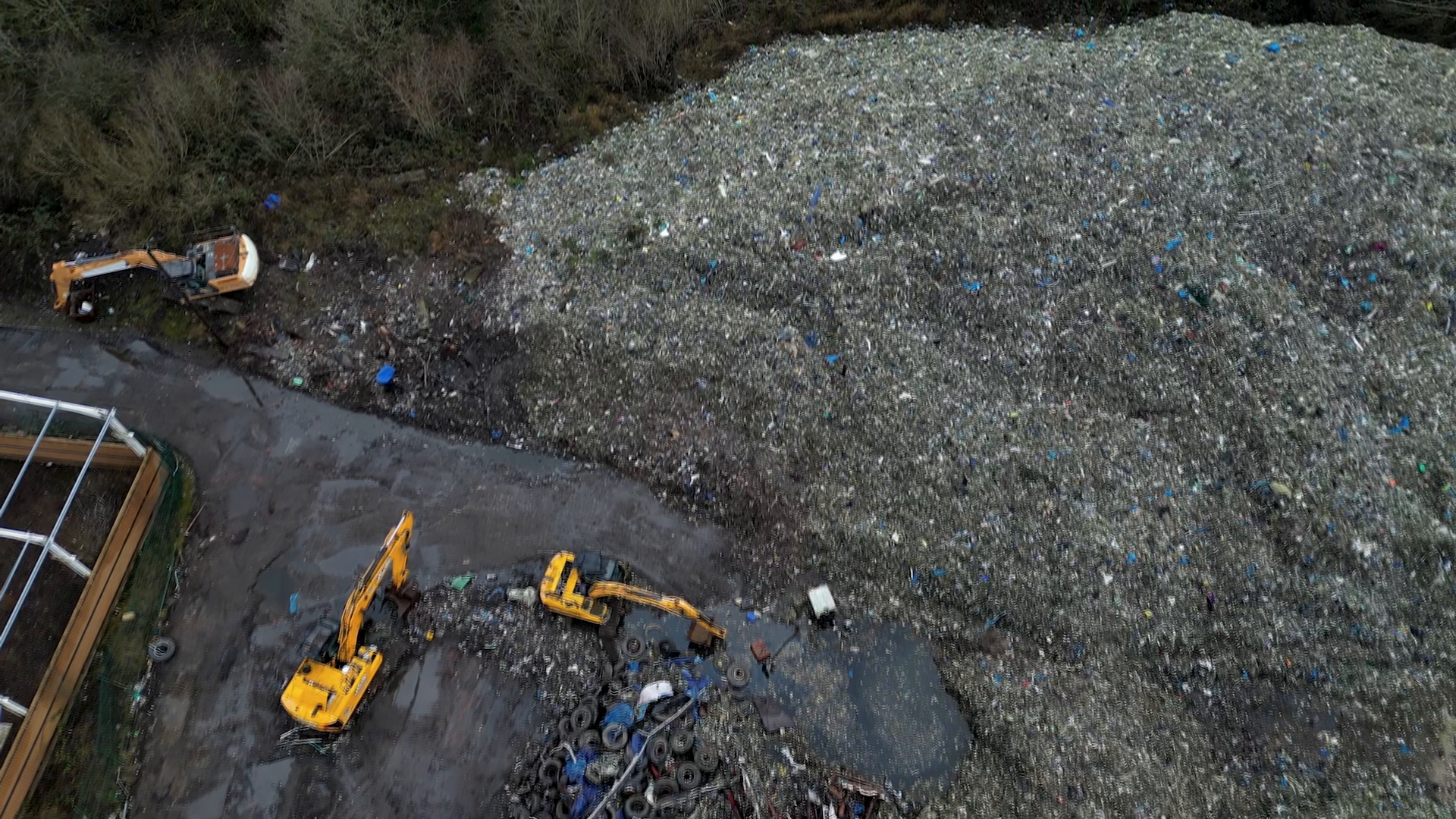
The wind across the Pennines doesn’t just carry the scent of rain anymore. In certain corners of Lancashire, West Yorkshire, and County Durham, it carries the sharp, metallic tang of rot. It is the smell of a landscape being digested by its own waste.
For years, the "North" has been a convenient shorthand for industrial grit, but today that grit is being buried under mountains of illegal plastic, hazardous chemicals, and shredded tires. These are the illegal tips—monstrous, unauthorized landfills that materialize overnight in the skeletal remains of old warehouses or on the fringes of forgotten farmland. They are not just eyesores. They are ticking ecological time bombs, and for the first time in a generation, the government has finally decided to pay for the fallout. For a deeper dive into this area, we recommend: this related article.
The Night the Trucks Came
Imagine a man named Arthur. He is hypothetical, but his story is a composite of a dozen very real accounts from the outskirts of Leeds and Newcastle. Arthur lives at the end of a quiet lane where the streetlights flicker and the pavement gives way to gravel. One Tuesday, at three in the morning, the silence of the valley is shattered by the hydraulic hiss of a HGV. Then another. Then six more.
By dawn, the abandoned quarry behind his house isn't empty anymore. It is filled with fifteen hundred tons of "mixed municipal waste." In the parlance of the Environment Agency, this is a Category 1 incident. To Arthur, it is the end of his peace. The trucks are gone by sunrise, leaving behind a mountain of trash that nobody wants to claim and, until now, nobody could afford to move. For additional details on this topic, comprehensive analysis is available at TIME.
This is the reality of the illegal waste trade. It is a shadow economy worth billions, run by organized crime groups who realized that dumping a ton of toxic sludge is far more profitable than smuggling drugs. If you get caught with a kilo of cocaine, you go to prison for a long time. If you get caught dumping five hundred tons of construction debris in a field, you might get a fine that represents a fraction of your profit.
The Price of a Clean Slate
The official announcement was dry, as government papers usually are. It spoke of "targeted funding" and "remediation strategies" for the North of England. But peel back the Whitehall-speak and the stakes are visceral.
The government is committing millions to clear these specific, high-risk illegal sites. Why now? Because the poison is moving. When rain falls on an illegal tip, it creates "leachate." Think of it as a concentrated, toxic espresso made of battery acid, heavy metals, and decomposing organic matter. This liquid doesn't stay in the pile. It sinks. It finds the water table. It flows into the streams where children play and sheep drink.
The cost of clearing a single major illegal site can exceed £1 million. For a local council already struggling to keep libraries open and roads paved, that kind of bill is a death sentence for their budget. So, the waste sits. It festers. For years, the North has been trapped in a stalemate between underfunded local authorities and the brazen greed of fly-tippers. This new injection of federal cash is the first real attempt to break the deadlock.
The Invisible Architecture of Crime
We often think of fly-tipping as a man in a van dumping a mattress in a hedge. That is a nuisance. What we are dealing with in the North is industrial-scale environmental sabotage.
The criminals operate with a terrifying efficiency. They lease a warehouse under a shell company, claiming they are starting a recycling business. They fill the building from floor to ceiling with waste—charging "customers" a discounted rate to take it off their hands—and then they vanish. The landlord is left with a building full of rotting garbage and a cleanup bill that exceeds the value of the property.
It is a game of musical chairs where the music stops and the taxpayer is the one left without a seat.
The new funding isn't just about diggers and hazmat suits. It is about reclaiming the dignity of these towns. There is a psychological weight to living in a place that the rest of the country treats as a dustbin. When a community sees a mountain of trash sitting in their backyard for three years, it sends a message: You don't matter enough to justify the cost.
A War of Attrition
Cleaning up the mess is only half the battle. The other half is ensuring the trucks don't come back the moment the last shovel is put away.
The logic of the North’s geography—its vast stretches of uninhabited moorland and its network of quiet, post-industrial access roads—makes it an ideal playground for the waste mafia. The government’s plan includes enhanced surveillance and more "boots on the ground" to monitor high-risk zones. But can you really police every dark lane in Cumbria? Can you track every unmarked lorry moving through the night on the M62?
The skepticism in the local pubs is thick enough to cut with a knife. People have heard promises before. They have seen "task forces" formed and "initiatives" launched, only for the piles to grow higher. The difference this time is the cold, hard cash specifically earmarked for clearance. In the past, the money went to "strategy." Now, it’s going to the heavy machinery.
Consider the sheer scale of the physics involved. We are talking about tens of thousands of tons of material. Moving it requires a logistical operation akin to a small military invasion. You need specialized landfills that can safely take hazardous material—ironically, the very thing these illegal sites were trying to bypass. You need soil testing. You need air quality monitoring.
The Silence After the Shovels
There is a specific kind of beauty in the North that people elsewhere don't always understand. It is a beauty of recovery. It’s the way the moss grows over the old coal mines and the way the rivers have turned from orange to clear over the last forty years.
The illegal tips are a reversal of that progress. They are a regression.
When the government contractors eventually roll into a site, the first thing that happens is the noise. The grinding of gears and the beep-beep-beep of reversing loaders. It’s a violent process, unearthing years of compacted neglect. But then, after weeks or months, something strange happens.
The trucks leave. The fences stay up for a while. And then, the silence returns.
But it’s a different kind of silence than the one Arthur heard at three in the morning. It’s a clean silence. It’s the sound of a field being allowed to breathe again. The funding announced this week isn't just a line item in a budget; it is a down payment on that silence.
We are learning, painfully and at great expense, that there is no such thing as "away." When we throw things away, they go somewhere. For too long, "away" has been a hollowed-out valley in Lancashire or a derelict lot in Sunderland. The ghost acres of the North are finally being reclaimed, but the scars in the soil will remain long after the checks have cleared, a permanent reminder of what happens when we look the other way.
The rain still falls on the Pennines, but perhaps soon, it will only taste of water.