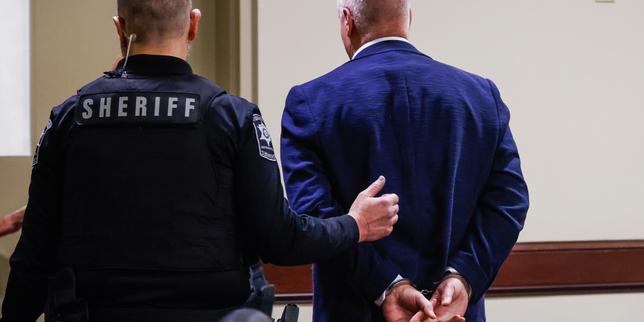
The American legal system just handed out a heavy dose of catharsis in Georgia, and everyone is high on it. Colin Gray, the father of the Apalachee High School shooter, was found guilty of involuntary manslaughter and reckless conduct. The media is calling it a landmark victory for accountability. The public is nodding in somber agreement, convinced that we have finally found the "pressure point" to stop the bleeding in our schools.
They are wrong.
This isn't a solution; it’s a distraction. By focusing on the "negligent parent" narrative, we are indulging in a collective fantasy that we can litigate our way out of a cultural and systemic collapse. We are treating a metastatic cancer with a designer bandage.
The Myth of the Deterrent Parent
The prevailing logic behind the prosecution of Colin Gray—and Jennifer and James Crumbley before him—is deterrence. The theory suggests that if parents know they will face decades in a cage for their child’s crimes, they will suddenly become hyper-vigilant. They will lock the gun safe. They will monitor the Discord chats. They will take the "red flags" seriously.
This assumes that the people we are targeting are rational actors capable of long-term risk assessment.
I have spent years analyzing the fallout of systemic failures in high-stakes environments. You cannot deter someone who is already living in a state of chaotic negligence. Colin Gray didn't give his son an AR-15 because he carefully weighed the legal risks and decided the rewards of "bonding" outweighed them. He did it because he was part of a broken, dysfunctional domestic ecosystem where the concepts of consequence and reality had already evaporated.
When a household has reached the point where a 14-year-old is planning a massacre, the threat of a future courtroom appearance is white noise. Deterrence works on the person who has something to lose. It does nothing to the person who has already lost their grip.
The AR-15 as a Tool of Negligence
Let’s dismantle the "it’s just about the gun" argument. The prosecution’s strongest lever was that Gray bought his son a weapon after the FBI had already visited their home regarding online threats.
The lazy consensus says: "Don't buy guns for troubled kids."
The harsh reality says: "The gun is the symptom of a parent who has outsourced his child's identity to a weapon."
In these specific cases, the firearm isn't just a tool; it’s a desperate, lazy attempt at parenting. It is "friend-parenting" at its most lethal. By focusing strictly on the hardware, we ignore the software. We are ignoring the fact that the state of Georgia—and most of the U.S.—has a mental health infrastructure that is essentially a sieve.
If we want to talk about "reckless conduct," let’s talk about a system that allows a child to be flagged by the FBI and then returned to the same environment with zero mandatory follow-up, zero state-funded intervention, and zero friction. We are blaming the father for not being a psychologist, while the actual psychologists are priced out of reach for families like the Grays.
The Liability Trap
By celebrating this verdict, we are opening a door that most people haven't looked behind yet. If we are going to hold parents criminally liable for the violent outbursts of their children based on "foreseeability," where does the line move next?
- Does a parent go to jail if their child kills someone while drunk driving in a car the parent bought?
- Is a mother liable if she ignores a daughter’s history of bullying, which leads to a classmate’s suicide?
- What happens when the "red flags" were reported to a school counselor who did nothing? Does the counselor face manslaughter charges?
We are moving toward a "vicarious liability" model in criminal law that has historically been reserved for civil suits. This is a desperate attempt to find a "villain with a pulse" when the shooter is a minor or has committed suicide. It feels good in the 6:00 PM news cycle, but it creates a legal landscape where the state can cherry-pick which parents to destroy based on how much the public demands blood.
The Institutional Escape Hatch
The most dangerous aspect of the Georgia verdict is that it grants a "Get Out of Jail Free" card to every institution that failed before the first shot was fired.
- Law Enforcement: They visited the house a year prior. They "cleared" the threat.
- The School System: They are often aware of the social isolation and behavioral shifts but are too hamstrung by bureaucracy or lack of funding to intervene effectively.
- The Healthcare System: Which treats adolescent crisis as a luxury issue rather than a public safety mandate.
When we put a father in handcuffs, the sheriff gets to stand at a podium and look tough. The school board gets to breathe a sigh of relief because the spotlight has moved from their hallways to a single family’s living room. We are hyper-individualizing a systemic rot.
The "People Also Ask" Fallacy
People ask: "Can this verdict stop school shootings?"
The answer is a brutal no.
If you think a father in Georgia going to prison stops a radicalized teen in another state from picking up a weapon, you don't understand the psychology of these events. These shooters don't care about their parents' future. Often, they despise their parents. In many cases, the parent is the first target.
People ask: "Should parents be held responsible?"
The answer is: Only if you are willing to hold the state to the same standard. If the parent is a criminal for missing the signs, the state is an accomplice for providing no roadmap to fix them. We are essentially telling parents: "You are on your own to raise a child in a digital minefield, but if you fail, we will bury you."
The Only Way Out
If we actually wanted to stop the next massacre, we would stop chasing the high of a "guilty" verdict and start building friction into the system.
- Mandatory Reporting with Teeth: If the FBI visits a home for a threat, that child should be under mandatory, state-monitored psychiatric evaluation for a minimum of 12 months. No exceptions. No "parental discretion."
- Universal Liability: If we charge the parent, we charge the school administrator who ignored the report. We charge the platform that hosted the radicalization. We make the pain of failure universal.
- The End of the "Lone Wolf" Narrative: We need to stop treating these as isolated incidents of "bad parenting" and start treating them as predictable outcomes of a culture that commodifies outrage and weaponizes isolation.
The Georgia verdict is a sedative. It makes us feel like the scales are balanced. But the scales are weighted with the bodies of children, and one father in a jumpsuit doesn't move the needle.
Stop cheering for the "precedent" and start looking at the vacuum that created it. We are convicting the survivors of a house fire for not owning a fire extinguisher, while the city continues to provide no water to the neighborhood.
The next shooter isn't checking the news for sentencing guidelines. He’s in his room, ignored by a system that thinks the job is done because a jury in Winder, Georgia, said "Guilty."
Go back to work. Nothing has changed.

.png?format=1500w)