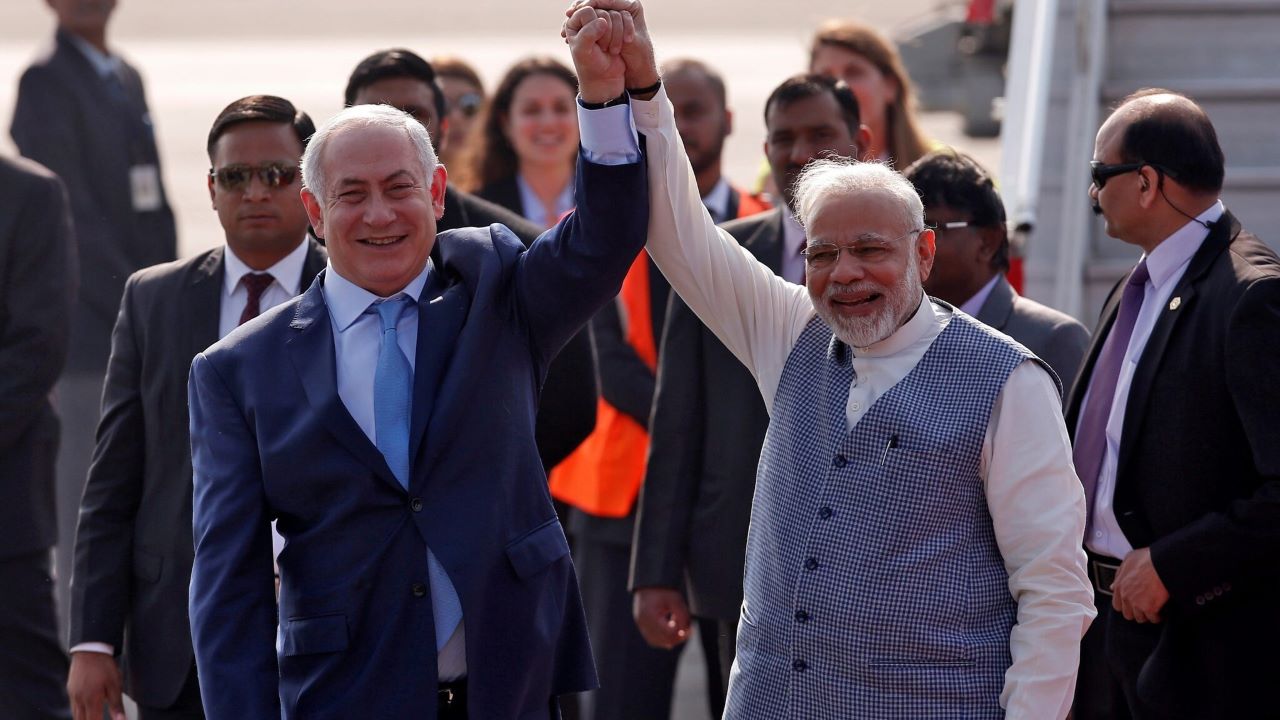
The February 2026 summit between Narendra Modi and Benjamin Netanyahu represents the final transition from a "buyer-seller" defense dynamic to a survival-oriented "Special Strategic Partnership." While previous diplomatic cycles emphasized the symbolic weight of high-level visits, the 2026 meeting serves as an operational hedge against regional instability and domestic political volatility. This alignment is driven not by sentiment, but by the convergence of India’s requirement for indigenous military self-reliance and Israel’s necessity to mitigate international diplomatic isolation through high-value export markets.
The Strategic Bilateral Utility Function
The relationship operates on a dual-utility function where both states optimize for specific, non-overlapping needs. This creates a high-resilience bond that resists the fluctuations of Middle Eastern regional politics.
- Israel’s Utility: Diversification of diplomatic support and economic revenue. Facing International Criminal Court (ICC) pressure and strained ties with traditional European allies, Tel Aviv utilizes India as a "Great Power" anchor that remains agnostic to Israel's internal legal and political friction.
- India’s Utility: Accelerated technology transfer to satisfy the Aatmanirbhar Bharat (Self-Reliant India) mandate. New Delhi leverages Israeli R&D to bypass the slow procurement cycles of Western aerospace and defense conglomerates.
The Pillar of Asymmetric Defense
The 2026 joint statement elevates the relationship to a "Special Strategic Partnership for Peace, Innovation, and Prosperity," but the core remains rooted in the co-production of asymmetric hardware. The 2025 Memorandum of Understanding on Defense Cooperation has transitioned from theoretical planning to hardware delivery.
- Direct Energy Weaponry: The integration of the 100kW-class Iron Beam laser system into the Indian defense architecture serves as a critical counter-measure to low-cost drone swarms, a vulnerability exposed during the May 2025 India-Pakistan aerial escalation.
- The Intelligence-Industrial Complex: The shift toward joint R&D through the I4F mechanism (India-Israel Industrial R&D and Innovation Fund) ensures that Israeli "source code" and algorithms are increasingly embedded in Indian-manufactured platforms, creating a long-term maintenance and upgrade lock-in.
De-hyphenation as a Structural Reality
The "de-hyphenation" of India’s relations with Israel and Palestine has evolved from a tactical choice to a structural baseline. India’s strategy now bifurcates its West Asian policy into two distinct silos:
- Silo A (Energy and Diaspora): Maintaining stability with the GCC and Iran to secure crude oil flows and protect the interests of millions of Indian expatriates.
- Silo B (Technology and Security): Deepening the "Strategic Intimacy" with Israel for defense, cyber-intelligence, and water management tech.
The friction between these silos is managed through "Strategic Autonomy." For instance, even as India supplied explosives to Tel Aviv during the 2024-2025 Gaza conflict, it simultaneously maintained its observer status on President Trump’s "Board of Peace" and continued investments in Iran's Chabahar Port. This dual-track approach signals that India will not permit its security requirements to be vetoed by regional ideological conflicts.
Domestic Politics: The Leverage and the Liability
The visit occurs against a backdrop of intense domestic pressure for both leaders, creating a unique "Political Insurance" mechanism.
The Netanyahu Survival Quotient
For Benjamin Netanyahu, the Modi visit functions as a domestic signaling tool. By hosting the leader of the world’s most populous nation, Netanyahu counters the domestic narrative of international pariah status. The "brotherhood" rhetoric—highlighted by the presence of Sara and Yair Netanyahu at the King David Hotel dinner—is designed for consumption by the Israeli electorate ahead of the October 2026 elections. It presents a vision of an Israel that is technologically indispensable to the Global South, thereby justifying his "security-first" doctrine.
The Modi Mandate
Narendra Modi’s 2026 return to Israel, the first since his historic 2017 trip, reinforces a foreign policy that is unapologetically nationalistic. By securing deals for the Iron Beam and AI-driven security platforms, the Modi administration demonstrates a "Mandate of Clarity." This strategy eliminates the hesitation of the Cold War era, replacing it with a clinical assessment of which partners provide the most rapid path to "Viksit Bharat 2047" (Developed India 2047).
Operational Bottlenecks and Risk Factors
Despite the high-velocity cooperation, three systemic bottlenecks persist:
- The "Indigenous Content" Threshold: India’s demand for high percentages of local manufacturing often clashes with Israel’s desire to protect its most sensitive proprietary algorithms.
- Labor and Mobility Friction: While the interbank payment link between NPCI and MASAV facilitates trade, Israeli labor unions continue to resist the large-scale mobility of Indian IT professionals and construction workers.
- The Iran Contradiction: India's refusal to abandon its strategic investments in Iran remains the primary irritant for Israeli intelligence circles. Israel views the "Shia Axis" as an existential threat, while India views Iran as a necessary gateway to Central Asia.
Strategic Forecast
The India-Israel partnership will increasingly move away from the "Mediterranean-centric" focus toward the India-Middle East-Europe Economic Corridor (IMEC). This transforms Israel from a mere arms supplier into a critical logistics node in India’s global trade architecture.
The next logical step for this partnership is the finalization of the Free Trade Agreement (FTA), which has remained stalled due to agricultural tariff protections. To unlock the next tier of value, New Delhi must transition from being a consumer of Israeli innovation to a co-owner of the intellectual property. This necessitates a shift from G2G (Government-to-Government) deals to B2B (Business-to-Business) deep-tech integration.
Would you like me to analyze the specific economic impact of the IMEC corridor on Israeli port valuations?