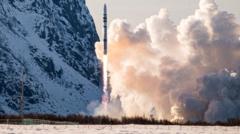
The shift of orbital launch infrastructure toward the Arctic Circle is not a matter of geographic novelty but a cold calculation of orbital mechanics and sovereign risk. For decades, the global space industry relied on equatorial or mid-latitude sites like Kourou or Cape Canaveral. However, the explosion in demand for Low Earth Orbit (LEO) small-satellite constellations has created a critical bottleneck. Polar and Sun-Synchronous Orbits (SSO) are now the high-value real estate for Earth observation and global telecommunications. Accessing these orbits from traditional sites requires complex "dog-leg" maneuvers to avoid overflying populated areas, which consumes precious propellant and reduces the net payload capacity of the launch vehicle. Arctic sites like Esrange in Sweden and Andøya in Norway eliminate this tax, offering a direct vertical corridor to the poles.
The Physics of Polar Advantage
The primary driver for the Arctic space race is the optimization of the Delta-v ($\Delta v$) budget. Launching from high latitudes provides a direct trajectory into polar orbits without the need for significant plane changes.
- Mass-to-Orbit Efficiency: A rocket launched from a northern latitude toward the pole does not need to cancel out the Earth's rotational velocity—which is approximately 460 meters per second at the equator but nears zero at the poles. While this rotational boost is a benefit for equatorial missions, it is a liability for polar ones.
- Launch Window Density: SSO and polar orbits require extremely precise launch windows. Sites above the 60th parallel provide multiple launch opportunities per day for certain orbital planes, a frequency that cannot be matched by lower-latitude facilities.
- The Buffer Zone: The Arctic offers vast, unpopulated ocean corridors (the Norwegian Sea and the Arctic Ocean) where first-stage boosters can fall safely without the diplomatic and safety constraints that plague more congested continental launch sites.
The Three Pillars of Arctic Launch Viability
The viability of a northern spaceport rests on three structural pillars: geographic latitude, rail and sea infrastructure, and sovereign stability.
Pillar I: Latitude and Delta-v
The proximity of sites like Esrange (Sweden) and Andøya (Norway) to the 67th and 69th parallels respectively minimizes the steering losses of the vehicle. This increases the mass-to-orbit ratio for small-satellite launch providers (SSLPs). When a 300kg payload is the difference between a profitable mission and a loss, the 10-15% efficiency gain from a high-latitude launch is the deciding factor in vehicle selection.
Pillar II: Logistical Resilience
The Arctic is traditionally perceived as a remote wasteland, but for space operations, it must function as a high-precision industrial hub. The Swedish Space Corporation (SSC) has integrated Esrange into the European rail and fiber-optic networks. This allows for the rapid transport of volatile propellants and sensitive satellite hardware. Without this integration, the high cost of Arctic logistics would negate any gains in orbital efficiency.
Pillar III: Sovereign Risk Mitigation
The geopolitical instability surrounding Roscosmos and the Baikonur Cosmodrome has left a massive vacuum in the launch market. Western satellite operators are moving away from dependency on Russian Soyuz launches. The Arctic North, specifically within the NATO and EU frameworks, offers a low-risk alternative. This is not about being "closer to space," it is about being closer to legal and insurance frameworks that protect high-value assets.
The Cost Function of Polar Infrastructure
Developing an Arctic launch site is significantly more capital-intensive than a mid-latitude facility. The "Arctic Tax" is a composite of three primary variables:
- Thermal Management: Launch vehicles and their ground support equipment (GSE) are engineered for specific temperature ranges. Maintaining the cryogenic state of liquid oxygen (LOX) in sub-zero environments requires advanced insulation and active heating systems, adding to the initial Capex.
- Construction Seasonality: Building launch pads and hangars in the Arctic is restricted by the winter season. The window for ground-breaking and heavy construction is limited to four to five months.
- Personnel Retention: Attracting specialized aerospace engineers to live in Kiruna or Andenes requires higher-than-average compensation packages and significant investment in local housing and amenities.
Mapping the Competitive Landscape
The Arctic space race is currently a two-way contest between Sweden and Norway, with the United Kingdom and Iceland positioning themselves as secondary players.
Sweden (Esrange)
Esrange is the most established player, having hosted sounding rockets and high-altitude balloons for decades. Their strategy centers on "Launch as a Service" (LaaS), where they provide the infrastructure for third-party launch providers like Isar Aerospace or Rocket Factory Augsburg (RFA). This model reduces the SSC's exposure to individual vehicle failure and positions them as the neutral utility provider for the European space sector.
Norway (Andøya Spaceport)
Norway’s strategy is more focused on deep-sea access. Because Andøya is an island, it offers even more flexibility in launch azimuths (the horizontal angle of the launch). Norway has aggressively pursued partnerships with major U.S. and European defense contractors, positioning their site as the premier hub for military and intelligence-gathering satellites that require polar coverage.
The United Kingdom (SaxaVord and Sutherland)
While not technically "Arctic," the Shetland Islands and the Scottish Highlands are the UK’s entry into the high-latitude market. Their geographic advantage is slightly lower than the Scandinavian sites, but they benefit from the UK's robust domestic satellite manufacturing industry. The UK model is one of vertical integration, where the satellite, the rocket, and the launch pad are all part of the same domestic ecosystem.
The Cause and Effect of the Small-Sat Explosion
The shift to the Arctic is a direct effect of the miniaturization of electronics and the decreasing cost of access to space.
- The Proliferation of LEO Constellations: Companies like SpaceX, OneWeb, and Kuiper require hundreds or thousands of satellites. These are not the multibillion-dollar geostationary (GEO) satellites of the past. They are short-lived, replaceable assets.
- Sovereign Capability Requirements: Countries now view space access as a national security requirement. Relying on a third-party nation for launch is a strategic vulnerability.
- The Data Latency Bottleneck: Real-time Earth observation for climate monitoring, maritime tracking, and military intelligence requires a revisit rate that only polar-orbiting constellations can provide.
The Institutional Failure of ESA
For years, the European Space Agency (ESA) focused almost exclusively on the Ariane and Vega programs launched from French Guiana. This centralized model failed to anticipate the rise of the micro-launcher market. The Arctic space race is, in many ways, an insurgent movement by individual nations (Sweden, Norway, UK) to bypass the slow-moving bureaucracy of ESA. By the time ESA’s "Boost!" program was fully operational, the private sector had already committed to northern launch sites. This decentralization of European launch capacity is a fundamental shift in the continent’s aerospace policy.
Strategic Bottlenecks: The Spectrum and The Slot
The ultimate constraint on the Arctic space race is not the number of launch pads, but the availability of radio frequency (RF) spectrum and orbital slots.
- RF Congestion: Every satellite needs to communicate with ground stations. The Arctic is already home to major ground station networks like SvalSat. As launch frequency increases, the risk of signal interference grows.
- Orbital Debris: Polar orbits are the most congested in terms of debris. A single collision in a polar plane creates a "debris ring" that affects every other satellite in that altitude. Arctic launch providers must now integrate debris mitigation strategies into their core business models to maintain insurance eligibility.
The Economic Model: Infrastructure vs. Vehicle
There is a historical parallel between the Arctic space race and the 19th-century railway booms. The real wealth was rarely in the locomotive companies, which were prone to bankruptcy, but in the land and the track infrastructure.
- The Infrastructure Play: Sweden and Norway are the track owners. They charge for pad usage, telemetry, and logistics. This is a low-margin but high-stability business.
- The Vehicle Play: The rocket companies (Isar, RFA, Orbex) are the locomotives. They face high R&D costs and extreme technical risk.
The success of the Arctic spaceports depends on the survival of these vehicle companies. If the micro-launcher market undergoes a consolidation—which is statistically likely—the northern spaceports will be left with overcapacity.
The Strategic Play: Multi-Orbit Resiliency
The next phase of the Arctic space race will be the move toward "Responsive Space." This is the ability to launch a replacement satellite within 24 to 48 hours of a primary asset being disabled or destroyed.
The strategic recommendation for any stakeholder in this sector is to focus on the integration of the ground segment with the launch segment. A launch pad is useless if the satellite data cannot be downlinked, processed, and distributed instantly. The winners in the Arctic will be those who treat the launch pad not as a terminal point, but as a node in a broader, high-speed data network.
The move toward the Arctic is the first step in the "Polarization" of the global space economy. As the reliance on LEO constellations for 6G and AI-driven Earth observation grows, the nations controlling the high-latitude corridors will hold the keys to the orbital highway. The focus must now shift from building the pads to securing the orbital planes they serve.