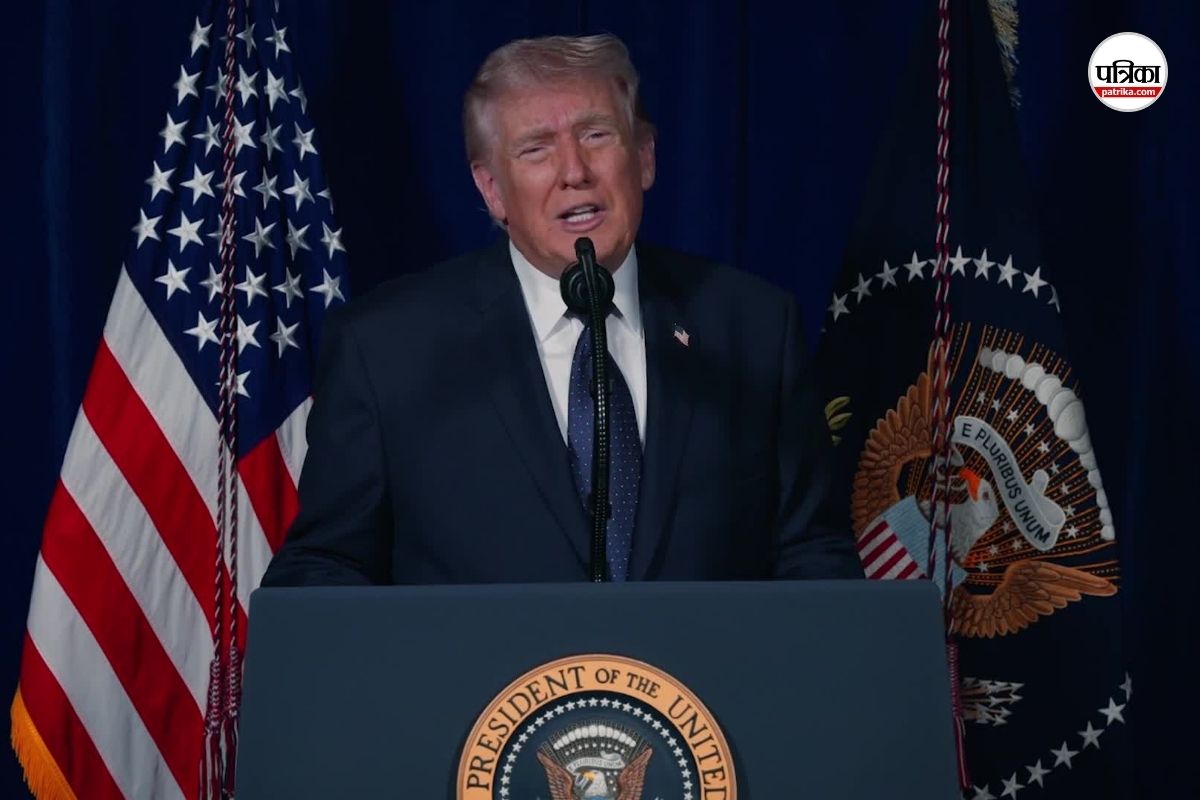
The Strait of Hormuz is not merely a geographical passage; it is the most critical pressure point in the global energy supply chain. While political rhetoric often frames the control of this waterway through the lens of regional brinkmanship, the recent rebranding of the strait as the "Strait of Trump" by the former and returning U.S. President signifies a fundamental shift from traditional "freedom of navigation" norms toward a more transactional, ownership-based model of maritime security. Understanding the implications of this shift requires a clinical breakdown of the strait’s physical constraints, the economic cost of disruption, and the strategic pivot toward American energy dominance.
The Physics of the Chokepoint: A Structural Vulnerability
The Strait of Hormuz connects the Persian Gulf with the Gulf of Oman and the Arabian Sea. At its narrowest point, the shipping lanes are only two miles wide in either direction, separated by a two-mile buffer zone. This physical reality creates a tactical bottleneck where any kinetic interference—whether through naval mines, drone swarms, or conventional boarding—immediately halts the flow of approximately 21 million barrels of oil per day.
The vulnerability of the strait is defined by three primary variables:
- Volume Concentration: Roughly 20% of the world’s liquid petroleum consumption passes through this single point. Unlike the Suez Canal or the Panama Canal, there are no immediate, high-capacity terrestrial workarounds.
- Asymmetric Risk: The cost for a regional actor to disrupt the strait is exponentially lower than the cost for a global superpower to secure it. A single sea mine costing a few thousand dollars can spike global Brent Crude prices by 10% or more within hours.
- The Insurance Feedback Loop: Even without a physical blockage, the mere threat of conflict increases "War Risk" insurance premiums for tankers. These costs are immediately passed down the supply chain, impacting the landed cost of energy in markets as far-flung as Tokyo and Rotterdam.
The Trumpian Doctrine: From Global Policeman to Proprietor
The assertion of the "Strait of Trump" moniker reflects a departure from the post-WWII maritime order. Traditionally, the U.S. Navy has acted as a neutral guarantor of the Global Commons, ensuring that trade remains unhindered regardless of the origin or destination of the cargo. The new rhetorical framework suggests that this protection is no longer a default global service but a strategic asset to be leveraged.
This shift is grounded in the reality of U.S. energy independence. In 2008, the U.S. was a massive net importer of oil, making the stability of Hormuz a matter of domestic survival. By 2026, the U.S. has solidified its position as a leading global producer of crude oil and liquefied natural gas (LNG).
The logical consequence of this independence is the "Decoupling of Interest." If the U.S. no longer relies on Persian Gulf oil for its own consumption, its presence in the strait transforms from a necessity into a service provided to others—specifically China, India, and Japan, who remain heavily dependent on the region. The rebranding suggests that if the U.S. is the one securing the lane, the U.S. should dictate the terms of its use, or at the very least, receive the geopolitical "credit" for its stability.
The Economic Cost Function of a Blockage
To quantify the impact of a disruption in the Strait of Hormuz, one must look beyond the price per barrel. The true cost is a function of time, inventory levels, and the elasticity of demand.
The formula for the Global Energy Shock ($S$) can be modeled as:
$$S = \int_{t_0}^{t_1} (D(p) - S(p)) dt + C_{ins} + C_{alt}$$
Where:
- $D(p)$ is the global demand at price $p$.
- $S(p)$ is the constrained supply.
- $C_{ins}$ is the surge in maritime insurance and freight rates.
- $C_{alt}$ is the cost of activating alternative routes (like the East-West Pipeline in Saudi Arabia or the Habshan–Fujairah pipeline in the UAE).
The total capacity of these bypass pipelines is approximately 6.5 million barrels per day, leaving a deficit of nearly 15 million barrels per day if the strait is fully closed. This creates a supply vacuum that the Strategic Petroleum Reserve (SPR) cannot fill indefinitely. The "Strait of Trump" rhetoric signals to global markets that the U.S. will no longer subsidize the security of its economic competitors for free.
Tactical Alternatives and Their Limitations
Strategic analysts often point to pipelines as the solution to Hormuz-dependency. However, these assets present their own sets of vulnerabilities:
- Fixed Infrastructure: Unlike tankers, which can be rerouted, pipelines are static targets for sabotage or state-sponsored strikes.
- Geopolitical Alignment: The East-West Pipeline requires the cooperation of Saudi Arabia. The Habshan pipeline is within the UAE. Relying on these routes shifts the power dynamic from the maritime domain to the sovereign control of transit states.
- Capacity Bottlenecks: Even at maximum throughput, these pipelines only handle about 30% of the volume currently moving by sea.
The failure to acknowledge these limitations leads to a false sense of security. The U.S. strategy involves maximizing the perception of control to maintain market stability while simultaneously reducing its own exposure.
The Shift Toward Bilateral Maritime Security
The "Strait of Trump" concept likely precedes a move toward bilateral or "pay-to-play" maritime security arrangements. We are moving away from the era of the Combined Maritime Forces (CMF) toward a model where regional and global powers must contribute directly—financially or militarily—to the protection of their own energy interests.
For India and China, the two largest importers of Gulf oil, this creates a strategic dilemma. They must either increase their own naval footprint in the region—an act that carries significant political and logistical baggage—or negotiate terms with a U.S. administration that views maritime security as a tradable commodity.
The second-order effect of this policy is the acceleration of the energy transition in energy-poor nations. If the security of the strait is no longer guaranteed by the U.S. Navy, the long-term risk of relying on fossil fuels from the Persian Gulf becomes untenable. This creates an opening for U.S. renewable technology and nuclear exports, further cementing American influence through different channels.
Strategic Play: Hedging Against Chokepoint Volatility
For institutional investors and energy firms, the "Strait of Trump" era necessitates a radical reassessment of risk. The assumption that the U.S. will always intervene to keep oil at $75 a barrel is dead.
The strategic play is to move capital toward:
- Western Hemisphere Production: Increasing exposure to Permian Basin, Canadian Oil Sands, and Brazilian offshore assets that do not transit Eastern chokepoints.
- Maritime Logistics Technology: Investing in autonomous surface vessels and advanced underwater monitoring systems that reduce the human and capital risk of navigating contested waters.
- Refinery Flexibility: Upgrading refineries to process a wider variety of crude grades, reducing dependency on specific regional blends that must pass through Hormuz.
The era of "globalized" security is being replaced by "privatized" or "nationalized" security zones. The Strait of Hormuz is the first and most visible test case for this new reality. Stability will no longer be maintained by international consensus, but by the credible threat of unilateral control and the tactical leverage of energy dominance.